
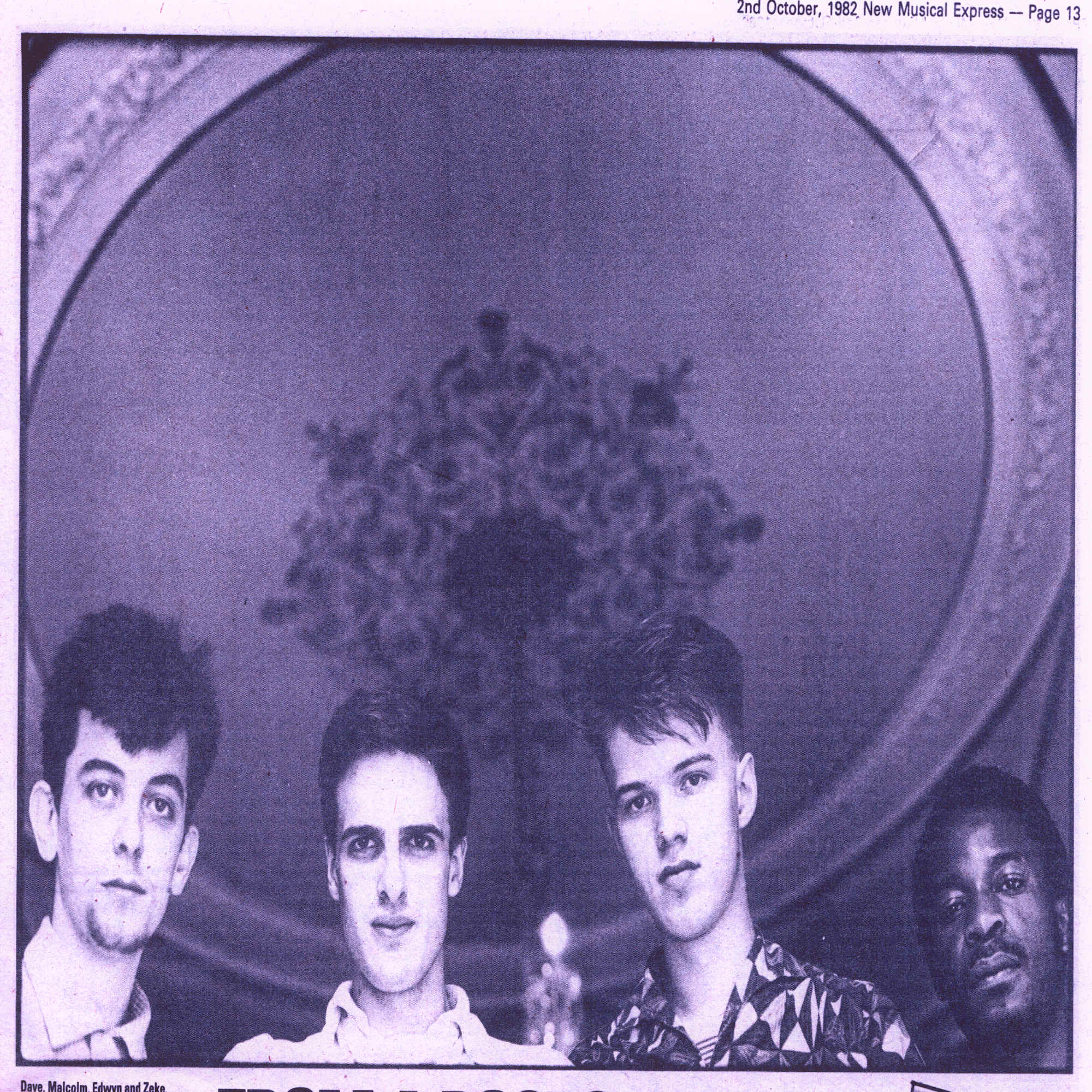
Will the sound of young Scotland rise again? Chris Bohn examines the declining fortunes of Orange Juice
Article published in NME, 2nd October 1982
Orange Juice | From A Postcard To A Postage Stamp | HATE—WITHOUT wanting to sound faddish about such a thing — is once more where the heart is.
“I’m getting more interested in punk again,” declares Orange Juice‘s Edwyn Collins, his previously boyish mop mangled into an aborted Eraserhead number.
He’s been announcing his allegiance by way of the Sex Pistols T-shirt he’s been wearing to London’s ritzier escape routes.
“Adrian Thrills came up to me at the Camden Palace and asked me why I was wearing a Sex Pistols T-shirt,” spits Edwyn contemptuously through goofy teeth, “and how come it wasn’t a Roger McGuinn? And I thought, fuck, pigeon holed again!”
Pigeon holing Edwyn and Orange Juice might have been a national pastime, had they come up with the hits everyone predicted for them. As it is, they’ve been more simply passed over. But Orange Juice — Postcard muddlemind Alan Horn told us and we subsequently told you — were going to be the alternative pop group. They were, we wanted to believe, the happy collision of lovesick guitars and adolescent curiosity, the embodiment of New World — Scotland, that is — optimism and youthful enthusiasm. Pop music for the young made and controlled by the young.
Until they were wrongfooted by the focus switching to the mainstream, it did seem they were it. When every one else was buttoning up his black shirt against the cold, they wore loud check and warm smiles, covering up for their inadequacies with a heap of silly grins and bad jokes.
With the passing of time, though, amateurism becomes shamateurism. Live or on record, there was no audible improvement in Orange Juice. Where the bemused expression of those wonderful, if rough Postcard singles rang genuine enough, it began to sound forced after it was cleaned up with Polydor money; and Edwyn’s voice cracking up on their biggest chart shot — a cover of Al Green’s ‘L.O.V.E. Love’ — was more careless than cute.
Anyway, nobody needed tolerate sloppiness in this new age of quality and distinction heralded by the ABC/Trevor Horn and Human League/Martin Rushent axis. What’s more Nicky Heyward has a goofier, more comfortable grin. His Haircut 100, Altered Images and the rest capitalized on the pop consciousness Orange Juice helped cultivate.
Orange Juice | From A Postcard To A Postage Stamp
Hate? Or just bitter about being left behind, Edwyn?
IT’S NOT a case of sour grapes,” he counters caustically, “because I don’t envy them, these groups who’ve put the ‘a’ back into pop music. Ha ha. I really don’t. I know there are certain factions who insist that Orange Juice propagated this wonderful, golden age of pop, but quite frankly if I thought we’d been in anyway responsible, I’d feel we’d have a hell of a lot to answer for. Because I think most of it is shit.
“That’s why I feel we’ve been misrepresented by the press, who’ve taken the more superficial and crass elements of what we did and amplified them, so they become twee. And because we haven’t delivered, which to some extent I admit, we’ve become the scapegoat for this horrible saccharine movement.
“It’s not that I’m bitter, it’s just that I hate them,” he continues. “I hate them the same way I hated progressive groups in ’77; hate was the good thing about punk. I think hate can be very positive if it is directed in the right way . . . ”
THE POSITIVE side of Orange Juice’s hate is the renewed sense of purpose that followed their virtual demise on the release of their long-delayed, out of date debut LP ‘You Can’t Hide Your Love Forever’ on Polydor. They dumped on Alan Horn, fell out with each other and fell apart, only to regroup around Edwyn and bassist Dave McClymont. The present line up is now completed by guitarist Malcolm Ross, from Josef K, and drummer Zeke, from Zimbabwe
—the nation, not a group. They meet me in pairs during the recording of their second LP, Dave and Malcolm outlining the schisms of the past, and Zeke and Edwyn mapping out the future.
Alan, the first pair say, had to go, after planting the preconceptions in the press they later found difficult to live up to, and for the hold he had on Edwyn.
“It was Alan who said Orange Juice were going to be a pop group,” accuses Dave,” that we would be on Top Of The Pops and have huge hits for Postcard. But I always thought we were like Pere Ubu! That’s why I joined the group!
“Besides,” he relates further, “I used to be very close to Edwyn, but once Alan came in I didn’t speak to Edwyn again for about six months. I thought Alan was taking over the group, and rather than making some rash statement like, Alan! You’re taking over the group, I crawled back to the flat and just whimpered.”
Orange Juice | From A Postcard To A Postage Stamp

Earlier drummer Steven Daly was purged simply because, “I wouldn’t talk to him at all, we didn’t get on, so the rhythm section was rubbish. And we would just laugh at James. . .”
. . . Kirk, their previous guitarist, that is, who, in the revised view of things, carries the can for Orange Juice’s shambolic reputation.
“James was always dizzy-eyed, playing novel things on guitar and wanting to write stupid twee comedy songs, like those you get in musicals,” sneers Dave. “A lot of people came to see us especially for James, because he would always do something wacky, like fall over.”
Malcolm, the gawky shy boy from Josef K entered the fray only to be repulsed by all the bitching.
“All this backstabbing,” he recalls with horror. “It was a horrible atmosphere. I just wanted to leave . . .”
Being their most disciplined and composed member, Edwyn and Dave hung onto him and sacked the other two. Malcolm’s splendid, terse style, which defined Josef K’s series of excellent singles, isn’t the only stabilising influence. There is also drummer Zeke . . .
ZEKE, THEY rightly claim, is their most interesting member. An affable, easy-going 27-year-old veteran of various Glaswegian funk/reggae whatever groups, he arrived in Scotland eight years ago as a political refugee from pre-Zimbabwe Rhodesia, where he was drawing too much attention through the black youth consciousness plays he was writing with other teenagers in the small hometown community in Rhodesia’s heartland.
His autobiography goes something like this:
“It was a crazy situation,” he recalls. “I was working with other teenagers during the school holidays, writing plays and staging them. We used to invite our white counterparts over to see them, but they never came, except once, and then they all left early because they thought it was too political.
“The title of that play, haha, sounds really grand and pretentious now, but it was called Search For Human Dignity. It was just about people coming out of school, reflecting exactly what was happening to us. We didn’t think our parents understood the situation. Most of us thought that our parents were just weak for accepting all this nonsense for years. So we were alienated from our parents just as much as we were from the white people.
“The alternative was to do music, write plays, things like that to try and show them what we were going through.
“But this is the funny part — I didn’t quite know what was happening at the time. My Dad, who was a headmaster then, was secretly working for the Zano Party (the then outlawed national party fighting for independence), his brother was in Mozambique, a young commander in the guerrilla force. So he had good reason to be scared, because maybe I would draw attention to them and the more important work they were doing.
“Nevertheless, he was proud of my plays and encouraged me, though he told me to be careful. All the while he was smuggling books to Mugabe, during that ten years Mugabe spent in detention, and I suspect he was passing on letters between people, acting as a link.
“After a while it started getting dead uncomfortable, the police started to follow us around, kept moving us on, preventing us from grouping together. We were becoming quite a noticeable group in the community. So my parents, who had some Scottish friends, suggested me going to Glasgow.”
Orange Juice | From A Postcard To A Postage Stamp
Didn’t he want to return once Zimbabwe was declared independent?
“No, my parents wanted me to, but I was really settled in Glasgow,” he answers. “I just felt a solidarity with the people here, I’ve never felt any conflict here. I just fitted in.”
In the meantime, his father is now working from the Zimbabwe embassy in Yugoslavia.
ZEKE HASN’T exactly awakened a new political consciousness in Orange Juice, but he’s an undeniably important presence, helping check their descent into self-parody and alerting them to the world outside the concerns of their love songs, acute though Edwyn’s observations generally are.
“People always ask us about politics, because they think we’re vacuous and that we don’t know anything about the heavier side of life,” despairs Edwyn. “But it’s not really the case. I hate being portrayed as being naive about vices, sex and drugs, thing like that. Which isn’t to say we are serious and this is the heavy political angle of Orange Juice; it’s just when I read the NME Quotes Of The Year which had me saying, I do have ideas about politics and the world but I’ve forgotten them for the minute I thought, aw fuck, that’s really asking for it. What I mean is, I am quite naive about conventional politics, because I’m not that interested . . . but I think the lyrics are ‘meaningful’ in inverted commas. I’d like to think they’re stimulating, in that we say things quite simply, communicating ideas succinctly. And some of them are quite accurate.”
There wasn’t much noticeable difference in the new group’s first recorded collaboration ‘Two Hearts Together’, the sleeve of which had Dave And Edwyn staring dewy-eyed at prospective buyers. Furthermore, their new production company titled Holden Caulfield Universal suggested they were grimly hanging onto their youth by making an easy association with the hero of J.D. Salinger’s Catcher In The Rye.
“Well, I just thought the novel was so evocative of adolescence, we’d take a little dig at ourselves,” counters Edwyn. “It was meant to be self demeaning, it was meant to be quite wry. Ha ha.”
The overriding preoccupation of the brashly honest, painfully funny Holden was the deceit that seemed to go with adulthood compromise, which he saw blossoming in his ‘young adult’ contemporaries.
Against his harsh ingenuousness, most everybody was exposed as phoney. I suspect ‘Two Hearts Together’ would shrivel before his stern gaze, but the flip’s ‘Hokoyo’ —written by Zeke — and the forthcoming single ‘I Can’t Help Myself‘ are agile and intuitive enough to look Holden straight in the eye without flinching.
“I do feel there’s a sort of strength back in the group,” enthuses Edwyn. “Some of the songs on the new LP are the best we’ve done — a post-post-Postcard feel both in timescale and sound.”
Unlike J.D. Salinger, Orange Juice might just survive the precocity of their early creations to become more than a one-shot wonder.


Leave a Reply