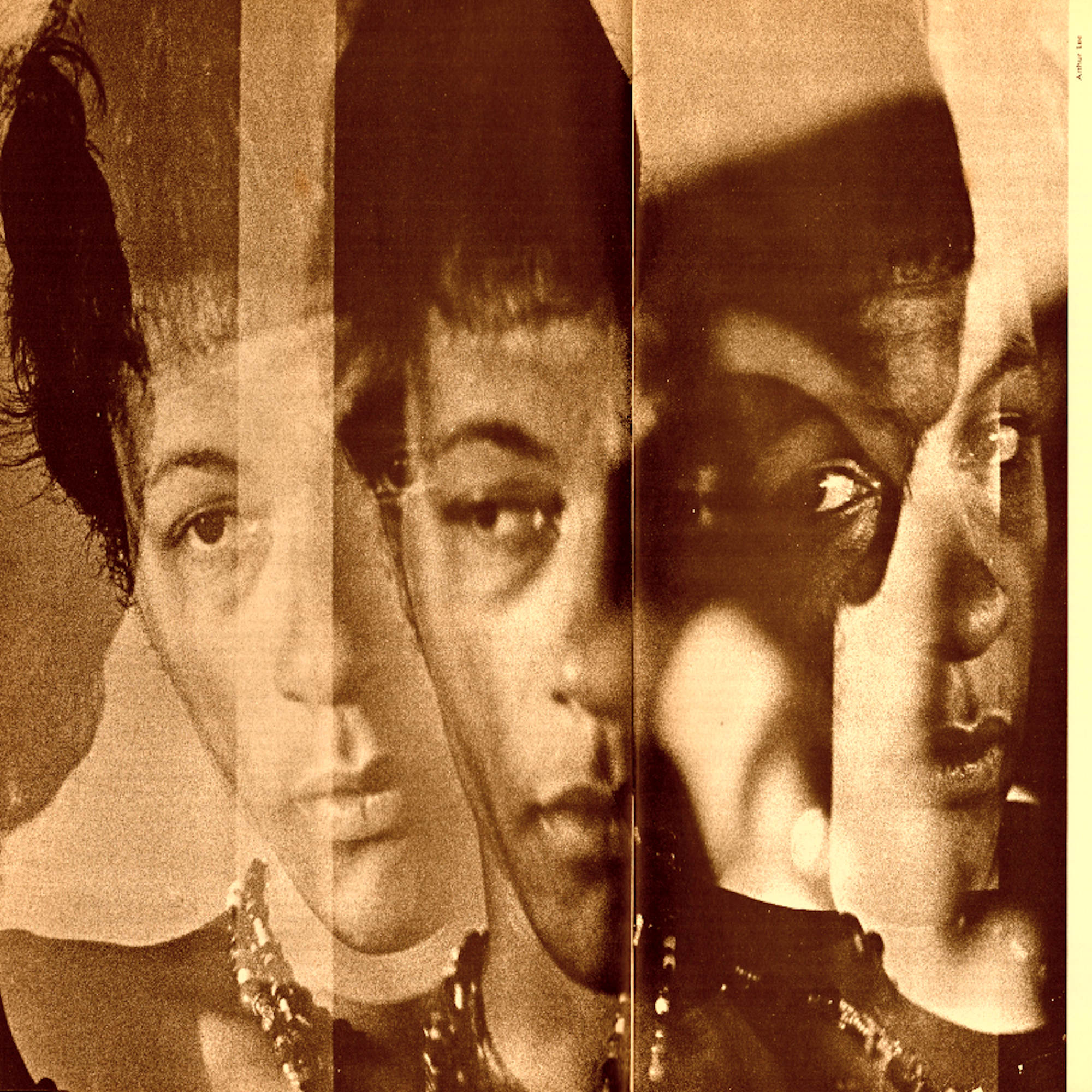
“The Red Telephone” is my pick from the LP | Love – ‘Forever Changes’ (Elektra EKS-74013) December 1967
Article published in Crawdaddy!, March / April 1968
Love’s ‘Forever Changes’: A Deep Dive into 1967’s Masterpiece | To adopt the terminology adopted by the boys over in the Elektra promo department, the first time Love “came” (on the album simply called Love), they were doing both the Byrds‘ (just you check Bryan Maclean‘s look on that album cover) and Jagger riffs. Significantly, nowadays, of these two, only the Jaggerism has managed to survive and mutate. Even to be rewarded by a latter-day Rolling Stones’ Loveism.
At that time Snoopy did the drumming. But by Love’s second coming (‘Da Capo‘), old Snoopy had been eased over to the keyboard and they had added Michael Stuart to do the drumming (more complex “jazz”-like, they said). And Tjay Cantrelli to blow reeds.
Tjay Cantrelli was outasight and he looked mighty peculiar on the cover next to Bryan Maclean and that big diz rock. His expression (facial) could be described as “transcendental meditation.” But with a “nonbeatific” proviso.
Incidentally, that big stiff rock had, after showing up on the first and second albums, become the traditional Love pose-point. At the time of ‘Da Capo’ there were so many (seven) boys in the band that people could say, “If you hire them, they’ll bring a whole tribe along.”
Love’s ‘Forever Changes’: A Deep Dive into 1967’s Masterpiece

Now they were doing both the Jagger and Johnny Mathis riffs. Why they’d even made it to silliness. It was one of the most beautifully recorded and produced albums in all the history of rock & roll.
Today the third coming of Love (‘Forever Changes’, Elektra EKS-74013) is being advertised and both Snoopy and Tjay Cantrelli are gone away. Jagger has been absolutely mutated and Johnny Mathis is on top. There are continuous studio-band comings and goings which suggest the Tijuana Brass or Xavier Cugat (“orchestrated by David Angel”!!).
And finally, as must everyone, Love’s come face to face with the spirit of Muzak. Get this, the scene on the Ed Sullivan show sometime proximate to the time wherein your Love group will have won their first gold record (and Elektra their second) for a million or even more sales of ‘Forever Changes’.
Ed Sullivan
Here is Mr. Ed (himself) listening—God, grooving even, and why not?—to the boys in the band as they run through a snappy number offa the album. But doesn’t that smile upon Mr. Ed’s face quickly turn to coldest, coldest ice as Arthur Lee sings “The snot has caked upon my pants . . . “, and Mr. Ed asks his aide de camp, “What did that coloured boy say?!!” And his aide de camp answers that “some girl who knew him hack in California said that he (Lee) was really Maltese, which is, you know, I trust, something else.”
And so the artistic issue sinks below the racial morass . . . Rut this is only one of the many potential consequences of this newest from Love: a new one which certainly qualifies as one of the best yet. And which certainly is incredibly beautiful. But in its own very, very odd way. Which is not at all the way of the Byrds, Procol Harum, Van Dyke Parks, the Left Banke or even any Bob Dylan.
Love’s ‘Forever Changes’: A Deep Dive into 1967’s Masterpiece

With Love it gets really hard to talk about form. They just haven’t persisted long enough in their styles to generate a form. (Yes, their formal problem has been temporal.) Rather, they’re top notch at establishing ad hoc relationships to, and between, their materials. And these relationships have been very, very theatrical.
They’ve had the self-conscious aspect of pose. But the pose has always been, I think, an occasional one. There are, you see, these very particular demands of the materials. And while some groups (say the Byrds) can overcome and formalize any materials at all (Beatles stuff, country & western, Gene Clark stuff, Dylan, for example, for the Byrds) via the merest strength of their forms, Love doesn’t do that at all.
Instead what they do is this: they take their materials and apply multiple stylizations. Here the only fundamental presupposition is that nothing’s wrong with inordinancy, and, in this they resemble the Doors who have also made inordinancy enduringly stylistic.
A thought in my head, I think
Then the materials are shaped to suit the occasion’s demands (or vice-versa), but as to what determines these demands, can anyone know? This ad hoc quality also recalls the Doors. Love and the Doors specialize in radically distending words, let’s say, according to the highly localized demands of the materials.
Of course, the Doors are far more cognitively and musically systematic. So much so that there are those who would say that all Doors’ stuff sounds “the same.” In this regard, check out “She Comes In Colors” (offa ‘Da Capo’) and “People Are Strange.” I think that Arthur Lee’s way of saying “a thought in my head I think . . .” is especially inordinate.
Love’s ‘Forever Changes’: A Deep Dive into 1967’s Masterpiece
Much of this material surely does sound as if it had been put together right there on the spot. Here inordinancy has gone stylistic because there’s nothing (no strong form) to forestall the advent of any sort of carrying on at all. And theatricality then becomes the only persistent mode, established through the succession of the numerous (ad hoc) dramatic poses which are adopted vis-a-vis the materials.
Already on the first Love album there were sufficient intimations of inordinancy to suggest pose. But really this was strict nascency. This self-consciousness was imitative rather than that (readymade) referentialism characteristic of both ‘Da Capo’ and ‘Forever Changes’.
Thus, nascency left it a mere exaggeration scene. At that time, Love was laying down the Byrds’ and Jagger riffs. Or, to be more precise, given the pretty Byrds’ typical character of both rhythm and lead stuff, the then (as now) uniquely Jaggerized-Byrd riff (i.e. “Can’t Explain,” “Message To Pretty,” “My Flash On You,” “No Matter What You Do,” etc.).
Thunder

Certainly the first Love album was one of the most highly rationalized developments of that West Coast accent first epitomized by McGuinn, Gene Clark and the Beach Boys. But above all, it was an example of inordinancy appearing in all the right places—that is, a proper example of exaggeration. Not yet an inordinancy expansive enough to push things out of phase (as with the classical interference effect).
On ‘Da Capo’ these intimations of inordinancy were rationalized into a matured interference effect. For example, the record featured some absolute vocal affectation on “She Comes In Colors” and “Stephanie Knows Who.” “Que Vida!” had either cheek or cork poppin’, as well as calliope-style music (you could ice skate to it).
A thunder storm offa the Elektra sound effects record rounded out “Seven And Seven Is.” “The Castle” is the first time for that big Spic acoustical guitar riff which was to prove so important for ‘Forever Changes’.
Snoopy’s harpsichord makes a cameo appearance on “Stephanie Knows Who” and “She Comes In Colors.” And Arthur Lee runs through (most famous of all) the entire Mick Jagger reflexive referential cycle on “Revelation.” That is, Arthur sounds like Jagger who sounds (in turn) like Ray Charles and so forth. (We’re back into the racial morass.) The key here is that Arthur Lee’s exaggerated Jaggerism is not merely inordinate, but self-consciously inordinate.
Love’s ‘Forever Changes’: A Deep Dive into 1967’s Masterpiece
Let’s say that herein Arthur Lee joins both Dewey Martin (“Good Time Boy”) and Albert Bouchard (“Rain’s Falling”). But he did precede these by a good year. So he becomes not only self-consciously referential, but primally so.
While both ‘Da Capo’ and ‘Forever Changes’ demonstrate Love’s potential for consistent inordinancy, they also (by this) really divide Love off from such other stylistically inconsistent bands as the Buffalo Springfield and the Stones. This is because Love’s inordinancy has, from ‘Da Capo’ on, consistently expanded to an interference effect.
With the Stones only ‘Between The Buttons’ thoroughly evidences an interference effect. Elsewhere it has made only occasional appearances. The Stones’ interference effect has been an occasional moment and not a primal focus. But Love does share that cynical base with the Stones, as they do with the Kinks. And, in fact, Love is cognitively and methodologically much closer to the Kinks. They share not only that cynical base, but the interference effect also.
Within their songs there are elements which really don’t rest easily together, which really do interfere with each other, and, which (consequently) really do call both themselves and their songs as a whole into question. Both groups utilize this interference effect method for rendering things questionable. However, Love’s sensual effect isn’t the Kinks’.
The Kinks’ use of the interference effect puts things both into sensual and cognitive motion. The interference motion is between both sensual and cognitive elements. Sensually speaking, with the Kinks there’s no recombination (no final synthesis).
But, on ‘Forever Changes’, wherein Love has taken conventional beauty, or more particularly movie or Johnny Mathis conventional beauty as its controlling referent, there’s managed a real sensual recombination. The interference effect is operating only cognitively and the stuff can (then) still sound pretty—while it seems silly. It is made questionable only in a cognitive sense.
Love’s ‘Forever Changes’: A Deep Dive into 1967’s Masterpiece

Yet isn’t it appropriate to note, at this time, that despite their differences, both Love and the Kinks have been decisively plagiarized by the Stones? Because “She Comes In Colors” was Arthur Lee’s song and that’s some phrase. Seeing how this works, let’s for example, turn to “Live And Let Live,” the new album’s closest equivalent to “Orange Skies” (offa ‘Da Capo’). This is the song that offended Mr. Ed and it begins: “Oh, the snot has caked against my pants, it has turned into crystal, there’s a bluebird sitting on a branch, I guess I’ll take my pistol, I’ve got it in my hand, because he’s on my land . . . .”
Now, this is certainly an obvious case, a setup, ideal typical even. I mean the very words sound pretty ad hoc. But what is most important of all is that nothing is necessary. The entire arrangement is seemingly gratuitous. And all justifications (i.e. “systematic interpretations”) can be added at the end, merely because they sound good.
With Love we’re all pushed right back to basic sensuality. From the beginning: the song’s intimations come from a nice light metallic (preheavy, non-Spic) strum on the acoustical. Then intro Arthur Lee’s “voice of his own.”
Strummed acoustic guitar
He invents so many pronunciations and vocal concepts that he’s right up there with both Mick and Gracie. Compare his “arch” attitude with Mick’s “mincing” (on “Lady Jane”). And check out (especially) his concept of “and.” Of course he’s your ad hoc virtuoso.
Then the bass. And what a bass, the most awfully nice riff, being one encompassing the cyclical variant from a (heavy) percussive to a (light) fancy filligree pattern. Finally, the drums, and they too are a little delicacy. The band has solved the problem of the inherent similarity of all percussion by giving a heavy Spic-strummed acoustical guitar the big percussive role.
And now the paradox. Because all this sounds really conventionally beautiful. The referents for conventional beauty are all obvious. With justice we can say that Arthur sounds like Johnny Mathis, the studio support-band like either Xavier Cugat or the Tijuana Brass, and save for a Creamish-fuzzed-out-final-lead line (John Echols), even the band stays within the conventional bounds of say the latest Dylan from Nashville (‘John Wesley Harding’).
Love’s ‘Forever Changes’: A Deep Dive into 1967’s Masterpiece

And yet neither this song nor the album as a whole have the Muzak ring. But aren’t all of this stuff’s most significant referents Muzak? That they are, and that it doesn’t sound Muzak, is highly significant because it means that Love has come up with the neat trick of The Internal-Muzak Denial Move. Specifically, they’ve modularized the Muzak components available, in overwhelming quantity, in the cultural pool.
But this makes for the subordination of these components (given their traditional role). The usual Muzak pop homogeneity has been short-circuited. Obviously, the rhythm section’s got a lot to do with such trickery. First of all, the bass (Ken Forssi) and drums (Michael Stuart) are very superficially prominent (punctuation marks) (like on the new Dylan), but, not with your old-time virtuoso prominence.
I mean, they’re absolutely adequate, as if adequacy were a culturally privileged category (i.e. something good) and they were an absolute realization of that category. That’s how good they are. Also, they’re a simultaneously visible/invisible active continuity factor (constant noise). Even obviously repetitive.
Most importantly they make rhythm and continuity in the noise seemingly identical. Unlike, that is, conventional Muzak they render the noise-continuity (obverse: silence-denial) well defined, rather than oceanic amorphous. Could it be that a sharp definition to the noise-continuity makes it, possibly pretty, but not so very-soothing-as-it-might-be?
Actually the so-to-speak “top-ping on the cake” here comes in with the really over-bearing always heavy strummed acoustical guitar (Bryan Maclean). The technique could be interpreted as either rudimentary or as degenerate Spic (i.e. bad “South Of The Border,” bullfight or Magnificent Seven—style accompaniment), but without doubt it acts to crystallize the rhythmic definition of the noise-continuity.
Bummer Folk-Riff
Simply stated, Love’s use of the strummed acoustical guitar represents the most striking and significant reification of that instrument used in that way since Richie Havens, Tim Buckley and, especially, Dave Roter. (Jackson Browne is, of course, a very special and elegant case.)
In this sense Love may well represent the absolutization and even perfection of the Bummer-Folk riff. Love has succeeded where Buckley tried and failed. And in the process they’ve made a move about which few have even dreamed. They have denuded Muzak of the soporific. Allowing even the words to be heard and enjoyed. And establishing a pretty gorgeous context that doesn’t prevent cognition. This here record and the English Traffic album (‘Mr. Fantasy’) are both really O.K. (Sandy Pearlman)



Leave a Reply