Psychedelic Soul from Chicago
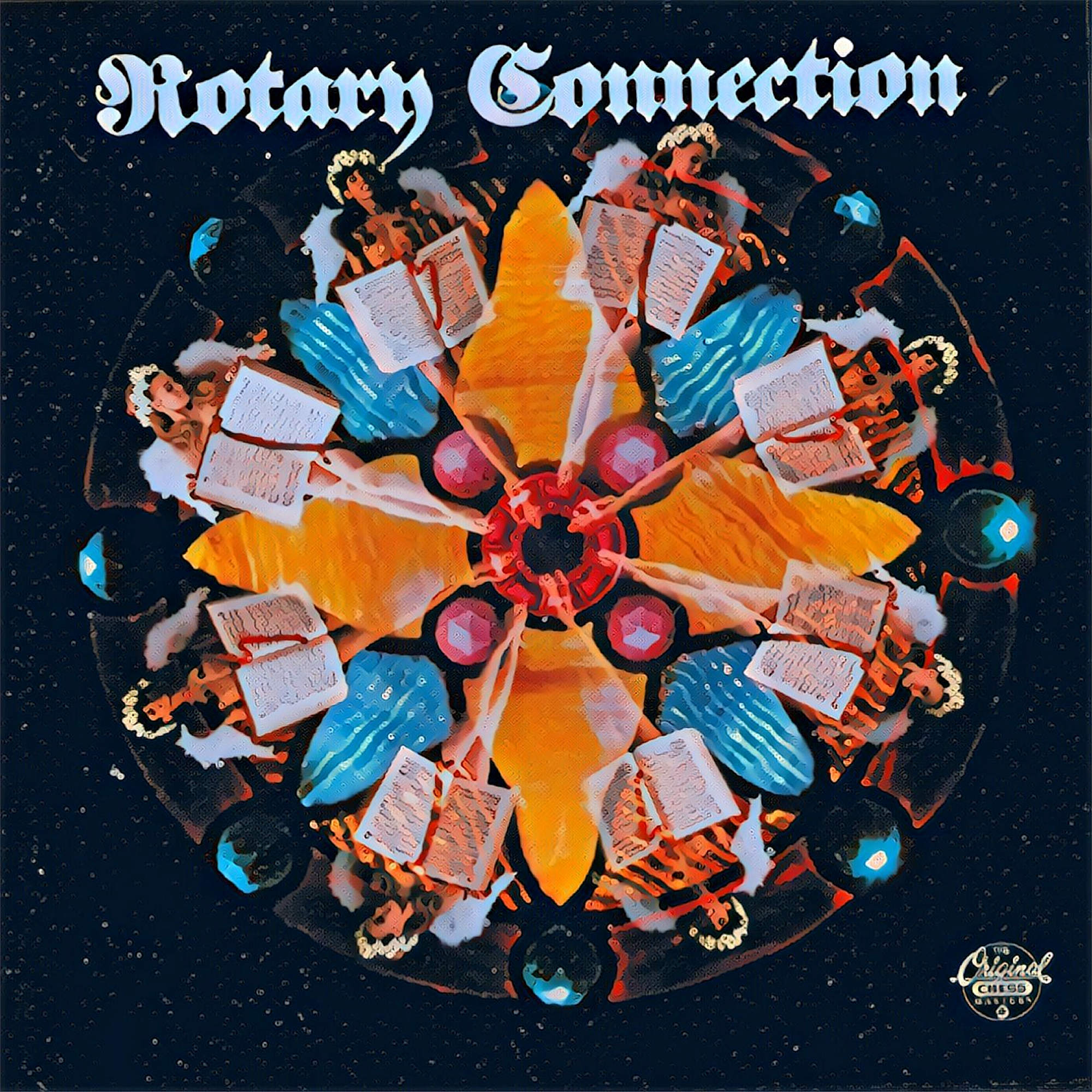
Rotary Connection | “Turn Me On” | (Cadet Concept) 1968 | Rotary Connection, from 1967, is one of the unheralded great progressive rock albums of the 1960s. It, and the group it spawned, Rotary Connection, began in the mind of Marshall Chess, the 26-year old son of Leonard Chess (co-founder with his brother Phil of Chess Records).
The company during the 1950s had built its reputation recording such bluesmen as Muddy Waters, Howlin’ Wolf, and Little Walter, and such pioneer rock ‘n’ rollers as the Moonglows, Bo Diddley, and Chuck Berry.
During much of the 1960s, under A&R man Billy Davis, Chess made its mark in the soul arena with such acts as Billy Stewart, Fontella Bass, and the Dells. But by the late 1960s the fastest growing genre of recorded music was rock music, and the cutting edge of the music was a more specialized genre called “progressive rock,” the alternative rock of the 1960s generation.
Progressive rock was thought to be a more adult, a more sophisticated form of music that took rock ‘n’ roll beyond its dance fad and pimple cream associations. Marshall wanted Chess to get on the progressive rock bandwagon, and he started a separate label for it.
Cadet Concept
“I had the key’s to the studio,” he relates, “that’s really how it began, I decided to start this label, Cadet Concept, which was really egotistically my concepts.”
The first act on Cadet Concept was Rotary Connection, which from the get-go was a manufactured group put together by Marshall, who saw it as a psychedelic progressive rock band. Marshall first recruited three members of a white rock band, Bobby Simms and the Proper Strangers, a group managed by Arnie Orleans, Chess Records’ sales manager.
“Arnie dragged me out of this club to see them,” remembers Marshall. “I went and heard them and said OK maybe this could work. Their material didn’t impress me, but their singing was excellent.”
For his concept of Rotary Connection he was looking for good singers. Members of the Proper Strangers brought into Rotary Connection were guitarist Bobby Simms, drummer Kenny Venegas, and bassist Mitch Aliotta.
Rotary Connection | “Turn Me On” | (Cadet Concept) 1968

“They were on the album,” relates Rotary Connection member Sidney Barnes, “to add the folkish-sound voices they had. They were into folk music and Dylan was hot, so we wanted that folk sound.”
Particularly folkish — in a particularly Renaissance church fashion — was the voice of Judy Hauff.
“I found Judy,” relates Marshall. “She was a secretary, she worked for the Cardinal, the archbishop of the Chicago diocese. She was a church singer, and she was fabulous.”
Marshall next turned to his own Chess organization for more vocal ammunition, and got it in a thrilling singer who possessed a surreal five-octave range, Minnie Riperton.
“I had known her for many years before,” says Marshall. “She was a receptionist at Chess, and she was in a girls group we had called the Gems. The thing that always blew my mind about Minnie was that HIGH she sang.”
Another recruited Chess singer was Sidney Barnes, who brought a strong songwriting talent to the group. Much older than the other participants, he had toured as a member of the Fiestas, recorded some singles on his own, and worked as a songwriter in New York.
Chess Records
Later in Detroit, Barnes teamed up with George Clinton and Mike Terry to form a production team. Barnes had just come from Detroit to Chess Records when Marshall tapped him for Rotary Connection. The musical anchor to the group was a black arranger at Chess, classically trained Charles Stepney. Marshall had met him in the Chess cafeteria.
“Charles was sitting there and we began talking,” relates Marshall. “In that conversation it turned out he had just written a classical symphony, arranged and written as part of his musical education. And we just hit it off! I said to him I have this idea of putting together a multiracial kind of soft psychedelic group, and would he want to work on it with me. Help with arrangements. I needed someone to translate my concepts into music.”
Besides co-producing and arranging the Rotary Connection sessions, Stepney also played keyboards. Marshall reflecting the company’s approach to recording soul — “our philosophy was always make it yourself” — used Chess’s regular session musicians to accompany the Rotary Connection, all who performed as vocalists.
The rhythm section all came from the house band, namely Pete Cosey (guitar); Bryce Roberson (guitar); Bobby Christian (guitar); Phil Upchurch (bass); Louis Sattersfield (bass); and Morris Jennings (drums).
“Bryce Roberson was fabulous,” recalls Marshall, “the best white guitarist of his time.”
Rotary Connection | “Turn Me On” | (Cadet Concept) 1968

The regular Chess horns, notably those of Paul Serrano and Chuck Handy, were also employed. Adding to the musical palette was the string section contracted through David Chausow, who brought in his fellow members of the Chicago Symphony Orchestra to the sessions.
“I had known them before Rotary Connection,” says Marshall, “like we used them for Etta James sessions and such. I remember Charles was
horribly upset and nervous for that first session. He had never directed musicians of that calibre.”
Progressive rock at this time was under the influence of South Asian music, and Marshall brought the sitar and two Indian percussion instruments — tabla and banya — to the musical stew. Another exotic flavour was provided by an electronic instrument sound.
He had first heard the instrument on the Beach Boys’ “Good Vibrations”. Once the sessions were recorded the album was still not done.
Relates Marshall, “Charles and I — and the engineers sometimes — then spent hundreds and hundreds and hundreds of hours at night playing with the stuff trying to make all kinds of subtle stuff you would only hear if you’re deep into it, mixing it, and remixing it. We were nominated for a Grammy for the production”.
Ruby Tuesday
The majority of the tracks were psychedelic covers of rock hits. One of the most notable was the cover of the Rolling Stones’ “Ruby Tuesday”. Judy Hauff’s lead provides the Renaissance church sound that contrasts magnificently with the thunderous choruses. The opening bars, with Marshall on Theremin and Stepney on a Churchy organ, is particularly impressive.
Hauff’s beguiling vocals are also used with great impact on another Stones’ cover, “Lady Jane,” which got a lot of play as a single in Chicago. On John Sebastian’s “Didn’t Want To Have To Do It,” on which Marshall spent eight hours on sound effects, also got good radio exposure.
Rotary Connection’s transformation of Sam and Dave’s “Soul Man” into a powerful folk-rock song in which Hauff’s lead undergirded by a clavinet (an electronic keyboard that provides a clavichord sound) makes it unrecognizable from the original.
Dylan’s “Like A Rolling Stone,” Marshall’s personal favourite, is a production triumph that counterpoint strings and guitar from opposite speakers, while the Rotary Connection sings the song in chorus.
The best of the album’s originals is “Turn Me On,” composed by Sidney Barnes. Riperton’s high trilling is especially compelling.
I was very Beatles’ influenced when I wrote it,” recalls Barnes. A lot of people thought it was about drugs, but it was about a guy praying to God. It was such a good song to do live, because we really really did it well.”
little psychedelic interludes
The majestic arrangement for another original, “Amen,” is particularly inspiring. It opens with an exotic Asian sound from the sitar and Indian percussion, with Minnie wailing gloriously in the background. Much of the rest of the number is sung in chorus, and is basically an oratorio, like Handel’s The Messiah.
The album’s third original, “Memory Band,” features la-la chorusing like one heard in European films at the time. Marshall and Stepney added to the psychedelic flavour of the album by sticking in-between each track what Marshall calls “little psychedelic interludes” — thirty second snatches of “mind-blowing” music with titles like “Pink Noise,” “Black Noise,” and “Rapid Transit”.
The final track, “Rotary Connection,” is a collage of sound snippets from songs on the albums, meant to seem like an Acid trip. Marshall’s conception of the album was completed with the trippy-type packaging, featuring a psychedelic cover, a track listing called “trip: and a photo of members of the group on the back cover passing weed.
Marshall Chess was never able to turn Rotary Connection into a national act like he had envisioned. But Chess Records was not unhappy with sales of the album.
Says Marshall, “Rotary Connection in Chicago was like the national anthem. It was a monster. It might have sold 50,000 in three weeks. That was a lot for one city at that time. It was a major hit in Chicago, Detroit, Cleveland, Cincinnati, and virtually nowhere else outside the Midwest.
free-form FM radio
We were not a strong enough company promotion-wise. We were just geared for black. And it happened so quick. At that time it was the beginning of free-form FM radio, which theoretically made the album a natural.
I toured the whole United States by car with the album, going from station to station, but couldn’t get it to break.”
The Rotary Connection recorded five more albums for Cadet Concept and lasted until 1971. Minnie Riperton, went on to build a substantial solo career before succumbing to cancer in 1979.
Mitch Aliotta became a member of a popular rock group called Aliotta, Haynes, and Jeremiah (of “L.S.D.” fame), and Sidney Barnes later recorded an album of funky R&B called Footstompin’ Music.
Marshall Chess had gathered a lot of talent in the Rotary Connection, and by providing top-notch session accompaniment shaped by Charles Stepney’s arrangements, he created a masterpiece of the progressive rock era.
(Robert Pruter, author of Chicago Soul)


Leave a Reply