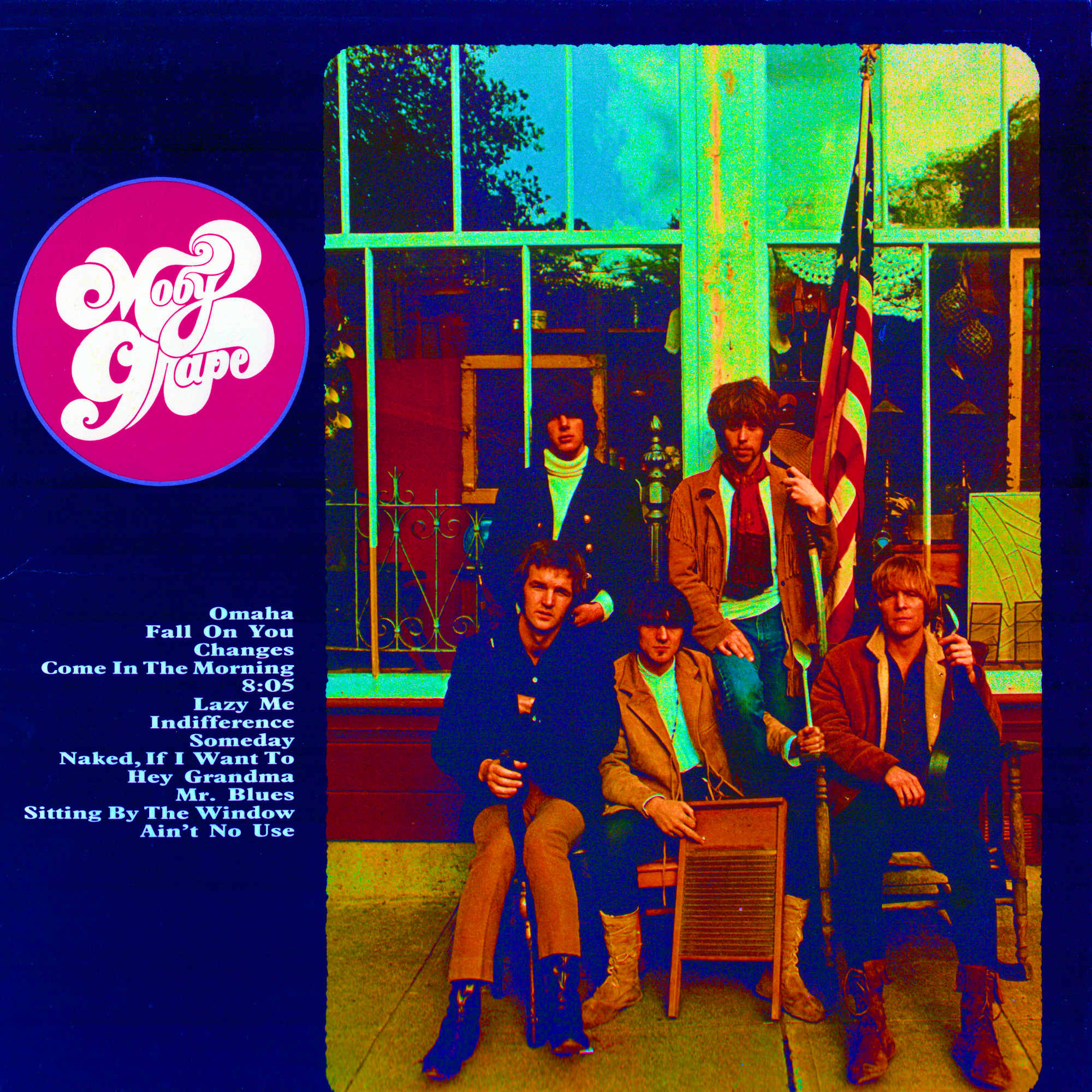
“Naked, If I Want To” is my pick from the LP | Moby Grape – ‘Moby Grape’ (Columbia CS-9498) June 1967
Article published in Crawdaddy!, August 1967
Moby Grape | Moby Grape | (Columbia) 1967 | Well, it took me a long time, but I finally figured out who Moby Grape remind me of: The Everly Brothers. Also Buddy Holly, Buffalo Springfield, middle-Beatles, Byrds, New Lost City Ramblers, the Weavers, Youngbloods, Daily Flash and everybody else. Above all the Grape gives off this very pleasant sense of deja vu. Rock has become so eclectic you can’t even pick out influences–you just sense their presence. I don’t really know why the Grape remind me of the Everly Brothers. But it’s a nice feeling.
Moby Grape is one of those beautifully inextricable groups with four guitarists (including bass), five vocalists, five songwriters, and about twelve distinct personalities (Skip Spence alone accounts for five of them).
The Grape is unusual for an SF group in that it does not have an overall, easily-identifiable personality. It is without question schizophrenic – which is nothing bad, because the group is extremely tight and they simply shift personality from song to song.
Moby Grape | Moby Grape | (Columbia) 1967

Their music is always unified; it’s their album as a whole that’s schizoid. In fact, much as I like it, I enjoy the songs even more one at a time (for your convenience, Columbia has issued almost the entire album on singles – which is particularly nice because the mono mix is far better than the stereo, which must have been done too fast).
Skip Spence’s two songs make it clear that he’s the most talented – though not the most prolific songwriter in the group. “Omaha,” to my tastes the toughest cut on the album, is one of the finest recorded examples of the wall-of-sound approach in rock. It surges and roars like a tidal wave restrained by a sea-wall.
Moby Grape is a particularly violent group . . . not in the sense that they want to do harm to anyone (it is a huge misunderstanding to think violence is inherently evil, or that it necessarily causes harm – there is violent joy, and this album is proof of that), but in the sense that almost every song is attacked with great force and abandon.
Moby Grape assault their audience, bathing them in almost unavoidable joy. Jamming it down their throats, in fact. The other Skip Spence song on the LP, “Indifference,” is another screamer, a well-constructed brilliantly executed shuffle number, to be sung on the street, loud, early in the morning, or listened to in the afternoon with your fist pounding the table.
Peter Lewis is second in the hierarchy of Grape writers, and probably the most sensitive. He shares with the other Grape members the ability to create extremely appealing melody phrases, chorus lines, and rhythm riffs; this ability, combined with the resultant concentration on structure, tightness and brevity, is what makes all the Moby Grape songs sound like good singles.
Moby Grape | Moby Grape | (Columbia) 1967

Lewis, in “Fall on You,” puts together a number of catchy little themes into a very nice, very fluid song, vaguely reminiscent of “One More Try.” In “Sitting by the Window,” he waxes almost eloquent, with just enough restraint to make the song both illuminating and unpresuming.
The guitar-work is really excellent; the three Grape guitarists work together with exceptional taste throughout the LP.
But describing each song is not really the way to write about the Moby Grape. They are elusive; you detect a thousand moods and changes, but you never quite hear the words, never know who’s singing, never are certain who’s playing lead. You can’t pin them down, can’t get too close; you learn to forget, learn to absorb their music, learn to stop trying, submit to it and sooner or later it all comes clear.
Country Joe, the Dead, are very clean; this group never lacks for tightness, but they get fuzzy round the edges. They aren’t involving, but you dig the changes; they aren’t involving, but you listen for the words; they aren’t involving, but there’s something going on here . . . and slowly but surely the depth in this music (which at first attacked you but seemed so uninvolving) swallows you up, and you feel the complexities it invokes.
Moby Grape | Moby Grape | (Columbia) 1967

Moby Grape is an almost ideal example of a “rock ‘n’ roll” group, and their emergence now, as the historical concept of rock ‘n’ roll seems on the verge of disappearing into a music too complexly based to fit a general description, is both surprising and quite pleasing.
The Grape play short, melodic songs, complex but straightforward, tightly structured with careful drumming and rhythm, experimental (but not “far out”) bass, exciting, well-thought-out lead guitar (no fooling around) and early Beatles or Everly style group vocals.
A given song (“Mr. Blues”) might draw on c&w and blues traditions, Otis Redding phrasing, Keith Richard restrained lead guitar, “Captain Soul” rhythm progression, etc. And every note is proper, polite. It’s enough to make you nostalgic; nothing is more refreshing than the unexpectedly familiar.


Leave a Reply