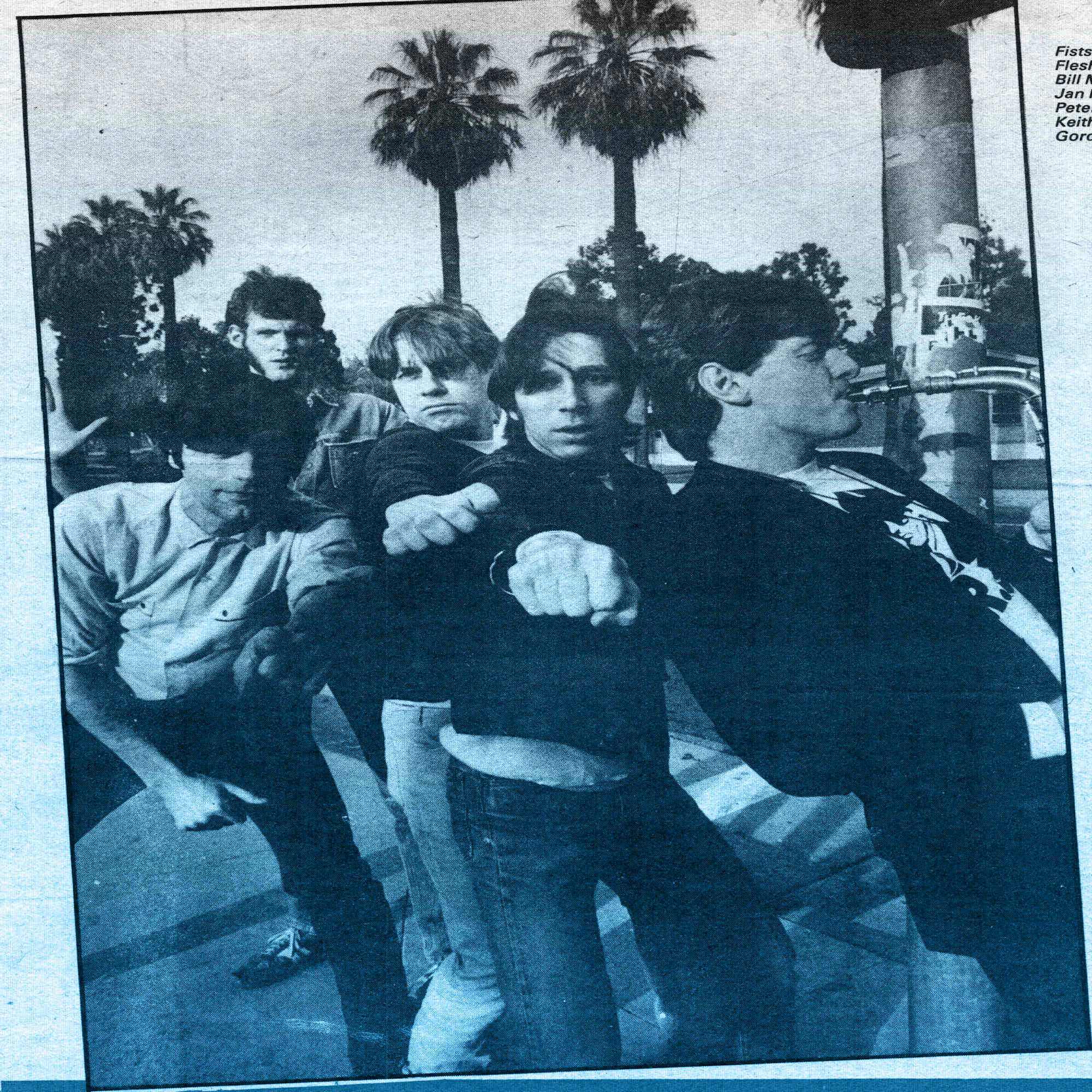
The Fleshtones know what makes the rock and roll heart beat – and they’re here in the UK making it hammer a little bit faster. RICHARD GABEL and JOE STEVENS examined the body electric tuning up in Pasadena
Article published in NME, 3rd April, 1982
The Fleshtones | New Blood Meets Old Beat At The Heart Of Parties | THE FLESHTONES didn’t start with a concept. They started with a need.
There were parties. It was the mid-’70s, and to their way of thinking there weren’t enough good new records to play at those parties. Somebody had to make some music, so they decided to do it themselves.
They took a lot of their inspiration from the past, but the motive was of the immediate present. There were friends around who needed some swing and zing in their lives, and these boys were going to put it there.
That’s still the way they approach their art. A good Fleshtones show crosses over the usual boundaries of a “gig” and dances all over the room. A good Fleshtones record (and finally, with the ‘Roman Gods’ LP, there is a great one) does the same thing and more. ‘Roman Gods’ is a record so personal and warm that some of the songs seem to have hands, the hands of a friend emerging out of a wild crowd to pull the wallflowers up into the revelry.
The Fleshtones | New Blood Meets Old Beat At The Heart Of Parties
WHITESTONE, QUEENS, is an ordinary New York suburb and all The Fleshtones except drummer Bill Milhizer grew up there. Guitarist Keith Streng and bassist Jan Marke Pakulski moved out of their parents’ houses into a cheap rented one of their own, and it was in that basement that The Fleshtones were born.
Keith and Jan would throw mammoth parties, fuelled by lethal punch concoctions with names like Blue Whaler, and the soon-to-be Fleshtones would bank out old favourites for their friends’ entertainment.
The Spaeth brothers, Gordon and Bryon, became an occasional horn section (last year Gordon became a full-time member). And gradually Peter Zaemba began to feel out a place as lead singer and spiritual ringleader of the crew.
Zaremba is an art-school drop-out who remains a good draftsman and graphic designer — he is usually responsible for the cover art on Fleshtones records. A classmate of his from art school days tells me the somewhat silly cover of ‘Roman Gods’ isn’t surprising, as Zaremba has always had a penchant for Greek mythology and European history.
While attending the School of Visual Arts, Zaremba used to spend a lot of time cutting classes in favour of afternoons viewing “Polish war movies”, his way of delving into his roots.
In ’76 The Fleshtones left Whitestone for Manhattan and embarked on a slow climb up the Max’s-CBGB’s circuit. They once shared a rehearsal space with The Cramps, an appropriate footnote to their story. The two groups have many similarities — the mining of American musical genres, the manic spirit of their reinterpretations, their commitment to their own style, not fashion.
The Fleshtones | New Blood Meets Old Beat At The Heart Of Parties
The Fleshtones aesthetic can be partially defined by the range of songs they’ve covered over the years. The list includes famous and obscure cuts by the likes of The Syndicate of Sound, Sam Cooke, The Rockin’ Rebels, Sonics, Dave Clark Five, The Shadows, Standells, Freddie Cannon, Lee Dorsey, Question Mark And The Mysterians, Kid Thomas, Desmond Dekker . . . Soul and R&B influences turn up at least as often as garage-punk and early psychedelia.
The key commitment is to the feel, the groove. But it has proved to be a very elusive sound to record. Marty Thau was the first to try, recording an album with them in ’78 for his Red Star label, from which only a single, ‘American Beat’ was released. The whole thing was recently issued on cassette by ROIR. There are great songs there lurking beneath a production that is too raw and unfocused to get their power across properly.
The cuts on Thau’s ‘2×5’ compilation LP were good, especially ‘Shadowline’, but still not really there. And their first IRS release, the ‘Upfront’ EP, was with the exception of ‘Girl From Baltimore’ a rather stultified affair.
“It’s been mystifying to a lot of people,” Zaremba says, “that for years we never had a good representation of us. We were nosing around for five years, we must have written and cast off a hundred songs, and there was no good record of any of it. I’ve seen ‘American Beat’ referred to as a classic, but it’s one of the most demented classics in the world.”
All that is part of the past now. It took a young English producer named Richard Mazda to do it. Mazda, who’s also done a great job for The Fail with ‘Lie Dream Of A Casino Soul’, stepped into the band and became a part of it.
The Fleshtones | New Blood Meets Old Beat At The Heart Of Parties
He played on both sides of the studio glass, getting in there with the band, playing percussion or guitar, keeping them up all night for what Zaremba calls “a diabolic, argumentative dialogue”, keeping on them until they got it right.
‘Roman Gods’ doesn’t attempt to reproduce the party out of bounds that is The Fleshtones live. Instead it takes the elements of their sound and holds them up to the magnifying glass of studio technology, creating exaggerated, strangely impressionistic versions of what The Fleshtones do.
It’s varied. ‘The Dreg’ could be cut from ‘Nuggets’. ‘Ride Your Pony’ is Lee Dorsey gone nuts. ‘Shadowline’ is here in its most haunting version yet, a rock fable, pure poetry. ‘Let’s See The Sun’ is luscious pure-pop, great for getting you up in a good mood.
‘Roman Gods’, just released as a twelve-inch single, is Fleshtones funk, what they call their “New York summer of ’81 sound”.
“A lot of the sound is due to Richard’s influence,” Zaremba acknowledges. “I myself of was determined to do a straight-ahead, hard, crude, gutter rock and roll record. It’s better that it didn’t turn out that way. It’s more interesting.
“There is a sombre edge to our music now. Maybe it’s not effective enough to say it’s tragic, but I think there’s less of the sort of Budweiser and speed feel it did have a year ago.”
RECORDING a great record is one thing, selling it another. In America it usually means touring, and The Fleshtones haven’t seen much of their homes lately. By the time you read this they’ll be doing the same thing in England with Nine Below Zero.
I got to see them do it in Los Angeles. A tacky neon sign hangs over Santa Monica Boulevard announcing the Tropicana Motel. Since the ’60s the Trop has been the rock and roll hotel for groups on the way up.
The Fleshtones | New Blood Meets Old Beat At The Heart Of Parties

Jim Morrison hung out there. Andy Worhol’s Heat was filmed there. Tom Waits lived there, and many others. While we’re there The Waitresses, Romeo Void, Starfighter (an English HM outfit), Nina Hagen, Christiane F and The Unknowns are all staying there.
The Fleshtones stay there not because it’s a rock and roll landmark but because it’s cheap. It’s also a bit seedy but, as long as you don’t throw the furniture in the pool, tolerant.
Last time The Fleshtones were here they threw a party, and Jeffery Lee Pierce of The Gun Club threw the furniture in the pool. So this time they’re treading lightly.
We find The Fleshtones in a great mood. Being in the LA sunshine is a treat, they’ve just been through the snow-bound Mid-West. On the roads out there they passed numerous accident scenes, and four or five dead truck drivers.
“I thought maybe they sent us out there to kill us and collect on the insurance,” Zaremba says with a sardonic grin.
We’ve all got reason to celebrate. So we get fuelled up, and — since this is LA — pile into the van and go cruising where the girls line up along Sunset Boulevard, and the boys along Santa Monica.
Zaremba, it turns out, lived in LA once before, as a seven-year-old child. His father, a Polish immigrant, brought the family out West looking for work, and after a fruitless month of job-hunting brought them back East.
“It really socked it to me,” he says of that time. “Before that I thought everyone was the same, and that we were like everyone else. My idea of the world was from television, I thought I was Beaver (from Leave It To Beaver) and so was everyone else. Then out here I began to realise that we were immigrants, that my parents spoke with accents, that my father drove a truck. And that the rest of America wasn’t like us.”
The Fleshtones | New Blood Meets Old Beat At The Heart Of Parties
THE FLESHTONES have travelled a lot. Do they see regional bands becoming more important in America?
Zaremba: “We can only hope so.”
Spaeth: “There are more bands like The Blasters, and more people aware of what garage rock is.”
Zaremba: “Even the term garage rock is misunderstood. People try to pin that down and say it has to do with this or that style. What it really has to do with is immediacy and the fact that you have a home-made sound. And the fact that people try not to go through all the channels of manufactured rock and roll, because of the immediacy they feel about what they’re doing.
“We’ve been all around the country, and we catch a lot of really good bands. Who knows if they’re going to be important! I wish they would, because that’s really what made American rock and roll so dynamite and what’s missing from it now. Everyone’s lost, including the record companies who thought that they were doing better for themselves by avoiding that spirit. No one had any trouble making money on records before they started homogenising it.”
When The Fleshtones were coming up through the New York club circuit, they tried to foster a co-operative spirit among a certain set of bands, organising gigs together with The Zantees, Nervous Rex and The Cramps. The idea never really gelled in New York, habits of competitiveness kept intruding. But in other local scenes today — Boston, definitely, and LA — they see it happening.
The Fleshtones | New Blood Meets Old Beat At The Heart Of Parties
“New York is a real look-over-your shoulder scene,” Zaremba says. “We tried to put something together there that never lasted. But it really exists here. You can go through all the clubs here and really get a feeling of something going on. So many bands people have no idea about. We just walked into this place and saw The Sheiks of Shake, they were great.
“Even the hardcore bands really have their finger on something. ‘TV Party’ by Black Flag really blew my mind. They’re in the best tradition of Eddie Cochran and The Ramones and everything else. It should be something that your parents want to take off the record player.”
But The Fleshtones themselves — aren’t they essentially conservative, redundant, repeating and recycling the beats of the past, tired old rock?
“What we do is a weird synthesis of various elements. OK, someone’s going to say, well I hear the fuzz bass, and certain kinds of lyrics, this and that, and it brings you back to 1966 sort of punk rock. OK, sure, we’re trying to pick up a thread there. But we try to pick up on a lot of traditions.
“It has nothing to do with nostalgia or recreating anything. We couldn’t give a damn about the ’60s, really, or the ’70s. We’re picking up a thread that we feel is just general rock and roll, black and white, soul and what-not, that we felt was cut off at a certain time.
“A lot of people’s problem is that they put style over substance, and they miss out on the real beauty of things, which is the gut and the real essence of it.”
Perkins Place
THE FLESHTONES’ LA gig is at Perkins Palace in Pasadena, a suburb miles from anywhere. The booking is a major mistake, and everyone knows it. The theatre is too big and too far away from things. And as luck would have it, X are playing the Roxy and The Plugz are playing the Whiskey that night, local faves with big followings. So Perkins Palace is half empty.
But The Fleshtones manage to create triumph out of possible disaster. The support act is Choir Invisible, plodding and deadly dull ‘electro-rockers’ who I hear locals refer to as “Spandex Ballet”.
Juice Newton, who’s in the audience, walks out on them, maybe the one bit of good taste she’ll ever show. But when The Fleshtones start playing, the deadness hanging in the air turns to crackling life.
The pit in front of the stage fills with kids, beautiful-looking teenagers who dance furiously and happily, not because The Fleshtones are a hip band to like in LA (not at all) but because they are moved.
I love the way The Fleshtones use a stage. Spaeth bends backward blowing sax in classic ’50s rocker position, and looks natural doing it. Streng hops and jumps, never walks when he can run. The way Zaremba moves is special. Always natural, always herking and jerking, always putting something of himself within easy reach.
The Plimsouls
After the show there’s a small party for the local music industry people, the press and the IRS and A&M execs. Though it’s supposed to be good for one’s career, glad-handing and party chat are not what The Fleshtones are good at. They leave early to go catch The Plimsouls at Madame Wong’s West.
Earlier I’d asked them if the six years it’s taken them to get this far had left them frustrated. They all agreed that it was frustrating but no, in the long run it really didn’t matter. These days there’s a lot of lining up on sides among music critics and music fans. All this pointing of fingers and debate about the rock-pop schism is just so much hazy hangover from a dead past.
What do you need to get out of your music? A justification of a stance? Do you need to stake out a position and have your musical taste support it?
Or do you sometimes just want to be tickled and moved? And will you take that kind of liberation where you can find it? Because The Fleshtones are giving one of the best parties in town tonight, and they’d never dream of not inviting you.


Leave a Reply