SYLVIE SIMMONS discovers the pleasures of the Fleshtones
Article published in Sounds, 27th March, 1982
The Fleshtones | Nero Worship | “We’re proud to say that we’re not the Undertones or the Overtones or the Tex tones or any other type of Tones. We’re the Fleshtones.”
Okay. Maybe not quite as concise as hey hey we’re the Monkees; then again it’s barely noon at the A&M lot, and there’s two, sometimes three, Fleshtones and myself; stuck in a bare and echoing white room, somewhere between a meat locker and a not yet padded cell, all this with just one cup of coffee between us.
The other two, I’m hoping, have managed to locate a liquor store. Live, the Fleshtones sound better still with something strong inside you.
Half-dead, as any self-respecting folk should be at this sunny time of day, the same should apply.
Good reasons to like the Fleshtones 1: “There are a lot of sayings in this country that are never true. One is, your cheque is in the mail. Another one is, there’ll be an open bar.
The Fleshtones | Nero Worship
When the Fleshtones promise free liquor, you’d better believe when we open the bar the bar is opened.” (Peter Zaremba, referring to the promised record company bash after the L.A. show).
But that show’s a day off. Tonight they were going to play in posh suburban Santa Barbara, where Ronald and Nancy go for a quiet weekend chopping logs and welfare money.
The press officer has just told them, to manic cheers, that that show’s been cancelled. Last time they were there, drummer Bill Milhizer got pulled up by a cop for jaywalking on an empty street.
Good reason to like the Fleshtones 2: “Our kind of folk ain’t wanted in Santa Barbara.”
Back in the meat locker, the metal ceiling is vibrating as people leap about overhead. “This place is really jumping from all the Grammies won by Quincy Jones won the other night”, observes Bill. Gentleman Pete passes me his coffee, sugarless.
Good reason to like the Fleshtones 3: unlike most of their fellow country people, the band have rock and roll teeth; Keith Richards’ look like Farrah Fawcett’s in comparison.
The vocalist tells me that when you combine sugary coffee with a donut and L.A. air you get “really out of it”. The working man’s speed. I wonder why they don’t economise and move out here then.
The Fleshtones | Nero Worship
Fellow New Yorkers and ex crypt-mates the Cramps came West over a year ago in search of clubs and suntans after all. “The day I see the Cramps with a suntan is the day we’ll move out here and get suntans as well”, reckons Peter.
“We stay out here a lot”, especially seeing’s their record company, IRS, son of A&M, is in Los Angeles.
“But we’re basically all New Yorkers, even if at this point we’re spending very little time there. In the past year we’ve been in LA more than New York. But we’re not really ‘Hollywood’.”
Pause. The coffee and fluorescent lights are having their effect.
“Okay, yes we are. Let’s say it. We’re Hollywood.”
HEY WERE NEW YORK. Though maybe you wouldn’t have guessed it to hear them, having more of that crude but complex garage sound of the best early LA punks (not the 70s variety) or the uninhibited merrymaking with a dash of menace of the Brits, than the self-conscious avant-garde chicness of New York.
Okay, their name sounds a bit arty, but only in an obvious paint-colour way.
“We don’t fit in”, Zaremba says with neither bitterness nor particular pride.
“Say ‘what is the New York sound?’ and most people would say something like the Bush Tetras or the Bongoes, the No New York sort of sound, Contortions-derived sort of thing.
“It’s not really so, because New York really just has a strange bunch of different bands coming out of it. It’s not as unified as anyone would want it to be. Parts of us are a New York sound. The real New York sound is really funk and salsa.”
So what are the Fleshtones — mongrel American? “It’s very mongrel American — Chicano, Velvets, New York in the sense that it’s not very provincial. It’s cosmopolitan.”
“We aren’t”, says Milhizer, “trying to be super new.”
The Fleshtones | Nero Worship
Neither are they trying to be a revivalist 60s garage band, in spite of the fact that just about everything written about them tags them with it — which must do a hell of a lot for their radio airplay potential — or says something along the lines of, if they’d come along in the 60s they’d have a number one by now.
“It’s amazing”, says Bill, how you can actually tell an interviewer that you’re not a retro band, and then the lead thing in the article is BAND BRINGS BACK THE 60s! I distinctly remember saying we weren’t.”
Zaremba’s not quite so emphatic. “There’s a lot of sounds on our record that are really associated with the 60s American punks, the garage bands. There’s a hell of a lot of sounds.”
Interrupts Bill: “But that’s because they’re good sounds, real good rock and roll sounds.”
Do they go home and study old Yardbirds and Kinks records and nick stuff then?
“I used to”, Pete. “In the early 70s. And most of the band members did. Because the records, in the early 70s, I considered to have lost interest in rock and roll itself.
“All of the music that happened in the late 70s really owes — whether they’ve just changed it around or something — a tremendous debt to all of those bands that maybe we are just a little bit more apparent about. Either the Velvets or the various garage bands of our country, or the Yardbirds, Kinks, early Stones.
“One big influence on us is the Mexican-American bands — like Chris Montez, Richie Valens, Question Mark, all these one-shot bands.
“I don’t think though that we attempt to invoke any 60s feel of any sort. We’re just using a lot of elements that we think are really valid and need to be used.
“Our next phase, which is titled emphatisism, shall be a true melding of all these elements”, Peter says as mysteriously as you can manage in a cell like this, “and I think there’ll be a lot less room for people to say this is a 60s band.”
The Fleshtones | Nero Worship
Bill: “There’s a variety of American rock and roll styles in what we do, not just something called ’60s’. There’s New Orleans, California surf, an urban funk thing . . . ”
Pete: “It’s kinds funny because we force all these different things we like together, and sometimes they’re not actually compatible. The 45 of ‘All Around The World’, the first thing we did with Richard (Mazda, producer) in London — to me that’s our best attempt at putting all those things together, all the elements of all the crazy things we like. The five elements are present and work really well.”
Bill: “After one of our gigs in Portland, someone came up to me and said, ‘well I watched you guys play that set, but I’m still not exactly sure what you do.’ I said, well thank you, I think that’s a compliment. It’s kind of a feather in our cap that we do like different flavours of rock and roll and try to incorporate them into what we do and take them further, just on the basis of who the five of us are.”
But do they honestly reckon five flavours will appeal to the homogenized palette of the great American record-buying public?
Bill: “That goes back to that formula problem and the blandness that has taken over the world — everything, music, movies, TV, you saw the Grammies . . . ”
Marek: “If we can hone it down to the elements that we speak about, it’ll be so infectious that they’ll have to buy it.”
Bill: “We have to be optimistic, because we’re not going to change.”
Pete: “Out of all the trash that is in the American charts, we do have a higher ratio of blandness than any country in the world. Just the size of the market. But out of that volume there’s always some good things as well, and a lot of unexpected things.
“Not to the extent of the British chart, which is like a madman compiled it — “Shuddup Your Face” mixed with Laurie Anderson mixed with Adam Ant and Val Doonican, insane things. But if we did something which was appropriate, I think it would probably blast into the national chart.
“As it is, we’re proud to say we’ve broken into the Top 200 in all three American charts. Now we can cop our Mussolini stances.”
Roman Gods
WHICH BRINGS US to ‘Roman Gods’, their debut album. Or not, depending how you look at it. “The public at large will consider it our first album”, says Peter.
“The people who know who we are, and there are a considerable amount of those people around, would consider it either our second or third album, if they know about the ‘Up-Front’ record or the ROIR album ‘Blast Off’ (released on the New York based cassette-only company).
“Personally I consider it our third album. Most of the band members consider it our real first album” (especially Bill, who joined the band just a year and a half ago).
“We’ve had a very slender output of vinyl over the past four years or so.”
‘Roman Gods’ appears in your record store a mere five years after the band got together in a New York basement, three years after Alan Vega of Suicide dubbed them the Next Big thing and got them a fated album deal with Marty Thau’s label Red Star, and two years after they decided to jack it all in-and become construction men. Could have come back as the Village People only someone beat them to the post.
One element common to just about everything they’ve done is the nifty song ‘Shadowline’, which has been attempted by producers with the verve of trying to stick the three minutes on a mechanical bull.
It’s on the ROIR cassette “because we were very proud of it then; we thought it was our first real song —’wow, this is a real song!’ “.
Blondie’s Jimmy Destri persuaded them to let him have a go at a remake job for his “2X5” compilation album. Miles Copeland, who inked them to IRS, liked the song and put it in his “Urgh! A Music War” movie, even though they said, “well look, we do have these other songs too.” And producer Richard Mazda, who’s done a fine job on Roman Gods, wanted his shot with the song too.
“The next album”, quips Bill, “is going to be titled Shadowline with the Fleshtones.”
Third debut album
STRANGE TO RELEASE a third debut album on the waiting world. Experience shows that just about every band’s third album is entirely different from their first, where they’ve got years’ worth of material to show who they are, and the second, which is ‘who we are part 2’, regrouping their fans around them.
The third (like “Kinda Kinks” for example) is usually odder, more experimental.
“It’s not like the big statement that a first album usually is”, Peter agrees. “It is odd, subconsciously or not. Roman Gods to me is pretty complex.
“As complex as it’s going to get for us! The ROIR album is more like, well here’s this bunch of nuts, these youngsters.” (Incidentally they’re in their mid to late 20s).
“This one is a lot more moody. I’d say the general tone of the album is down.”
But the general tone of the live shows is more definitely up. Manic even.
“Yes. But records are one thing in our life, the shows are another thing. We don’t have time to be sombre onstage at all, or to create dark moods of any sort.”
Wonder what IRS thought of that? They’ve just had pretty big hits with Oingo Boingo, a revoltingly formulaic and cheerful new wave dance band, and of course the cute GoGos.
My press release on the Fleshtones was headlined as coming from the company that brought us the GoGos. Didn’t they want a perky dance album with HIT written all over it?
Peter: “They’d have loved that.”
Bill: “They might have done, but the good thing about being with someone like IRS is they don’t force it down your throat.”
Peter: “They do have trouble understanding us a lot”.
Because you’re New Yorkers?
Bill: “I think that was part of it a year ago. They’re based out here and signed this New York City band. And if you asked different people in the company what we were like, you’d probably get several different answers.”
Peter: It was just the band they’d read a lot about or heard about or something.”
Sally Go Round The Roses
Bill: “The overall effect of the record is a Rostro Infernal.”? “
“That’s our favourite Mexican movie, about a scientist musician who gets acid on his face and goes crazy. Like ‘Sally Go Round The Roses’, that has that totally sombre, foreboding quality to it, but is totally danceable at the same time. Definitely Rostro Infernal sound.”
So why not call it ‘Rostro Infernal’ instead of ‘Roman Gods’, or does that sound too much like a Police album?
“No! They’d never call their album ‘Hellish Face’! To me”, says Bill, “it has to do with a sense of stance and strength at a time of putting out a first or a third album or whatever. A sense of pride in what you’re doing.
“And it also has specifically to do with the fact that when we were playing in Houston, we rolled into our motel and the swimming pool was surrounded by these hilarious-looking Roman and Greek statues, $20 apiece down the road. We immediately knew there was something we could identify with!”
“It’s not entirely mock”, says Peter. “We wanted to hold ourselves like this sort of Mussolini-like presence, which doesn’t fit me in a way very well, but that self-assuredness and bravado thing. And it’s like looking at these mindless so-called new wave bands around us. We just wanted to set ourselves a few cuts above.”
Why stop at sticking your face on the cover over Julius Caesar’s body? Why not dye your hair black and have a group of Al Pacino look? For the same reason they opted to break up two years ago rather than wear skinny ties, form an image and go for a record contract when times were hard.
“Everyone in the band’s real stubborn about that”, says Peter. “We’ve all looked the same way for a long time. I established my basic look in grammar school, and I haven’t really deviated too much from it, except for a year and a half where I developed hippy tendencies – this is a long time ago — and then I reverted back to my grammar school appearance, which has stood me in good stead since then.
“And that goes for the music too. We’ve never wanted to do anything we’d be sorry we did because everyone else was doing it. I don’t think we have an anti-image. Certainly our lack of artifice dismays some people. They try to peg us and they become uncomfortable.”
Big following
SURPRISINGLY, DESPITE all the artifice in the New York clubs, where you’ve got to be well over the age of consent to get in, as well as know the owner, have a fortune, the capacity to stay up all night “and own a fashion house or be a coke dealer”, the Fleshtones still have a big following in New York.
All this travelling out of town — like Texas, where they’ve got a rabid-following who smash themselves about the head with beer bottles whenever the Fleshtones play, the West Coast, or England where they head next month — is mostly because they’ve no desire to be a New York “cult band.
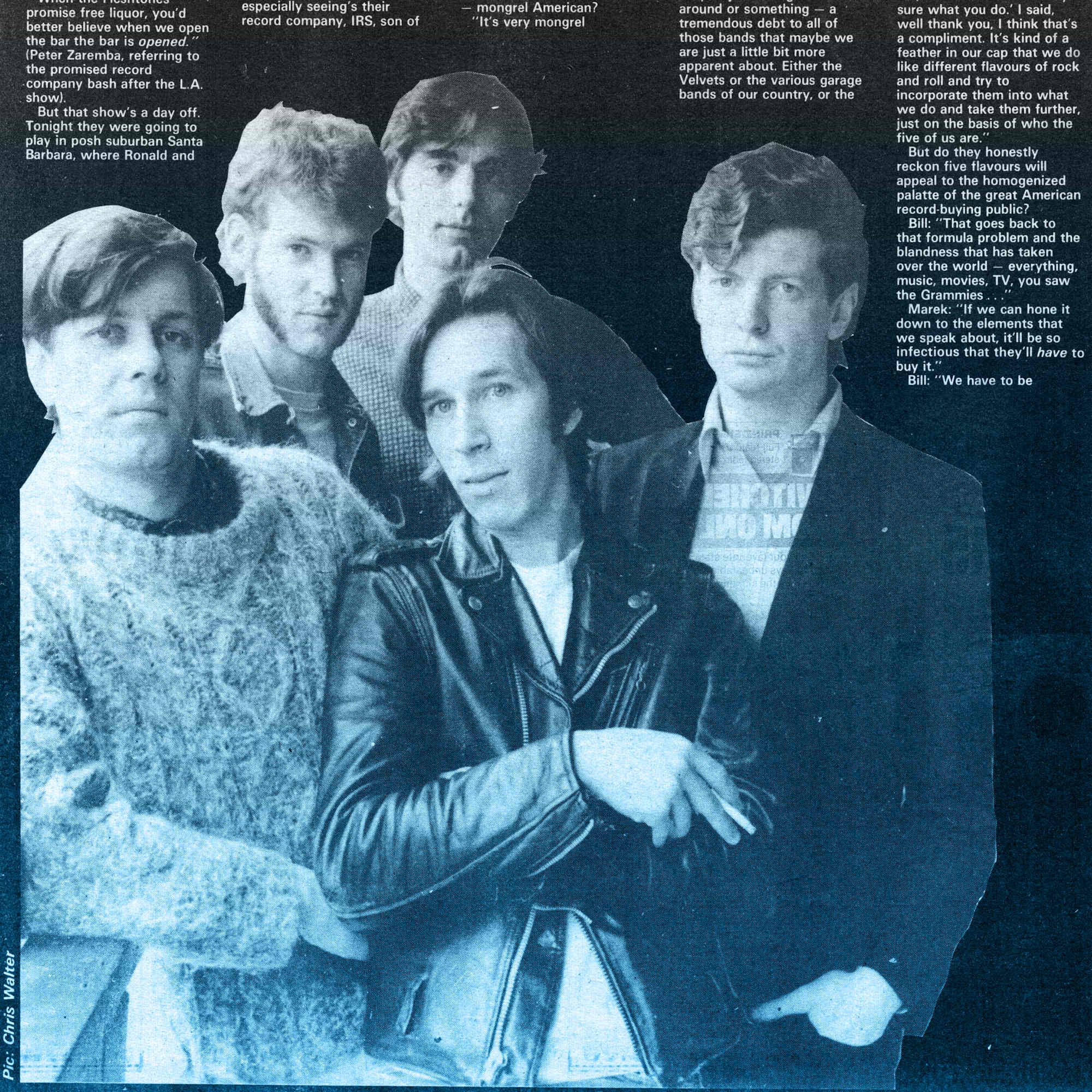
The other members (entire line-up Peter on vocals, Keith Streng on guitar, Bill on drums, Marek Pakulski on bass, Gordon — formerly part of their back-up horn section, the Action Combo, now fully-fledged Fleshtone — on sax, organ and harmonica) come back. Haven’t got the beer, but I like them anyway.
“The whole band”, they agree, “is very happy. Although by this point the band is already somewhere different again.”
Whatever place that is, this fan is going to want to be there too.


Leave a Reply