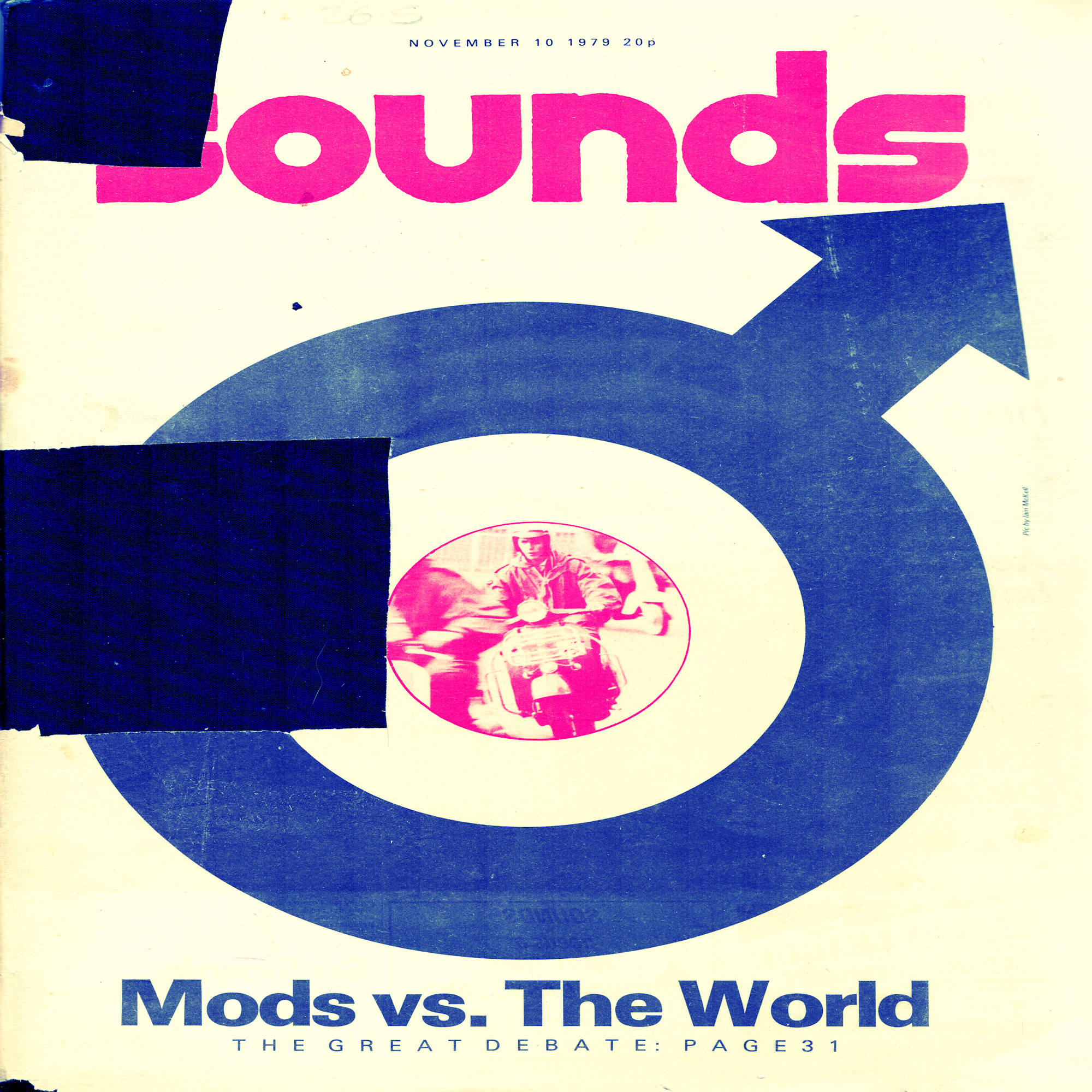
Article published in Sounds, 10th November, 1979
Mods Versus The World | War Of The Words | Is there life after mod? Or is it just a media manipulated fad? Sounds brings together the finest brains of our generation (it says here) in a verbal battle to the death.
BUSHELL started it a month ago with his one-off ‘Cruelty Corner’ in which he not only defended mod but called less enthusiastic scribes (I quote) ‘silly ponces, ‘bores, ‘has-beens, non-gig-attenders and bottle jobs’, ‘tedious self-important pseuds’ Now look what he’s done.
The gauntlet being hurled at his feet McCullough naturally had to pick it up. A Great Debate was proposed and here we are in the Sounds conference room (deluxe choice of deafening traffic noise or no air) arranging ourselves round the table in hopes of plucking some clear insight out of the aggro.
the teams
As impartial (oh yeah) chairman may I introduce the teams. In the blue corner with the East End Cockney accents Goffa ‘Norway’ Gladding from Maximum Speed fanzine, Billy ‘Allforfunfunforall’ H from the Chords, Garry ‘Worimeantersay’ Bushell from his mum and later on Dave ‘Idontagreewithianabouteverything’ Cairns from Secret Affair. In the red corner with the
American/Yorkshire/Irish accents Mayo ‘Substantively’ Thompson from Red Crayola and Rough Trade, and Dave ‘howcanyousaythat’ McCullough from the White Lion. Paul ‘Anotherfinemess’ Slattery was on snaps and occasional verbal.

McCullough: My attitude towards mod is that it’s harmful because of its continuation of the outdated idea that rock ‘n’ roll is merely a business or some sort of economic lifestyle. I’ve heard no mod records that light any spark in me so far. I think the idea of perpetuating something that’s ten years old . . .
A Voice: Twenty!
McCullough: . . . is boring. I think this discussion is worthwhile because some useful points of view might come out of it on the music business and why this so-called phenomenon mod has managed to claw its way into our lives.
Bushell: Well living in London as we do is the best place to see how punk and everything it set out to do has been distorted and destroyed. It’s the best place to see how bourgeois values have crept back into what was essentially an anti-business thing.
Mods Versus The World | War Of The Words
How the whole punk movement which started out to be anti-commercial and was supposed to be an explosion of ideas from ordinary kids has been turned into a whole profit-making machine.
You only have to look at the charts now — it’s Gary Numan, Police, Blondie. Punk has opened up the market to these people who have become the new establishment and they’re exactly the same as the old one.
You go out now to gigs, you go to Hammersmith Odeon to see the Buzzcocks, you go down the King’s Road and you see ‘punks’ who are . . . it’s just a uniform, another way of dressing.
The whole thing that punk started out to be which was individuality, encouraging people to think for themselves and oppose the way things are, it’s been destroyed. It’s a caricature now.
Renewal
So I was getting disillusioned as were a large number of people and those people created mods. It was not the creation of people in boardrooms, music business entrepreneurs and fashion entrepreneurs, it was the creation of ordinary kids who wanted something of their own that was vivid and lively and not the toy of somebody who was trying to manipulate them at all.
It’s a renewal, don’t believe that mod has the importance or the meaning that punk had. It’s never thought in terms of any sort of revolution. But the way it’s been criticised in the Press has been for entirely false reasons, ridiculous.
People have said that it’s powerpop which it patently isn’t, that it’s a big business hype which it isn’t because it began in the Bridge House and the Wellington, places like that. But all chance of mod growing and achieving something has been destroyed by the papers and the business.
McCullough: I can’t understand why Ian Page isn’t here anyway, maybe he’s washing himself.
Bushell: He’s been working on the album. He didn’t go to bed until eight o’clock this morning.
McCullough: It’s a pity he’s not here to defend the baby he’s brought up.
Gladding: Secret Affair haven’t brought up the baby!
McCullough: Well he’s more or less championed it in the music papers. (Bedlam!)
Sutcliffe: Hold it! Before we get into a melee I’d like to hear from Mayo Thompson.
Thompson: I agree that the substantive issues raised by punk were never dealt with and I can understand why people want to keep some energy going.
Sutcliffe: What were the punk issues in your view?
Thompson: Socially that the access to the means of producing music didn’t belong to the people who wanted to make it. Obviously mod will be appropriated in the way that punk was appropriated.
Mods Versus The World | War Of The Words
Punk was never a well-formed movement and I don’t think mod will be because the grounds on which it is proposed are too shaky. Garry, you raised the bourgoiseification of punk rock and it seems to me that punk actually never sorted out the way it was going to stand against that happening.
The individualism never got beyond an individual being for himself. We see the same thing with mod. Of course one of mod’s main areas of self-expression is fashion. And as clothes become a uniform they can lead to factions and conflicts — none of which anyone present seemed to favour.
Thompson: How anyone can get worked up about what people wear completely baffles me.
Sutcliffe: Do you get worked up about what people wear Billy?
H: No, it doesn’t matter to me whether there’s mods or punks in the audience. As far as I’m concerned people come out just to enjoy themselves. If they come to see us it’s a compliment.
Gladding: I don’t give a monkey’s what people wear to be quite honest. Three years ago I was possibly seen wearing spikey hair (blushing prettily) but at the same time, without going into much greater depth about it, I don’t really see what that’s got to do with it.
Sutcliffe: Is there anyone here who wants to speak up for clothes, physical style and appearance, being of any importance in this?
McCullough: I think its only importance is that it indicates the kind of unimaginative, repetitive, unadventurous character of mod and . . .
Thompson: There are areas where people are being very careless. Such as being able to get the clothes right and then you can fool somebody. That is dangerous, giving people the impression that all they have to do is get a shopping-list of features right.
It’s in none of our interests to perpetuate that.
(‘Sclurpeeeooo!’ says my Sony — Slats is holding two bare wires under my nose which he’s just kicked out of the mains plug from my tape recorder. I question his parenthood loudly. We continue on batteries.)
Mods Versus The World | War Of The Words

H: You go to a gig to meet your friends. you think you’ll wear a Fred Perry and . . .
Thompson: But doesn’t all that stuff come from above, come from people who are trading on the evaluations of the public the same way they always have.
The real force of it, the real interest, the real possibilities of those people who are all dressing the same, the way that group relates to another group of people who dress differently but have the same interests and the same enemies — well, nobody has been able to sort that one out. And I think it is the position of musicians to try to sort it out.
Mods Versus The World | War Of The Words
Talk turns from the (possible) Big Brothers of fashion to the ones we are all more familiar with in the record industry. The ‘opposition’ is disconcerted by Mod’s seeming haste to sign itself away to the highest bidder i.e. the major companies.
Thompson: Why do you deal with record companies? It is because you feel you have to?
H: A geezer, right, picking up the guitar and starting to learn it, he dreams of being in a group and he dreams of being on Top Of The Pops. Then you you say to him “Ah, credibility. You shouldn’t be playing on TOTP”.
He wants to do gigs, play to an audience, play on TOTP, make records. That was the first reason why he picked up a guitar, that’s why everyone I talk to started.
Thompson: I don’t deny that’s part of it. What I would ask is whether you think what you’re doing is going to make any substantial difference to answering the question should you or should you not be on TOTP?
Should you or should you not put out records on coloured vinyl? Should you or should you not be with record companies who maybe have an arms division? How are you going to answer the ethical problems?
McCullough: It all comes down to your basic idea of what you are doing. What is rock and roll?
Ah now there’s a question. Rebellion? Art? Neither? To be answered no doubt after this short intermission. Ice creams? Hot dogs?
Mod is a surrender
Sutcliffe: What’s been said in response to the issues Mayo has raised does sound like mod is a surrender, waving the white flag and being happy beneath it.
Bushell: It’s a question of realism, because the whole thing is. ‘Will music ever change the world?’ I don’t think it will. I don’t think groups have it in them to even change the music industry because it’s part of present day society.
With record companies all you can decide is whether you’re going to sign to a big capitalist or a small capitalist. If you’re in a group you’ve got to think which one’s going to have better promotion of your stuff, which one’s going to distribute it better. All the small capitalist boils down to is inefficiency really. ( Wails of protest on my left.)
McCullough: What you are saying is very negative, a bland cop-out in fact.
Thompson: What does realistic mean? Does making the most lucrative deal represent realism? Or is it making one that most accurately represents what you’re aiming for, what you think music is about and how it relates to our lives? I would disagree heartily that the bigger companies are more efficient.
Look at their profit margins, look at the cries going round the industry right now. EMI is obviously in serious trouble, a lot of these people are and they’re getting ready for a recession.
But I think it’s pessimistic to say there’s no way you can change this system. If I didn’t believe there was some different possibility there would be no point in carrying on.

Mods Versus The World | War Of The Words
Dave Cairns arrives and is instantly picked on with accusations that mod is presenting a ‘clothes-maketh-man’ delusion. Bill H is enraged.
H: You can’t understand! What we’re really on about is just going out and having a good time.
McCullough: Come on! 1979! How can you possibly say that rock ‘n’ roll is about going out and having a good time? Only that! How can you? Nothing to do with threatening the economies through which rock ‘n’ roll is being syphoned . . .
H: There’s geezers up there right and they’ve got all the money and then they decide. Not us.
McCullough (incredulous): Do you accept that? That they decide the way you’re going to live?
Sutcliffe: What you were saying Billy did sound as though you were papering over the cracks of despair really.
H: Yeah. It’s sickening. It’s awful, It’s stupid.
Thompson: Essentially we’re arguing against the ideology of common sense all the time. Common sense tells you that the best thing to do is get your head down, get a deal, make a lot of money, go out and give the kids what they want, entertain.
Common sense tells you to do that kind of stuff when in fact all of your instincts, all of your social relations tell you to tear that down if you can.
I-Spy label
Puzzling exchanges ensue in which Dave Cairns pans independent labels as a whole then claims Secret Affair’s I-Spy, distributing through Arista, is completely different because thy have secured the fabled ‘artistic control.
Thompson: What you have is total control to present material in the way that you did when Arista took you on. How much control will you have the moment you deviate from that? You have money, support, choice, freedom, only as long as you play the game. If things start to fall off they’ll dry out, pull the plug on you.
Cairns: That’s purely down to confidence isn’t it. We pay all our recording costs because we get better percentages that way and we are confident that we are going to sell our records right? When we signed the contract we actually got it written in that we would have certain powers.
McCullough: but you’re signing the contract! You’re ignoring completely the independent recording thing as if it never happened. Bands like Swell Maps have proved that the whole system isn’t really necessary. How much control do you really have?
Cairns: You’re right in that if we have a flop record people might turn around and say “You can’t do that” but there again we’ve got that much confidence . . .
Attacking ‘fun’ ain’t no fun even if it seem.’ logical. How to reach the heart of mod, or whether it has such an organ, is the problem.
Sutcliffe: Could I ask is mod inspiring?
Bushell: It inspires a lot of people to make music, it inspires a lot of people to write fanzines.
Mods Versus The World | War Of The Words
Cairns: there’s no doubt at all although a lot of people may think it’s just this year’s trend at least it’s positive. A lot of things that punk did and stood for were great but it became so negative very fast. I mean kids on the street getting into the idea of ‘no future’ and tearing things down and not putting anything up instead.
Sutcliffe: Dave Cairns, what does mod inspire you to?
McCullough: It’s a long pause (it was)
Cairns: Yes. It’s a difficult question.
McCullough: For someone who’s been in a band for so long and ranting and raving about being positive and building things up it’s a hell of a long pause!
Cairns: What confuses me . . . I wrote a song called ‘Time For Action’ which was purely for some of the kids who had been mods out on the street and been pushed around and now they’ve come together with a lot of people and they don’t get beaten up which is great.
But I’m very confused about the people who follow us now. What does it all mean to them? the philosophy we’ve set out doesn’t seem to have any reaction.
Sutcliffe: Is that it then? By wearing the same clothes they’ve been able to identify one another as a gang and therefore they can protect themselves?
Wage packet
Cairns: No, it’s not that. Some kids have really picked up on the idea, the fashion scene, smart dressing, the whole attitude. Even the attitude to work of some people I know has improved. They’re into working hard, earning a good wage packet and enjoying what they do.
Sutcliffe: When you say that you can surely understand why mods get labelled Thatcherite music. It makes Mayo’s image of heads down and be sensible very appropriate. Or is there more?
Cairns: What interests me is that friends of mine who got into punk gave up their jobs and went on the dole whereas now mods are going out and getting jobs which is pleasing to me.
Sutcliffe: Billy, would you go along with Dave in being pleased if you thought your music was inspiring people to do more hours at work, turn out more products?
H: Urn, no, not really. Mod is about getting money for clothes. Look better than your boss and that’ll frighten him. You want to look better than the next geezer.
Elitist
McCullough: Why?
H: To be smarter.
McCullough: You’re associating mod with buying things.
H: No, it’s being one over the next bloke.
McCullough: That’s very elitist.
H: Well the ones who were in it from the beginning were an elite. Why not? Why can’t you have that?
McCullough: Why can’t you have elitism? How can that be fun, recognising that somebody’s better than somebody else? Surely you’re moving into very ugly areas there.
H: That can inspire the other bloke to get on better than you.
Thompson: If the world worked that way it would be just great but it doesn’t. Capitalism doesn’t inspire all of us to have a lot of capital. It just inspires us to be very opportunistic with respect to our neighbours. If capitalism worked it would be ducky man, because capitalism is full-blown right now. Capitalism is based on the self-interested individual aspiring.
Self-pride
Sutcliffe: Did you really mean that about wanting to frighten the boss Billy? You said it then changed it to wanting to be ‘better than the next bloke’ which is a very different attitude.
H: Yeah, well that bloke’s going to be looking better than the boss anyway.
Bushell: It’s self-pride init?
McCullough: Self-pride? About what sort of things in yourself?
Bushell: You don’t feel inferior to someone who . . .
McCullough: You don’t feel inferior! You mean people who are growing up in 1979 all feel inferior?
Bushell: You’re taught to! You’re taught that the bloke who’s in charge of the company and the bloke who’s in charge of the music paper is better than you, that you’re just a dreg. You’re nothing and his decision goes. They’re the people who control everything and you’re made to feel they’re right.
McCullough: But what Billy was saying about the early mods being superior to the later mods completely defeats that argument.
Thompson: We live in a welfare state and the main issue is the right to earn a living, the right to access to the means of production, the right to continue to exist, those are basic questions and this is an attempt to deal with it in some way.
The main problem is that the ideas are half-baked, nobody thinks anything through, nobody is willing to organise in the way that things have to be organised to actually consolidate that ground and win that space, that’s why we always give it up over and over again.
What’s your alternative?
Billy gives it up to catch a train for a gig in Birmingham. Now Bushell finally corners his opponents with the refrain he has been grinding out: “What’s your alternative then?”
McCullough: there’s not just one, you have to think of loads of them.
Sutcliffe: And what are they?
McCullough: The steps forward that have been made by the independent companies and by certain groups. The growing awareness of the groups, their hesitancy about signing for major labels — which apparently mod doesn’t share. In general we’re going forward with bands like Swell Maps. And even Stiff Little Fingers, the way their album was paid for, produced and distributed.
Bushell: As an alternative New Faces for Chrysalis?
Thompson: It worked out that way I agree.
McCullough: But it didn’t have to. It was their choice.
Thompson: It was weak practice.
Bushell: It was because falsely or not they thought Chrysalis could ship more units for them.
McCullough: they retrogressed, it was their fault.
Swell Maps
We must be tiring. Suddenly we can’t remember names like the Stones or the Clash. Swell Maps are the centre of our universe, the name on every lip to justify every point.
Thompson: Swell Maps is one of those bands that operates in its own way and does it well. Their task is to win space —but they do have the backing of Rough Trade, they are part of a complex.
They are part of a projected neighbourhood of production (if you think this is tough you ought to know I’ve cut out the bits where he said ‘ontological’ and ‘reification’) which includes I hope Red Crayola, Scritti Politti and various others.
I think that’s maybe not a ‘movement’ but I would call it a neighbourhood. That could be the alternative approach. Conceive of who your neighbours are and which ones are good and which ones are bad.
Mod music is not the issue. The question is what impels people together for their mutual interest. People want to organise, they want to have a grip on their own lives.
Bushell: And in mod the are creating something for themselves, scenes of their own. Mod has been identity and it’s been a lot of fun and that’s probably the end of it and if you want to criticise it it’s probably valid to say that it’s not going to bring about any changes.
But then if you are talking about social change you’ve got to start thinking about political parties and unions which is a whole wider thing altogether.
Dispiriting
Sutcliffe: What you’ve said about identity needs to be challenged it seems to me. Can you only have an identity by being like other people? That’s a peculiar concept. Do you think mod raises its followers’ awareness of society, the position they’re in?
Thompson: It certainly acts as a filter: seeing everything in terms of it.
Sutcliffe: Dave, does it raise awareness?
Cairns: No, I don’t think so. The people who come to see us, they don’t see beyond five yards. It’s really dispiriting. They’re not into it as anything more than the style, something pretty to wear. It’s disappointing.
Slattery: Doesn’t that make you try and raise their level of consciousness then?
Cairns: Ian tries very hard, yeah, I think he does. Sad. The outcome I see from this meeting is you guys over there searching into the ideals and the philosophy, what it all stands for, while we’re coming out with, like you say, long pauses and, er, it is very shallow. There’s very little in there . . .
. . . after all that.





Leave a Reply