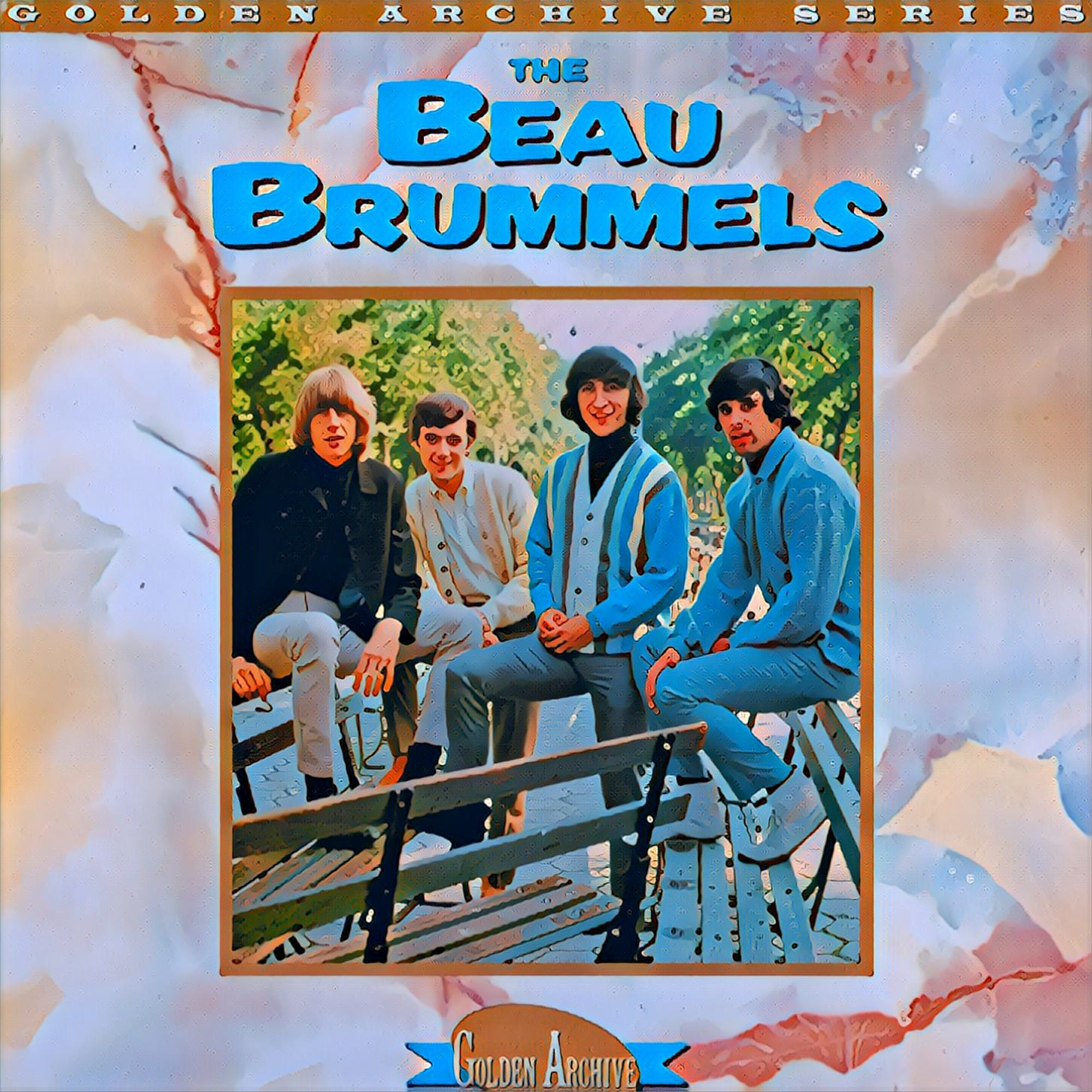
“Deep Water” taken from the LP ‘The Best of the Beau Brummels’ | (Rhino Records RNLP 70171) 1986
The Beau Brummels | Deep Water | (Warner Bros.) 1968 | If a band’s worth were measured solely in terms of their performance in the Top Forty, the Beau Brummels would rate not much more than a footnote in rock’n’roll history.
They had three chart hits, scattered throughout 1965, of which “Just a Little” was the biggest, and “Laugh Laugh” the best known. Fortunately, there are other yardsticks by which to gauge merit, and, when applied, the Beau Brummels begin to look like one of the more significant American bands of the Sixties.
British Invasion
Certainly, they were responsible for subtle innovations throughout their career, but, like most pioneers, the Brummels’ tracks were trampled over by the many who followed, claiming the glory and the gold for themselves.
The Beau Brummels were among the first American bands to successfully return fire against the British Invasion. “Laugh Laugh,” a Top Ten success in early 1965, had the crisp pop sound of the Beatles and the Merseybeat bands, plus a nod in the direction of the homegrown folk stylings of the Everly Brothers and the Kingston Trio.
The Beau Brummels‘ early records, forged a premonitory synthesis of folk and rock, which, combined with the transatlantic influence of the Beatles, pointed toward the inevitable arrival of an American pop sound. Just as impressive, the Beau Brummels were on the leading edge of San Francisco’s emergence as a musical stomping ground.
The Beau Brummels | Deep Water | (Warner Bros.) 1968

Formed in 1964, they were several years ahead of the Haight-Ashbury inundation and the full flowering of the San Francisco sound. The group was formed by Sal Spampinato, a swarthy, dark-haired singer whose father advised him to change his name if he was going to try to make it in pop music.
The elder Spampinato, a heavyweight boxing manager, suggested the surname of one of his former fighters, and Sal Valentino was born.
His first group, Sal Valentino and the Valentines, attempted to cash in on the early Sixties go-go craze with a song called “I Wanna Twist.”
When the British Invasion began invigorating the airwaves with new sounds, supplanting the tired American formulas (bogus dance fads, simpering pop crooners, stale Fifties grease), Valentino dispersed his Valentines and set about answering the challenge of the English Sound.
folkish
His recruits in this endeavour included bassist/ guitarist Ron Meagher, then attending college across the bay in Oakland, and drummer John Peterson, fresh from a stint with a San Francisco group called the Sparklers. The most auspicious find, though, was Ron Elliott, an accomplished guitarist and prolific songwriter who dropped out of San Francisco State College in his second year to join the group.
Elliott had a singular playing style, a hybrid of lead and rhythm guitar with a lot of folkish fingerpicking that gave the Brummels’ songs their deep, delicate textures.
The name “Beau Brummels” showed a canny calculation on the band’s part. Though namesake Beau Brummell, a renowned nineteenth-century British fop, spelled his name with two ll’s, the group’s minor alteration mattered less than the fact that the name cleverly managed to suggest all things English.
Moreover, anyone who happened to be browsing the Beatles bins—and who wasn’t in ’64 and ’65?—would also stumble onto the Beau Brummels’ records, since “Beau” naturally followed “Beat,” alphabetically speaking.
The Beau Brummels | Deep Water | (Warner Bros.) 1968
At one of their early shows, a dance concert at an Irish ballroom, the band met Declan Mulligan, a recent arrival from County Tipperary in Ireland. He became the fifth Beau Brummel, filling in the sound as second guitarist and harmony voice (and giving their adopted U.K. roots some legitimacy).
Over a period of months, the Brummels fine-tuned their act, mixing in some fine Ron Elliott originals with a raft of Beatles-Stones-Searchers covers. Their big break came when a lady of the night commended them to local radio personality Tom Donahue.
Donahue, then a boss jock at KYA, was on the prowl for talent to sign to Autumn Records, a local label he cofounded with a fellow deejay. Autumn had a sizable national hit with Bobby Freeman’s “C’mon and Swim” (named for topless celebrity Carol Doda’s jiggly dance of the same name), but several swim-related follow-ups sank into oblivion.
The Beau Brummels rescued Autumn with “Laugh Laugh,” produced by yet another disc jockey, Sylvester Stewart from KDIA, who had musical ambition as well as a talented hand in the studio.
Perhaps his input was partly responsible for the bright, toe-tapping sound of “Laugh Laugh.” In any case, Stewart, the producer of the Brummels’ first two albums, went on to greater fame as Sly Stone.
1965 was the big one for the band, who became an instant sensation on the strength of their hits. Like their mop-top role models, they grew their hair long, appeared on syndicated rock’n’roll TV shows like Shindig and Hullaballoo, were cast as cartoon characters (their animated likenesses turned up on The Flintstones) and toured every burg and hamlet in a cross-country marathon of one-nighters.
The Beau Brummels | Deep Water | (Warner Bros.) 1968
And then 1965 was over. There were no more hits from the Beau Brummels. Autumn Records folded, and a treasure trove of unreleased Brummels songs was passed on to another obscure indie, Vault Records, where they languished.
The story, so typical of the Sixties, might have ended there, with a line like: ” . . . and so the Beau Brummels broke up, having made a brief but lasting mark on rock’n’roll.”
However, they possessed an extra something that induced them to persevere. Without looking back, the Beau Brummels ditched their mod threads for the obscurity of the studio, where they made some wondrously visionary music.
Moving to Warner Bros., which acquired Autumn’s artist roster, the Beau Brummels masterminded a pair of brilliant albums—Triangle and Bradley ‘s Barn—which remain among the lost treasures of the late Sixties.
Reduced to a core of Valentino, Elliott and Meagher (with even Meagher leaving after Triangle), the Beau Brummels weaved spellbinding tapestries, delivering imagistic story-songs that flowed as freely as mountain water.
the Break-up
Sal’s voice, considered by many to be the best in rock, had a timeless quality, with its Appalachian-folk quaver. Elliott, meanwhile, had become a first-rate purveyor of modern folk music and one of the most tasteful, deft guitarists around.
Despite sterling assistance from the likes of Van Dyke Parks, Randy Newman and some of the best pickers in Nashville, the Beau Brummels’ later work earned them not much more than high praise and a cult following, and Sal and Ron parted ways in 1969.
Not surprisingly, the Beau Brummels’ records sound as enchanting today as they did twenty years ago. Listen closely, and you too are bound to fall under their spell. —(Parke Puterbaugh)


Leave a Reply