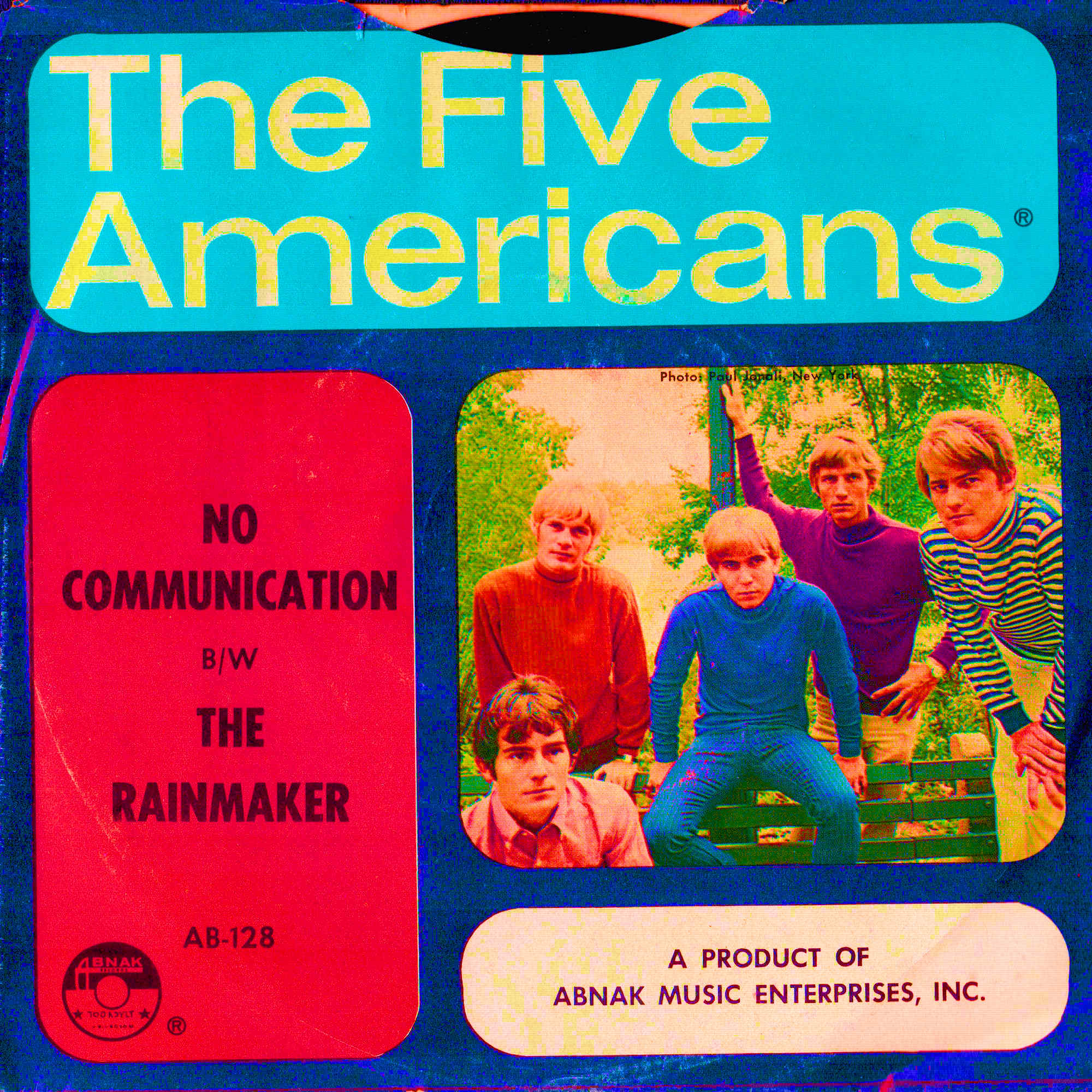
“No Communication”/ “The Rain Maker” (Abnak Records AB-128) March 1968
The Five Americans story
The Five Americans | “No Communication” | (Abnak) 1968 | The history of The Five Americans begins on the campus of South Eastern State University in Durant, Oklahoma, in the early 1960’s. Aspiring guitarist Mike Rabon was leading an instrumental cover band called The Mutineers with his college classmates Norman Ezell and Johnny Coble.
Ezell handled the rhythm guitar chores, Coble the drums. Another buddy, John Durrill, a graduate of the same school the previous year, would come down to Durant to play keyboards with the group on weekends.
With the addition of their friend Jim Grant as resident roadie and occasional maraca shaker, The Mutineers churned out covers of “Walk, Don’t Run,” “Pipeline,” and other current favourites. They were the perfect party band for campus frat bashes and local gigs.
After several months of performing in and around Durant, the boys penned their first originals, a pair of instrumentals. With Mike Rabon’s father footing the bill for studio time, they were recorded in Dallas, at Seller’s Recording Studio.
the Mutineers
About a thousand 45’s were pressed, bearing The Mutineers moniker, to be sold both on campus and at the band’s local club dates.
Norman Ezell continues the story: “We went up to Oklahoma City, we were going to get our 45 on the radio up there, and that was the first time we ever saw the Beatles. It was just a picture in a Billboard magazine, but they looked real mysterious; they were dressed in black, and were standing by a fountain.
Boy, when we saw them we said, ‘Wow, look at these guys, they really look different!’ Cause we had all our hair all combed back, ya know, our flattops. After that, when we went back to school, “I Want to Hold Your Hand” came on the radio, and man, it blew me away! Man, I never heard anything like that. So, then we started singing Beatle songs there in Durant.”
Once back on campus, guitarists Rabon and Ezell were chiding their buddy Jim Grant to take up “a real instrument.”
The Five Americans | “No Communication” | (Abnak) 1968
Jim Grant: “We went to Ardmore and saw Bo Diddley, and his band had an electric Fender bass, the first one I’d ever seen. I went out the next day to Wakefield Music in Durant, and bought a hundred and fifty dollar ‘Alamo Titan’ bass and we rented a tiny little one or two room shack right off campus on a Tuesday, and started practicing and just trying to learn.
And, we played that Saturday night . . . terribly, but we played!”
With the summer of 1964 rapidly approaching, The Mutineers, fuelled by the positive response to their new sound and repertoire, decided to gig full time, as an alternative to finding day Jobs during the upcoming school break.
Dallas was picked as a likely target for summer residency, it being the closest major market with an already thriving club scene. Johnny Coble, the group’s current drummer, declined making the trip, leaving a vacancy in The Mutineers’ line-up.
Their replacement was found in Jimmy Wright. Although still In high school at the time, Wright was already well-known locally as the powerhouse drummer with The Accents, a rival band, also from Durant.
Dallas music scene
Wright eagerly joined up, excited by the prospect of playing music in a new town that summer. After an intense, two week rehearsal at Mike Rabon’s parents home in Sawyer, Oklahoma, The Mutineers headed for Dallas.
Once relocated, The Mutineers found work in area clubs and quickly established themselves as worthy contenders in the local Dallas music scene.
Norman Ezell: ‘We got this job in a place called the 4500 Club and we started playing in there and people liked us because we had real good personalities. We weren’t any good . . . you know what I mean . . . but people liked us because we were wild, you know, we were copying the Beatles, and being like them, letting our hair grow out.
I think we were the first people in Texas to have long hair and tight pants, Beatle boots, and boy, we got persecuted! They used to make fun of us, walking down the street. They thought we were horrible. We’d get in fights all the time. They’d say ‘Is them’s boys or is them’s girls?‘ We’d say, ‘Ask your mother, she knows for sure . . . ‘”
The Mutineers moved from the 4500 Club to another Dallas nightspot, The Pirate’s Nook.
Ezell continues: “We got matching shirts. Short sleeve shirts, real cheap ones, and we’d wear them all week. I don’t think we smelled too good, cause we didn’t have any way to wash them too often.
We were making like 40 bucks a week apiece, and we’d play every night with people buying us drinks all the time. We went to Louann’s, the biggest club in Dallas, and started getting a pretty good name there.”
It was at Louann’s where the band first heard mention of local entrepreneur John Abdnor. Abdnor, already successful in the insurance business, also owned Abnak Music Enterprises, comprising the labels “Abnak” and “Jetstar”, as a sideline.
The Five Americans | “No Communication” | (Abnak) 1968
His son, Jon Jr., was in charge of the day to day activities of the newly formed company, which, at this time, had released but a few records by local artists. Jon Jr. would later find a bit of recording fame himself, as half of the duo ‘Jon and Robin, with chart successes such as ‘Do It Again, Just A Little Bit Slower’ to their credit.
The Mutineers continued to build a reputation for themselves at Louann’s, gaining confidence and enthusiasm as the crowds grew.
Drummer Jimmy Wright: “At the time, we really weren’t sure of exactly what we were going to do. As we got together and began to play, we became more serious about pursuing it on a professional level. Some of the guys began to write tunes and we began to spend some of our money to go into the studio, and decided to pursue it in the record business.
By that time, we were really convinced that we could do it. And, honestly, we sounded terrible. We really did. But, we were really convinced that we could do it, and we pursued it on that level. We really didn’t take no for an answer. If anyone didn’t feel like that we had what it took, we just didn’t feel like they knew what they were talking about:’
As the band continued to perform in town, some of their earnings were channelled into recording a few originals at a local studio. They brought the demos to Ken Dowe at KLIF radio for his appraisal and advice.
Dowe, who, at that time, was the most influential disc jockey on the Dallas airwaves, suggested the group visit John Abdnor in person. Abdnor and the small staff at Abnak Music Enterprises liked what they heard, and recognized the potential this new act offered both musically, and as an asset to their fledgling record label.
Record deal
An immediate deal was offered and was soon accepted by the group. Roger Guegenheimer, who worked for Abdnor’s labels in the A&R department, suggested a new name for the band. “The Five Americans” was unanimously approved, and work began.
Mike Rabon, Norm Ezell and John Durrill had been continually composing new material throughout this period, building a repertoire of originals which they had begun to use in their live shows.
“The three of us lived together, so we each would contribute a bit,” says Rabon. “Usually, I would start a guitar riff of some sort and I’d play it for the other two and they would add what sort of melody or what they thought should go in there. So, we just decided that whatever we wrote from that point on should be a group effort.”
The Five Americans | “No Communication” | (Abnak) 1968

A recording session was quickly set up at the nearby Sumet Recording Studios, resulting in the completed tracks “It’s You Girl” and “I’m Gonna Leave Ya.” Released as the first Five Americans 45 on the Jetstar label, it was quickly determined that the songs did not accurately portray the group’s sound, and distribution was halted.
Abdnor then sent the group to Nashville to record another original, called “Show Me,” which was in turn licensed to ABC-Paramount for national release. The record failed miserably, and the group again was sent into Sumet Studios in Dallas to cut material.
Abnak label
Two 45’s followed: “I’m Feelin’ OK,” backed with a blistering cover of Little Richard‘s “Slippin’ and Slidin’” became the second Five Americans’ release on Abdnor’s Jetstar label, and, “Say That You Love Me,” backed with “Without You” became the group’s first release on the Abnak label proper.
Sales-wise, the records were disappointments, failing to garner significant airplay even in the Dallas-Fort Worth area, but, they did serve as a catalyst to The Five Americans themselves, intensifying their desire for a real ‘hit’ record.
“We felt like we weren’t getting anywhere very quick,” Jimmy Wright recalls. “We had run into a couple of groups playing in town that were really good, and it got us to considering where we were musically, and our ability, so we started rehearsing eight hours a day, five days a week, just like you’d go to a regular job.”
Norm Ezell adds: ‘Abdnor let us use one of his warehouses in South Dallas and we’d practice, six or eight hours a day and, after six months of that, we were getting real good.
Abdnor also sprung for us to get some good Fender amplifiers. We wrote some of our hits while we were in that warehouse.”
The Five Americans | “No Communication” | (Abnak) 1968
It was at this creatively explosive time in the band’s career that they met Robin Hood Brians. While The Five Americans were woodshedding in the Dallas warehouse, Brians was assembling somewhat of a local musical institution in the form of a recording studio, in his house in Tyler, Texas, where it remains, in part, today.
Robin Hood was (and is) a madcap genius of sorts, building his studio from scratch, and possessing an understanding of, and love for, the music whose recordings he would engineer masterfully.
“When I tell you it was hand-built, I’m not kidding” Robin says, “from punching out the holes for the tube sockets in empty metal cases, right on up.”
Brians’ studio became a second home for the Americans, providing them with a relaxed recording atmosphere, which in turn spurred their creativity.
Drummer Jimmy Wright: “We really liked recording there because it was in his home, it was just Robin Hood and his mother, and his mother really took care of us. When some of us weren’t working in the studio, we could sit in the living room and watch TV, and she’d also cook for us.
It was really a home-like atmosphere. We were getting a really decent sound out of the studio, and we began to record down there quite a bit.
Jim Grant adds: “It was like being with a mad professor! Robin’s got as much energy and craziness as anybody that walks in a studio, and that’s infectious. Plus, he’s really, really smart.
Robin’s mom was in there, we used to call her “Mrs B. It was like the Andy Griffith Show, on acid . . . “
Studio sessions
One of the first trips to Brians’ studio turned into a marathon session. The result was the completion of a number of tracks that would give the band their first taste of national success.
With Dale Hawkins producing, the group started to show just what they were now capable of in the studio. Out of the ten songs that were recorded in that session, one in particular was a standout.
“I See The Light” was unanimously chosen to be the group’s next single release on the Abnak label. With Dallas radio station KLIF given an early exclusive on the record, and airwaves guru Ken Dowe giving the send-off push, the record broke out regionally in the Texas/Oklahoma area.
“As soon as we got as much airplay and attention as we did, and that was a lot, Hanna-Barbera Records called and said ‘We see your song is breaking . . . “
explains Rabon. “That was pretty well common in those days.”
HBR deal
A licensing deal was set with HBR, to gain solid national distribution for “I See The Light,” something that the still young Abnak Music Enterprises was not yet set to accomplish on its own. By the end of January 1966, the song had climbed to #26 in the country.
“I don’t care where you were In the house, when that organ riff started, you came into the room where the radio was to give a listen, “cause it was a great hook,” says Jim Grant.
Jimmy Wright adds: “We stuffed envelopes for weeks on end, sending out mailers to radio stations, to DJs, to get our record played. We personally, all of us, stuffed mailers, to send all over the US . . . “
Jim Grant: “We worked so hard…there were two bands. There was a band on record, with all the ‘dit dit dit dits’, and, there was a freight train on stage.”
An LP followed, comprised of the new hit, plus tracks the band had recently recorded at Brian’s studio. Released on the HBR label, the “I See The Light” LP still stands as a meaty overview of the band’s varied styles and Influences at that stage. It’s well worth searching out.
Two further 45s were released on HBR In the first half of 1966 “Evol-Not Love” charted only at #52 nationally, due to the unfortunate circumstances described later in this booklet.
Late 1966
It was a good song and deserved a better showing “Good Times,” the last 45 to be released on HBR, was a Dave Clark Five influenced rocker with a Texas garage edge; too intense perhaps, for the pop audience to embrace. It failed to chart at all on a national level.
The band was working hard, desperately trying to find the follow-up hit to “I See The Light.” It was now late 1966, and the agreement with HBR had ended. John Abdnor was now convinced that if there was indeed another hit, Abnak would handle their own distribution.
The band, was once again, embroiled in recording sessions at Brian’s studio, painstakingly assembling and arranging the material they had been composing throughout the past few months.
Jimmy Wright: “At that point, we might record for two days and two nights straight, until we just were blithering idiots, and then we’d go to the Holiday Inn and we’d sleep for a day and a half, and then we’d go back in. We’d just do that until we had like twelve or fourteen songs.”
After two more single releases on the Abnak label failed to dent the charts, “Western Union” was picked for release, from a group of recently recorded songs. It was the most commercial sounding track the group had cut to date, and Abdnor had a strong feeling about it.
He was right. Blitzing the trade papers with advertisements introducing the new “communication” theme of the song, and showering radio with orange-coloured vinyl promo copies of the record, (this use of coloured wax would become standard procedure for all future Abnak promo 45s, “Western Union” soared to number five in the charts in April of 1967.
Where The Action Is

Everything started to fall into place for both the group and Abnak Music Enterprises. The band appeared on Dick Clark’s ‘Where The Action Is,’ and ‘American Bandstand,’ as well as joining up as part of Clark’s current ‘Caravan of Stars’ tour, along with Buffalo Springfield, The Young Rascals, and others.
A major U.S. tour with the Beach Boys followed.
Jimmy Wright: “It all just sort of blossomed into place at one time, it seemed to be one those things that just came together.”
Another chart success, “Sound of Love,” followed two months later, with both the music and the promotion still firmly anchored around the ‘communication’ theme.
Soon, the “Western Union/Sound Of Love” LP was released, the front cover depicting the group bursting out of a mock telegram. (The group’s Abnak LP covers, incidentally, were designed by bass player Jim Grant.)
Western Union LP
The Western Union LP was smooth and refined in comparison to the youthful rawness of their first. Gone were John Durrill’s frantic yelping vocals and the blazing, distorted guitar solos. Nearly all the tunes on the new LP featured a much more controlled, deliberate sound, with Rabon’s voice mixed up front on nearly all the tracks.
“It was decided at some point, that I had the most commercial voice in the group. Not necessarily the best, just the most ‘commercial’,” says Rabon.
On the whole, the LP was another good effort, despite the inclusion of a few needless cover versions, which paled in comparison to the group’s originals.
Mike Rabon: “We got a little bored with writing every song, and a couple of us had favourite songs that were out on the market at that time, and so we indulged ourselves while we were in the studio. It was our idea, bleak as it was.”
The group continued to record at Brian’s studio, starting to question the image they had been given by both radio and their own label’s promotion. Brian’s studio was becoming a refuge for them, a place where they could try out new musical ideas and experiment without confine.
Yielding to the pressure to produce another hit, the group recorded and released “Zip Code” as their next single. It was wonderfully catchy and melodic; just what radio was looking for. The song went on to chart at #36 in the fall of ’67.
Zip code
Bassist Jim Grant: “‘Zip Code’ was our last shot at getting right back to a ‘Western Union’ style deal, and it made it, it got up there, but after that we were just sick of it, and it was like ‘Well, if that’s all they’re gonna play; we’ve hit the end of our incentive, if that’s what we have to do, ‘Cause it wasn’t fun anymore, everybody had put us in a pigeon hole . . . “
The follow-up to ‘Zip Code’ was ‘Stop Light’, The Five Americans’ song which seemed to bridge the gap between the communication-flavoured pop songs radio was looking for, and a slightly more progressive sound that was now gripping the interest of the band.
Durrill’s Vox organ was thrown out of this tune in favour of a cathedral-like Hammond sound, and the song itself had swaying tempos, stopping and starting as Rabon’s voice swished through the Changes. It was a great track.
But, it was not a record that could be danced to, and AM radio balked. The song ‘bubbled under’ the charts for one week only. Another LP followed. Appropriately named ‘Progressions: it contained the singles ‘Zip Code’ and ‘Stop Light,’ as well as the original recording of ‘Evol-Not Love,’ which, up to this point, had not appeared on LP.
Emerging rock underground
This release remains, again, an interesting and good LP, and certainly lends insight to the graduated musical stage of both the band, and the writing that came from within.
But, the group was feeling stifled. Radio’s reluctance to air their new material had dampened their spirit, as well as their desire to be continually creative. They were growing increasingly dissatisfied with Abnak itself. They felt restricted and confined in their contract with John Abdnor, but, were still legally bound.

And, tensions were building inside of the group, over differences in musical direction and goals. ‘7:30 Guided Tour,’ penned by Robin Hood Brians, was
recorded and released by the band as sort of a ‘tribute’ to its composer, and did serve to endear the group, however slightly, to the emerging ‘rock underground. It charted for a period of only two weeks, in early 1968.
A few more 45s followed, but the momentum had been lost. Ezell and Durrill soon departed, their writing and musical aspirations veering into directions different than Rabon’s.
Ezell and Durrill split to the West Coast to work as a song-writing duo. When it didn’t pan out, Durrill left to tour and record with The Ventures. He appears on their ‘New Testament’ LP.
Jimmy Wright: “We understood why they (Ezell and Durrill) left, but we didn’t feel like we were through, and didn’t feel like we had accomplished what we had set out to do, so we continued.”
Virginia Girl
‘Virginia Girl,’ a song that had actually been started before Ezell and Durrill’s split, was finished and released. Despite its seemingly commercial appeal, it bubbled under the Top 100 for one week only, and then disappeared.
‘I See The Light ’69; a heavy reworking of the group’s original classic, was then released, but fared no better.
In mid 1969, the group, now with new personnel added, billed themselves as Mike Rabon and the Five Americans and put out their fourth and final LP. entitled ‘Now And Then’, it was a double record set of their most recent recordings.
One LP featured the last recorded work of the band’s original line-up, the other featured the new group and new material.
Now And Then
The ‘Now And Then’ album was basically an uneven effort. The styles contained within its four sides were too varied in content to show either a direction or intent. That isn’t to say that a lot of the music wasn’t good.
The new, harder-edged, progressive sound was indeed interesting and well done, but, it, as so often is the case, just wasn’t the same.
Jimmy Wright: The music from there on to the end realyy reflects basically that we were really kind of going underground. FM music and hard rock and roll was considered underground, and that’s really the vein that we were headed, a more hardcore, radical type of rock and roll, but the DJs wouldn’t have anything to do with it at all. They just wouldn’t do it.”
The Five Americans disbanded soon after the record’s release, with Rabon and Wright continuing on together for a brief time, releasing an LP under the name ‘Choctaw’ on the UNI label, which continued the laid-back country-rock approach that they had earlier experimented with. (Sundazed liners 1989)


Leave a Reply