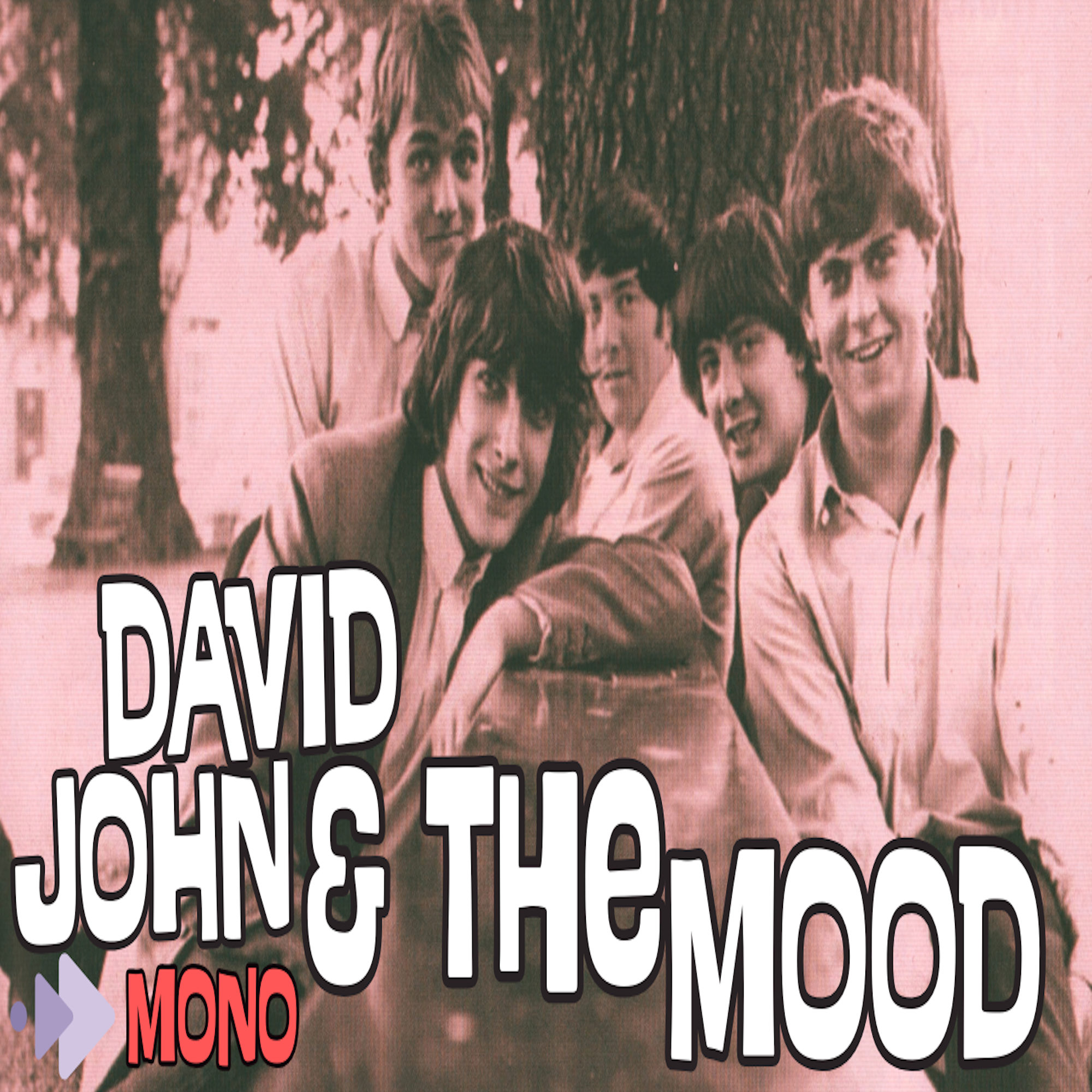
DAVID JOHN AND THE MOOD – “Diggin’ For Gold” / “She’s Fine” (Parlophone R 5301) July 1965
One of Great Britain’s most popular stage groups, David John and the Mood, are almost certain to make the charts, even if in the lower regions, with their latest release, “Diggin’ For Gold”. It’s not a brilliant number and there is too much background noise, but I feel that with a few more plugs they could achieve the lower forties with the song.
It’s catchy enough, and I believe that the boys have built themselves up a large following and these extra fans could just shove the disc into the charts. I hope so anyway because they deserve success. (Pop Weekly, 14/08/65)
DAVID JOHN AND THE MOOD – “Bring it To Jerome” / “I Love To See You Strut” (Parlophone R 5255) March 1965
Despite the fact that their first record was definitely an R & B number, originally recorded by Bo Diddley, David John and the Mood are not, (and they are emphatic about this), an “ordinary run of the mill R & B group.” On stage they play all sorts of numbers – in fact, Just whatever they feel like playing.
They’ve been together for about a year now, although they have known each other for longer than that. They were all playing in groups of one sort or another, but none of them felt really happy until they Joined up together.
They’ve played all over the country since forming, and have built up a large following, especially in the North, where they are very well known although they are not a Northern group.
Individually, they area:-
DAVID JOHN: who sings. He’s nineteen and hails from Bradford, in Yorkshire. David is a fan of Christmas, which he feels is especially noteworthy for the warmth that people display at that season. He confesses to two weaknesses: bad eyesight and a passion for making omelettes.
MALCOLM ISHERWOOD: another nineteen year old, is the drummer. Among his likes he lists cheese, tea, the colour grey, Margaret Rutherford and sweeping carpets which are clean. The reason for this last is, he explains, because it is easier than sweeping a carpet that is dirty! His biggest break is 31 pairs of drumsticks in one year.
JOHN BRIERLEY: the bass guitarist. He’s a Mancunian and proud of it, and was once an employee of the government although he cannot say in which department. He likes horror films and soap powder commercials. His reading matter consists mainly of either science fiction or James Bond. He would be happiest, he says, in a world in which nobody wore clothes since he’s more comfortable when naked.
PETER ILLINGWORTH: guitarist and harmonica player. He comes from Lancashire, and claims that he is a methylated spirits addict, although he occasionally drinks milk! His favourite clothes are pin-stripe pyjamas and suede ties, although he seldom wears the two at once. His hobby is collecting beermats, and wants to be able to say that he has succeeded in everything that he’s attempted.
PETER ATKINSON: guitarist, comes from Runcorn in Cheshire, and was once in the R.A.F. If you ask him who his favourite singer is, he replies that he “likes all singers who sing like I like them to” which makes sense, even if it doesn’t tell you anything. His religion, he says, hasn’t got a name, but he is nonetheless an earnest devotee of it.
The group as a whole got their chance when they wrote to Joe Meek and asked for an audition. Meek, who has produced many hits in his time (Tornados, Honeycombs, Heinz), liked their sound and decided to give them a chance. The boys took full advantage of it! (E.M.I. Press Office)
The story of David John & the Mood
David John & the Mood | Diggin’ For Gold | Parlophone | 1965 | For many years now,”digging for gold” has been a phrase that evocatively conjures up record collector obsessions and, in particular, the search for rare garage R&B from the mid-Sixties. First used in 1994 as the title for a series of (unauthorised) collections of what the compiler described as “demented Sixties R&B punk”, the term was adopted three or four years later by Record Collector magazine as the title for a monthly column that showcased the latest discoveries in the world of rare vinyl.
The catalyst for its belated adoption was, of course, a “demented Sixties R&B punk” rarity emanating from the Joe Meek stable. Lancashire group David John & The Mood had recorded the song with Meek and issued it as one of three brilliant but hopelessly rare singles that, for many admirers, encapsulate the appeal of the rawer, more belligerent end of the British R&B boom.
Sadly those three singles seemed to be the sum total of David John & The Mood’s recorded legacy. However, Cherry Red’s recent acquisition of the legendary Joe Meek “tea-chest tapes” – a treasure trove of Meek masters that contain a huge amount of unreleased, hitherto-undocumented material — has enabled us to expand the group’s story. In addition to their pre-Meek single under the guidance of early Rolling Stones manager Eric Easton, Diggin’ For Gold contains the original master tape versions of their two singles with Joe as well as the hitherto-unheard ‘That Little Old Heartbreaker Me’ and various alternative versions, including works-in-progress backing tracks — which we’ve included primarily to complete the picture of the group’s recordings with Meek, but also as an insight into the maverick producer’s working methods.
the early years
As Joe seems to have sped up tracks and compressed recordings at mixing/cutting stage, we’ve also included dubs of those four single sides, which of course is how the world knows the recordings. As a bonus offering, we’ve added the original acetate recording — presumably made by the songwriters — of ‘Diggin’ For Gold’ that was sent to Meek, and which he then gave to the group to learn the song.
Born in the Lancashire town of Preston on 24th March 1946, David John Smith — known to his friends as Miffy —developed an interest in music at an early age. By the end of the Fifties, he was hanging around with local group The Bobcats, watching them rehearse at St. Gregory’s School in Deepdale and even holding the microphone onstage for the group’s singing drummer, Des O’Reilly. After leaving school and taking a job at an electrical contractors, David even accompanied The Bobcats when they spent a few months in France in 1962.
However, it was elsewhere that year that saw David play a small but important part in changing the face of the pop world forever. Liverpool was reasonably close to Preston, and David — now sixteen years old – began to frequent lunchtime sessions at The Cavern, where local hopefuls The Beatles would often be performing.
In October 1962, after chatting to Paul McCartney, David wrote two letters to BBC producers in London asking for them to consider giving The Beatles some TV exposure (“Believe me, if you took an interest in this very talented group of lads, you would not regret it at “I wasn’t a letter writer by nature”, he told Beatles biographer Mark Lewisohn in 2005. “But I suppose I just wanted to get The Beatles some exposure — even though like many fans, I was afraid of losing them.”
The Beatles were certainly appreciative of his efforts: Paul asked Brian Epstein to find him a job with NEMS, while John nicknamed him ‘Letters’. They were even more appreciative when the Corporation replied to David’s entreaties, inviting The Beatles down to London on 23rd November 1962 to audition for BBC Television.
However, David was intent on being a participant rather than a mere bystander, particularly after seeing Bo Diddley perform on an October 1963 package tour that also featured The Everly Brothers, Little Richard and The Rolling Stones. “He was amazing”, David would later enthuse. “He was using feedback, and had a great electric jungle sound. And I knew then that that was what I wanted to do.”
David John & the Mood | Diggin’ For Gold | Parlophone | 1965

By that point he had already become involved with Preston rock’n’roll band The Thunderbeats. “We met a guy called David John Smith, who was heavily into blues music”, Thunderbeats guitarist John Brierley recalls. “Due to his influence, we started putting blues into our set, usually things by John Lee Hooker, Bo Diddley etc. By now we had included Dave in the band to sing some tunes. When the band folded, Dave and I formed The Questions – I had now switched to bass guitar. We only did four gigs, then Reg (Welch, guitarist) and I joined Freddie Starr &The Midnighters.”
Meanwhile, David also played with the other leading Preston group, The Falcons – as their guitarist and singer, the late Peter Illingworth, once reminisced. “We were approached to play at a regular Friday night hop at the Queens Hall . . . it was put to us by the promoter, Paddy Jones, that if we allowed his compere to sing with us. it would help to raise his profile in the town. We agreed to this, and duly went along to his home to sort out some music to play. This in itself was a revelation, because suddenly we were turned on to Bo Diddley, John Lee Hooker and Jimmy Reed. The compere was David Smith – Miffy. So began an experiment in R&B and a love affair for me with Bo Diddley’s music.”
The Falcons duly morphed into David John & The Mood. One or two of the original members quickly fell by the wayside — Falcons keyboardist Robb Shenton (aka Robb Deka, who had already passed an audition with Joe Meek as a singer), bassist Rick Greenwood — but the new group soon settled down to a permanent line-up of David John Smith (vocals), Peter Illingworth (guitar, harmonica, vocals), Peter Atkinson (rhythm guitar), John Brierley (bass, vocals) and Fred Isherwood (drums).
Atkinson and Brierley (who’d just left Freddie Starr’s group) had both been with The Thunderbeats, Illingworth and Isherwood were with The Falcons, while their frontman had adopted the stage identity David John – the name that McCartney called him. LATCH (“I signed my letters David John Smith, It) my full name. so Paul took to calling me John. When I formed my own group and we sought a name, one of our managers suggested The Mood — then a friend said I should I call myself David John, as Paul had done.”)
Having left Easton, the group signed with local agency New Age Partnership, who were about to organise a world tour that was to be headed by P J. Proby: David John & The Mood were promised a place on the tour, and one of the agency’s partners, a Captain Kevin Beery, took over as their new manager. Although ‘Pretty Thing’ hadn’t sold that well, its release acted as a de facto calling card that enabled the group to play at prestigious London venues like The Marquee, The Crawdaddy, The 100 Club and Eel Pie. Indeed, they even had a south London-based fan club as well as one in Lancashire.
P. J. Proby
The P. J. Proby tour was intended to take in Britain, America, South Africa and Australasia. Unfortunately, however, it failed to leave English shores. The mercurial Proby had agreed a deal that saw him receive a percentage of the takings, but he disputed the declared audience figure on the first night. He failed to show up on the second night (which meant that Julie Grant, backed by The Mood, became the headline act for the evening, leading to many audience members demanding their money back), and then demanded his fee upfront before setting foot onstage on the third night. Given such shenanigans, Beery had little alternative but to cancel the tour.
That was obviously a crushing disappointment, but Beery did introduce the group to leading British R&B enabler Giorgio Gomelsky, at that stage managing a small roster of acts led by The Yardbirds. Renting a house in Thornton Heath, south London, the group played the Ricky Tick circuit and other venues in the area before Gomelsky told them that he was going to cut a record with them. However, another of the entrepreneur’s bands, Gary Farr & The T-Bones, warned them that Giorgio was a control freak who would dictate the material they would be allowed to record. Reluctant to accept that scenario, particularly as it would tie them to the increasingly difficult Beery, they fell into conversation with another Preston band,The Puppets, who had been recording with producer Joe Meek.
The Puppets suggested the group try to interest Meek, and they duly camped outside his door until he agreed to give them an audition – which they passed.
Imperial Ballroom

Meek gave them a date for their first recording session, which unfortunately clashed with a booking that Gomelsky had organised for them at a studio in Soho Square. The boys told Gomelsky that they wouldn’t be able to attend as they had been offered a session with Meek on the same date. That decision infuriated the volatile Gomelsky, who told them that he would finish them in London (which he did — work dried up to such an extent that eventually they had no option but to return home to Lancashire).
Meanwhile, they started recording with Meek at his 304 Holloway Road studio in north London. Early sessions yielded a band original: “I Love To See You Strut”, but the A-side of their first 45 with Meek would again be a Bo Diddley cover. Released by Parlophone it March 1965, the swaggering ‘Bring It To Jerome’ featured Meek’s regular penchant for compression as well as an unorthodox percussive effect, as David explained. “After we’d recorded ‘Jerome’, we felt we needed something different to add to it. I went to the toilet and dismantled the metal chain. When I got back to the studio, Joe’s eyes lit up, and he immediately left the room, returning with an old biscuit tin. We dropped the chain into the tin on the beat, and Joe layered it with echo and mixed it into the recording. It was a crazy thing to do, but it sounded fantastic.”
“Drums are always the best thing to bash when you want a heavy offbeat”, Meek amplified. “I always look round for something to beat, and we use screens, doors and the like. David John & The Mood needed a steely sound on the offbeat.”
At the same time, Meek described David John & The Mood as “the weirdest and most unusual group I’ve ever worked with, and the most talented in this type of music. I was bombarded by them several months back. They were not easily put off by a ‘No Admittance’ notice. They waited several hours for the arrival of a vocalist who came to put her voice on a backing track — as the door was opened, they filed into my office.
‘We want to cut a record here, they can’t get the sound we want at other studios, and we know we can make a hit for you’, said David John. They got their contract, and I feel this is a group which is going to create a tremendous impact with ‘Bring It To Jerome’.”
Despite their new producer’s confidence, the group didn’t make a commercial breakthrough with ‘Bring It To Jerome’, even though Fred Isherwood does recall it as the best-selling of their three singles. By this point the group were struggling to make ends meet due to New Age Partnership’s inability to find them sufficient live work. Eventually they became so desperate to leave that they agreed to pay the company to release them from their contract.
However, after they’d filled in at late notice for The Hollies at Nelson Ballroom, they were signed by the ballroom’s owners, Nelson Imperial Agency. Despite the venue being hugely popular — the group saw The Byrds play there in August 1965 at the beginning of the American group’s first UK tour, with The Who, Bo Diddley and Small Faces following in the next few weeks —the agency never did come up with the money that they’d promised would be made available to promote David John & The Mood when they signed.
Meanwhile, the group continued to trek down to London to record with Joe Meek. Curiously ‘That Little Old Heartbreaker Me’ – a mean, moody and magnificent cover of an October 1964 Bobby Freeman B-side penned by Freeman’s producer Sly Stewart — failed to appear at the time, and belatedly gains its first public airing on our anthology.
David John & the Mood | Diggin’ For Gold | Parlophone | 1965

However, a new single did emerge in early July 1965, with the band augmented for the recording by pianist Peter Cook (aka Peter London), a Meek regular. Once again, the B-side offering,‘She’s Fine’, was a W.C. Charnley original, but the promoted side was ‘Diggin’ For Gold’, an outside song that Meek (who had been sent it as a songwriters’ demo) persuaded them to record even though Pete Illingworth described it as “not one of the band’s favourite tracks”.
“We were not keen on it”, confirms Fred Isherwood. “When it came to recordings, it was a very frustrating time for us. Miffy was a blues singer through and through, and would not do anything that sounded ‘commercial’. As a consequence, none of us particularly liked our records — but for different reasons. However, it must be stressed that we never argued about anything. We all got on well and really enjoyed performing together and the life that we led for three years.”
Despite receiving some minor exposure on Radio Caroline, sadly ‘Diggin’ For Gold’ failed to make a mark, and the track would have to wait another couple of decades before being disinterred by collectors and reissue compilers alike.
Without a hit record and no long-term recording contract – Meek licensed to major ‘ labels on an individual basis – and still paying commission on gigs to the Nelson Imperial Agency (even though Illingworth was finding the bulk of them), David John & The Mood were becoming increasingly disillusioned. Management issues continued to trouble them, and after Peter Illingworth left, the remaining members decided in early 1966 that the only way to free themselves from their contracts was to break up and go their separate ways. (David Wells, March 2023)


Leave a Reply