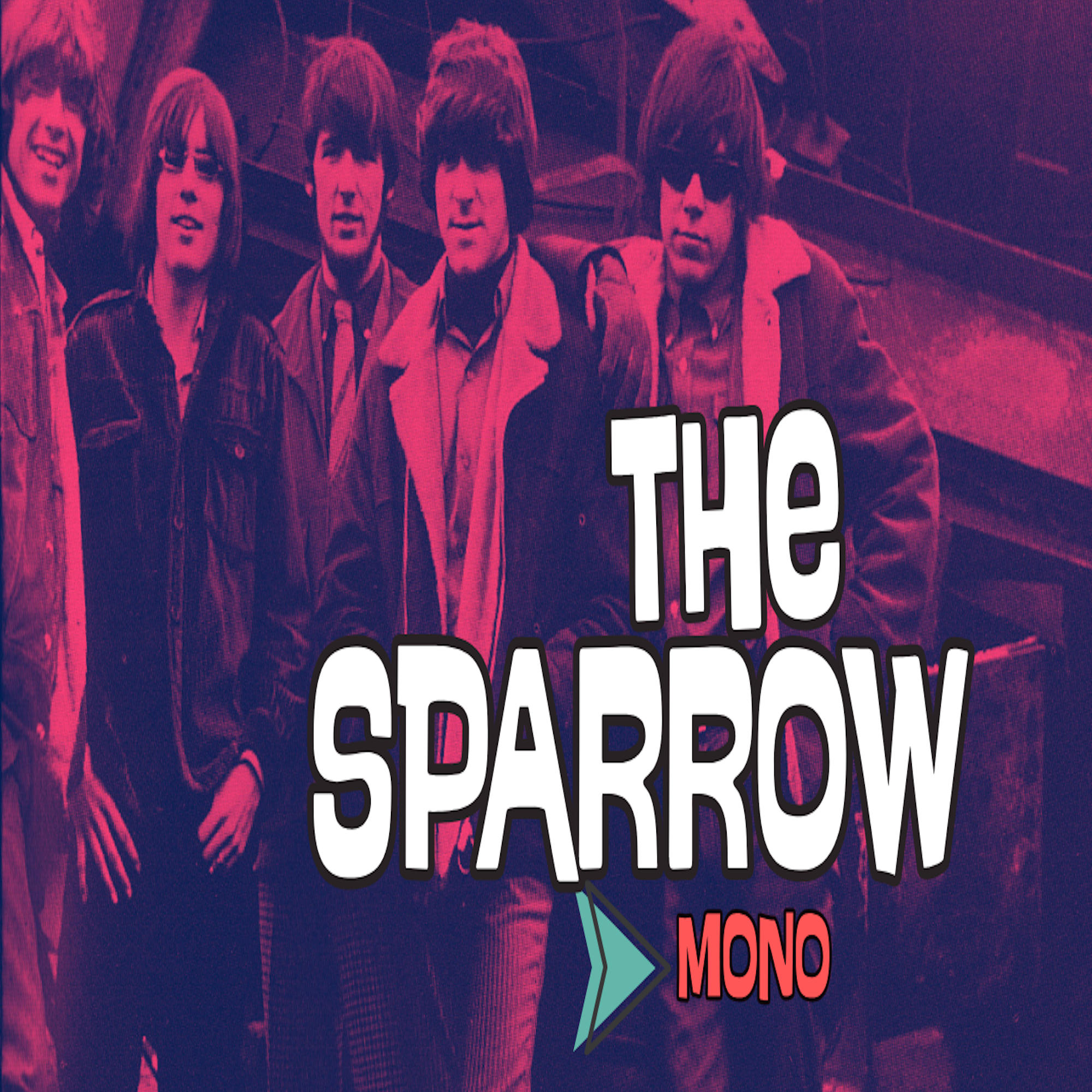
The Sparrow – “Tomorrow’s Ship” / “Isn’t It Strange” (Columbia 4-43755) August 1966
The Pre-Kay Sparrows
The Sparrow were a creation of the McCrohan brothers, Dennis and Jerry. Their dad owned a big ballroom in Oshawa where the two of them grew up seeing every act under the sun. The McCrohans met Jack London (assuredly not his real name), who was interested in starting a band to capitalize on the British Invasion. London had connections in the Toronto music industry, and soon Jack London and the Sparrows were signed to Capitol of Canada. The McCrohans adopted an appropriately British last name, Edmonton, making the Sparrows line-up Dennis Edmonton (guitar) Jerry Edmonton (drums) Nick St. Nicholas (bass) and Art Ayre (organ).
Jack London and the Sparrows’ first single, “If You Don’t Want My Love,” shot to the #1 spot in Canada, and was followed by three more singles and an LP. Dennis Edmonton explains, “After a while, the band started going different directions than Jack London. He wanted to stay pretty much bubblegum pop, and we wanted to go in more of a bluesy direction, so we parted ways.”
No one paid much mind to the next single from the now-quartet Sparrows (“Hard Times With The Law”). “We tried to carry on vocally.” Dennis adds, “although none of us was really a lead singer.
Doin’ Blues
Back at the above-mentioned party, Sparrow Art Ayre invited Kay to sit in with them at their next several gigs. The next invitation offered full membership.
Edmonton: “We were impressed by him and he needed the band so it was natural for the two of us to get together.”
Kay: “I gave it some thought. Doin’ blues with a whole band instead of acoustic packed a whole lot more wallop, and they were nice guys, so I said yeah, that sounds pretty good to me.”
It was 1965. Little did anyone know this would be one of life’s fortuitous peanut butter/chocolate collisions.
John Kay & The Sparrows

Armed with a vocalist and aiming for a bluesier sound, the Sparrows replaced Ayers with keyboardist Goldy McJohn. The mix was 40 percent popular covers, 30 percent originals, and 30 percent obscure blues covers, which the young audience often mistook for originals.
Jerry sang the Jimmy Reed / John Lee Hooker / Manfred Mann stuff; Dennis did a lot of the low-key ballads, and Nick did the generic covers a la “Walkin’ The Dog.” Kay performed his originals, some Sonny Boy Williamson stuff, and an occasional “Eve Of Destruction” kind of cover.
“We were doing weeknight gigs in Toronto’s Yorkville Village and weekending on the road in Ontario and Quebec,” boasts Kay. “We had a band apartment, we had a band charge account at the music store, we had a leased station wagon and trailer, and we were putting money in our pockets every week.”
Not only that. They were making a name for themselves in the heady early days (1965-’66) of legendary Yorkville Village. The Sparrow joined a growing circle of local superstars such as Luke and The Apostles, The Paupers, The Ugly Ducklings, The Rogues, Roy Kenner and the Associates, and the Mynah Birds. But they knew, as did every Canadian act of the times, that the real golden ring lay on the other side of the border.
The U.S. Offensive
The Sparrow put out feelers for a competent, connected manager, and found one in Toronto businessman Stan Freeman. Freeman promptly brought them to New York City for a handful of demos at Allegro Sound Studios. Bruce Botnick engineered. The first three cuts on this collection (“Twisted,” “Goin’ To California” and “Square Headed People”) are from that demo. All are Kay originals.
Returning immediately to Toronto, The Sparrows waited for Freeman to do his stuff. It wasn’t much of a wait. A deal was struck with David Kapralik’s production company (Kapralik also managed Sly and the Family Stone). In turn, Kapralik’s affiliations brought the whole package to Columbia. The Sparrow (now singular in name) returned to New York after the Columbia deal was clinched. They quickly conquered the Big Apple in the summer of ’66, gigging regularly at The Arthur, the Downtown Club, and The Barge out on Long Island. Kapralik scheduled a repertoire demo, a rundown of the band’s best tunes from which to choose recording material.
The session began at the unholy hour of 9 a.m., after an Arthur gig ending just six hours prior. Out of the eleven tunes, recorded live with no overdubs or rehearsal, seven (“Good Morning Little Schoolgirl” “Bright Lights, Big City” “Hoochie Coochie Man,” the premiere performance of “The Pusher” plus “King Pin,” “Goin’ Upstairs,” and “Baby Please Don’t Go“) appear on this compilation.
The Major League and Pop Fouls

In sharp contrast was the Byrds-esque “Tomorrow’s Ship,” a remarkable early career left turn and The Sparrow’s first official Columbia release. This little slice of mid-’60s folk/ psych represented Dennis’ pop leanings, at odds with the band’s image as evidenced in the hard-edged cuts which preceded it. Ditto for “Isn’t It Strange,” a Doors-y psychedelic romp which prefigured the Stones’ “2,000 Light Years From Home” by a good year (inspirational verse: “So strange and round and big and blue”).
Schizophrenia followed that unsuccessful debut. The Sparrow returned to the studio in July to re-record two earlier blues cuts, “Goin’ To California” and “Twisted.” These master sessions show a confidence and electricity lacking in the earlier versions. They also hint at a Steppenwolf sound to come.
“Green Bottle Lover,” a punky little gem, seemed an attempt to reconcile the band’s overall toughness with the Edmontons’ poppiness. As such, it emerged as a wonderfully snotty dead end which pleased no one in particular, least of all the vinyl-buying public.
Los Angeles
John Kay: “The producers were urging the pursuit of the pop stuff, ’cause they thought it was commercially more viable, and so they really aggravated the musical tension within the band by making Dennis feel that that was the way to go.”
Sensing impending doom in New York, The Sparrow left for Los Angeles in late ’66. They started right at the top, playing the Whiskey, the Tropicana, the Galaxy, Ciro’s, and It’s Boss. The first West Coast recording session yielded the unreleased and wonder-fully hip “Tighten Up Your Wig,” in which Kay sings through his harp mike for an extra growl. Their tenure in L.A. would be short lived, ending abruptly with the club closings following the Sunset Strip riots.
Sparrow (no more ‘The’) migrated northward, rented a house in Mill Valley, and joined the San Fransisco scene. That’s where Columbia brought David Rubinson into the picture. Rubinson had a much better grasp of the band’s concept than any previous producer. Says Kay, “He listened and said “You guys are a blues band, a blues-rock band. These guys have been trying to do you as a pop band.”
The Sparrow | Tomorrow’s Ship | Columbia | 1966

Rubinson brought Sparrow to L.A. in February of 1967 to record five more tracks, two of which were “Too Late” and “Can’t Make Love By Yourself”
Kay continues, “David insisted I had the right vocal sound for those kind of tunes, but I wasn’t keen on doing either. They weren’t bad, they just weren’t me.”
Still, more than any tracks on this collection, these final two numbers suggest a part of Sparrow that would soon evolve into Steppenwolf.
“Finally it was a mish-mosh of tunes being recorded at that session. And afterwards, nobody was particularly happy about it—neither the band, nor David, nor Columbia, and they finally gave us our release. That sort of was the final nail that caused the two factions within the band to go their separate ways.” After a brief gig at L.A.’s Galaxy, Sparrow disbanded for good. (CD liners, The Best of John Kay & Sparrow)


Leave a Reply