The story of Fifth Pipe Dream
San Francisco Sound | Matthew Katz | Matthew Katz — pronounced ‘Kates’ — was born alongside his twin brother Bernard to Samuel and Jenny Fine-Katz in Lynn, Massachusetts on December 20th 1929. His father was a pioneer in the shrink-packaging machinery industry, and his mother was a housewife. He grew up an orthodox Jew and attended Boston Technical High School, where he sang Israeli songs with a folk group and became involved in drama and dance. He was talent-spotted dancing in a local hotel and invited to take ballet lessons, which he enjoyed, whilst working in a local shoe factory.
Having got his call-up for the military, he served three years in the Air Force, including a stint in Japan. En route his unit stopped over in San Francisco. The city immediately took hold of his imagination, and he vowed to return one day. Upon completing his military service, he bowed to family pressure not to pursue a career in dance and considered becoming a rabbi before joining the packaging company. Not finding it a sufficient outlet for his creativity, he decided to move to San Francisco.
As well as being involved in amateur theatricals, he grew fascinated by the vanished aviator Amelia Earhart. This brought him into contact with broadcaster Fred Goerner, who was writing a book about her. They carried out research together, travelling back to Japan in 1963 in search of evidence. Matthew offered to act as Goerner’s literary agent, seeking to sell the film rights to the story, but — in an augur of things to come — they fell out and ended up arguing in court.
Jefferson Airplane

The folk boom was at its height and his imposing figure became a familiar sight in local coffee-houses. By all accounts, he looked striking: tall and balding on top, sporting long black hair and a raffish beard, and clad in a Spanish hat and a black cape with red lining, his white Jaguar sedan always nearby. He had a forceful character to match. In a November 1964 interview he cheerfully described himself as an “egomaniac,” stating: “I can’t stay away from show business. Because of my family’s feelings about dancing, I gave it up when I came out of the Air Force and agreed to do something more conventional. But I always come back to show business…”
He decided to move into music management, his first act being a group called the Countrymen. They didn’t get very far, but Matthew’s life changed in the early summer of 1965, when an ambitious young singer named Marty Balin got wind of the fact that Matthew had copies of some unreleased Bob Dylan songs, including ‘Lay Down Your Weary Tune’. He was in the process of forming a new folk-rock group and, having previously met Matthew when singing with the Town Criers, he re-established contact. Matthew offered to manage the new group, which took the name Jefferson Airplane, and with his support they quickly became the pre-eminent exponents of what was evolving into psychedelia.
On August 13th they opened their own club, the Matrix, in which they rehearsed and performed to growing popularity. According to the San Mateo Times on September 27th: ‘Under the careful guidance and excellent business management of Matthew Katz, the young musicians have been making a big noise on the music scene by word-of-mouth alone. They’ve played a few clubs in San Francisco and have auditioned for several big recording companies.’
Ultimately they signed to RCA in November, the deal involving the then-huge advance of $25,000 — a tribute to Matthew’s conviction and powers of persuasion. In December he signed contracts with the group that gave him 20% of each member’s gross earnings for five years, and a publishing deal that gave him 50% of their royalties for the next five years. In turn he continued to strive to raise their profile, finding them gigs and buying them equipment.
They recorded their debut album between December 1965 and March 1966, with Matthew nominally co-producing it alongside the more experienced Tommy Oliver. By the time it was released that August, his relationship with the group had disintegrated. He lacked musical training, which undermined their ability to interact with him about their work, and on July 26th he’d caused a scene backstage at a Rolling Stones show at the Cow Palace over their place on the bill. They were thoroughly embarrassed and sacked him shortly afterwards, envisaging that San Francisco’s leading rock promoter Bill Graham would take over.
Graham duly began to promote the Airplane at his Fillmore Auditorium. He barred the incensed Matthew from coming backstage, leading him to seek legal redress. The Airplane’s mercurial drummer Skip Spence, meanwhile, had left them by early June 1966 to focus on singing and playing guitar. Matthew remained friendly with him and encouraged him to form a group with fellow local singer-guitarists Bob Mosley and Peter Lewis, which he would manage. By that fall they were a quintet named Moby Grape (also featuring Don Stevenson and Jerry Miller), playing a late-night residency at the Ark, a new Sausalito club Matthew was involved with.
At the Ark Matthew also met a charismatic young keyboardist named Lee Michaels, whom he started to represent too. Around this time he conceived of a trademarked enterprise entitled ‘San Francisco Sound’, to encompass recordings, management, live agency and concert promotion, operating from an office and rehearsal space in the basement of a church at 1725 Washington Street. Moby Grape were to be its centrepiece, and in October he signed them to a management contract that gave him the rights to their name and publishing. The group later contended that they’d been strong-armed, but as a new entity they were glad simply to have momentum.
Although Matthew came to be characterised as a cynical opportunist, he sincerely believed in the power of music, and his mission to promote and preserve it. Not a hedonist himself, he was happy to focus on the day-to-day practicalities of his artists’ careers so they could focus on making music (and its attendant distractions). In the short term, the group was satisfied with him. Don Stevenson told Classic Rock in 2024 that they thought he “was cool at first. He had credentials and did a hell of a job in doing the promotion and getting the Ark going.”
As well as working with Moby Grape, Matthew came up with bizarre and creative concepts such as selling miniature records that would serve as the lids of plastic coffee cans, or opening a San Francisco club to be named the Olive Branch, where executives who disliked the volume rock bands played at could sit in a VIP room (to be named ‘the Twig’) and watch through thick glass whilst listening on headphones. Neither came to fruition.
Moby Grape

After another round of offers and negotiations, in February 1967 he signed Moby Grape to Columbia, and on June 6th CBS launched their debut album with a press reception at the Avalon Ballroom, as well as simultaneously issuing its contents across five separate singles. It was an extraordinary publicity stunt but also a major misjudgement, creating the impression that the group was little more than a hype. No one has suggested it was Matthew’s idea, but it fed into their growing misgivings towards his management.
They were spooked by the fact that he had filed a suit against Jefferson Airplane and Bill Graham on June 2nd, and frustrated by his hard-nosed attempts to get them a more prominent spot at the Monterey Pop festival on June 17th. (Don Stevenson later contended that Matthew’s behaviour on that occasion was affected by having unwittingly eaten some potent hash cookies backstage.)
Matthew’s claim against the Airplane sought $2.5m on account of their ‘malicious, wilful, wanton and reckless’ conduct, which he said intended to destroy his ‘name, reputation and success in the entertainment industry’. The Airplane, meanwhile, contended that he lacked the necessary licence to manage an act, hadn’t arranged for them to seek independent advice on their contracts, and hadn’t opened his books for inspection. Graham cautiously responded that “If Katz is somehow proven to be correct, I will do my personal utmost to see to it that he is reimbursed properly.”
Unsurprisingly, the press began to take an interest in Matthew, and he was interviewed in the Berkeley Barb of August 25th. Posing with a dummy Moby Grape songbook, he pondered his standing in the city, remarking: “I wasn’t accepted by hippies — they said I was plastic. I wasn’t accepted by straights because I was a hippie. I kind of got squashed between them, and I was melted into both.” He also expressed frustration about how little co-operation there was in spreading the San Francisco Sound: “So far we’ve done a piss-poor job of getting it out, because no one will get together to work things out. It’s got to be a family. Everybody pretends it is, right?”
The Grape weren’t feeling much familial love towards Matthew by this point. Tired of his tendency to book them dates they didn’t care to play and resentful over not being paid for their appearance in the movie The Sweet Ride, they split from him in September 1967. Matthew had now lost two major clients, but continued scouting for others, such as a new quartet fronted by the arresting violin work of David LaFlamme (who had until recently been with an outfit named the Orkustra). One of Matthew’s quirks was thinking up band names. Driving through San Francisco one fine morning that summer, he thought of `It’s A Beautiful Day’, which he prevailed upon them to use.
Initially they got along very well. “Matthew used to come over to our apartment and sit and talk until one in the morning,” recalled David’s wife Linda to Please Kill Me in 2020. “He was an incredibly interesting man who’d done so many things in his life. I really loved him. David did too. We had wonderful evenings together, speaking evenings.”
Matthew was also managing Californian rockers the Now, whom he renamed Tripsichord Music Box (aka Tripsichord), inspired by recent press ads by Abercrombie & Fitch, and the Seattle group West Coast Natural Gas, who’d been performing around San Francisco for several months. He’d met both through his assistant, whose name is remembered only as `Smitty’. The earliest documented performance by Tripsichord — billed as `Tripsy Cord Music Box’ — had taken place at Legion Hall, Merced on May 12th, alongside Melvin Q Watchpocket and SF pioneers the Charlatans.
Matthew later contended that Janis Joplin had also asked him to handle her career at this time, stating: “She asked me to become her manager, but I had to turn her down because I knew the man she had as a manager [presumably Albert Grossman] and I considered him competent. It would have been an unethical move on my part to have accepted her offer.”
He also recalled declining another opportunity in the fall of 1967: “Jann Wenner came to my office and asked me to be involved with Rolling Stone. He gave me the names of the people involved and I said, ‘I can’t be involved with this.’ I bid him good day and said, ‘Don’t write anything good about me, don’t write anything bad about me.’ And then the first issue came out and they printed a bunch of lies about me.”
In October Matthew spoke to the San Francisco Chronicle and was asked to define ‘the San Francisco Sound,’ a challenge he aptly likened to “trying to describe air. It’s nearly impossible. The Sound is made up of folk music, rock’n’roll, negro blues of the 1940s, jazz, gospel, and country and western music, and it comes out of people’s heads and lives.”
Perhaps he felt a better definition could be heard on the first release on his own label, San Francisco Sound, which had appeared in late September. West Coast Natural Gas’s ‘Go Run And Play’ / ‘A Favor’ was local ballroom rock with a distinctive folky flavour, and received local airplay but limited national exposure.
Tripsichord Music Box

The better to spread his vision, Matthew leased the Encore Ballroom (at 13th and Pike) in Seattle, renaming it ‘San Francisco Sound’. Its opening weekend was November 17th-18th, with shows headlined by West Coast Natural Gas and Tripsichord Music Box. He had all his artists play there, as well as lodge in a large and cold house he’d rented nearby: the newly named It’s A Beautiful Day roomed in its attic, where David LaFlamme and the heavily pregnant Linda came up with their immortal ‘White Bird’.
As 1968 dawned, alongside It’s A Beautiful Day, West Coast Natural Gas and Tripsichord Music Box on Matthew’s roster were the folkier Black Swan and the mysterious Five Pound Smile (possibly a light show). In February 1968 he was quoted in World Countdown stating: “They say the San Francisco sound is over, that nothing is happening here anymore, that it’s dead. But it can’t die because the people are now, and the music is alive and now. We’ve given our groups time — time to grow, time to experiment and learn, time to think and feel things out. Now we think that they’re ready to tell their stories honestly.”
It’s A Beautiful Day


However, because he maintained ownership of the lucrative Moby Grape name, he also took to sending out his musicians to rake in four-figure fees as such. In particular, Tripsichord Music Box (supplemented by others as the occasion required) gigged widely as Moby Grape, and were intermittently called out for not being the real deal (not least because the original group was still very much in existence).
For Matthew, however: “It was the music that was Moby Grape, it wasn’t the individuals.” He even contended that Tripsichord “did a better job than the original guys. They were disciplined, they worked better together, they liked each other, they listened to each other, and they sang better…”
Tripsichord’s leader David Zandonatti wasn’t wild about masquerading as a member of Moby Grape, though. “I wasn’t real excited about doing it,” he says. “It was a compromise of my integrity, but I looked at it as helping Matthew out, plus we were going to earn some money. We made two grand each — two grand in 1968 — holy shit! That was a lot of money!”
Velvet Plastic Productions will present THE SAN FRANCISCO SOUND (after all) and is doing so at the request of Mathew Katz producer of the JEFFERSON AIRPLANE, the original MOBY GRAPE and a number of top rock attractions over the years. It was his feeling that St. Louis audiences should be given the opportunity to hear and judge for themselves the quality of his latest production THE SAN FRANCISCO SOUND.
This show includes the NEW MOBY GRAPE, WEST COAST NATURAL GAS, BLACK SWAN, and the premier performanco of the 5th PIPE DREAM. This will be a dance-concert friday and saturday, June 7th and 8th at the Armory, 3676 Market beginning both nights at 8130 PM and is continuous until 1:00 AM Admission price fer this engagement has been reduced to $2.00 and that’s only 25c more than yen would pay to hear three local bands.
Those holding tickets will receive a $1.00 refund or may hold them for admission to CANNED HEAT dance June 14th and 15th at the Winterland Skating Rink, 11443 St. Charles Reek Rd. in Bridgeton- 3 blocks waist of Lindbergh. Times are the same as above. Public Service Blues Band will appear with CANNED HEAT. COSMOS (Press release, St. Louis, June 1968)
It’s A Beautiful Day, however, were firmly opposed to the practice. They had not enjoyed their sojourn in Seattle, and resolved to break with Matthew. Upon returning to San Francisco in early 1968 they set about finding new management and gigs, and signed to CBS in June. Although they hadn’t signed any paperwork with Matthew, he owned their name, and further complex litigation ensued.
Matthew was now mired in legal action with three groups, and had also lost Lee Michaels, but he sincerely believed himself to be the wronged party in each case. He was aggrieved at the notion that the artists had all been only too happy to avail themselves of his support (financial and otherwise) when starting out, only to abandon him when success beckoned. He regarded their claims that he had taken advantage of them as spurious, and didn’t see how he could be blamed for their failure to engage properly with papers they signed.
San Francisco Sound | Matthew Katz

PROMOTION: The beginning of the 1968 year sees a whole new surge of action on the San Francisco scene. Matthew Katz Productions, which made it big with the Jefferson Airplane and proved it with Moby Grape, has seven groups ready to break onto the national scene.
“They say the San Francisco sound is over-that nothing is happening here anymore-that it’s dead. But it can’t die because the people are now and the music is alive and now,” says Matthew Katz. “We’ve given our groups time-time to grow, time to experiment and learn, time to think and feel things out. Now we think that they’re ready to tell their stories honestly of what has come out of the last three years-the better parts of the be-ins and love-ins, the search for equality, peace and the good life by the young people of the times.”
Each group is unique: It’s A Beautiful Day has a strong classical background, fine musicianship, and the electric violin and poignant songs of David LaFlamme; West Coast Natural Gas has played music that has some out of the West Coast happenings with a little Buck Owens sound now and then; Tripsichord Music Box is a young, fun group. They play only music written by the group. Black Swan has a horn quality. Indian Puddin’ and Pipe has a blues sound—but more. But each of the groups come out of the sound that WAS San Francisco and makes the music that IS San Francisco Sound. (World Countdown, February 1968)
There was a fundamental disconnect between his business-like approach to rock management and some of his artists’ naïve and dilatory attitude towards their responsibilities. “I was a fucking living saint for those people,” he expostulated in 1978. “I was the protector in the story. They forget how naive and scared they were. It was my money they did everything with. They slept, ate, drank and smoked with it.”
Matthew took to ferrying his groups between Seattle and California in a Greyhound bus he’d converted into living quarters. “We just trucked down in a Greyhound bus that we’d bought in Seattle, the Hippy Dippy Funky Dunky Bus — aka Bus for short,” as he later put it. They also played dates he promoted in places such as St. Louis, Salt Lake City, Denver and Phoenix, often with ‘the fake Grape’ headlining, and the bills bulked up by mutable aggregations drawn from his pool of musicians under names including Indian Puddin’ & Pipe (inspired by a San Francisco menu offering ‘piping hot Indian pudding’), Games, Melvin Q Watchpocket and Fifth Pipe Dream.
He commissioned numerous posters, handbills and cards to market these events, mostly designed by Donna Wallace, which aided his concept of SFS being one big musical collective, a travelling troupe performing under various names and making records separately and severally. In particular, Indian Puddin’ & Pipe have long been considered an enigma, perhaps because — by Matthew’s account —there never was such a band. Instead, they, Fifth Pipe Dream and other purported acts were made up of a shifting cast of players under contract to him.
“They were a collection of all the musicians,” he explained. “They were a family effort of about ten or twelve musicians. When we went out and performed, one of the guys would double as the drummer in the other band. It was a family participation between Indian Puddin’ & Pipe and the guys in Tripsichord and a few other soloists we had with us. Indian Puddin’ & Pipe music captured you and held you and never let you go, because there was no such thing as a song. There was six and-a-half hours of music that would be played without repeating. It was classically structured rock’n’roll with a lot of changes and storylines to it. They were good musicians.”
Over the course of 1968 Matthew booked studio time at the independent Coast Recorders at 960 Bush Street, San Francisco, where producer Marcus Uzilevsky (formerly known as Rusty Evans) made recordings with various of his acts. By the fall Matthew had a good many tapes, though — in keeping with his vision — not all were by readily identifiable ensembles. He decided to showcase cuts by West Coast Natural Gas, It’s A Beautiful Day, Tripsichord Music Box and Black Swan on a various artists album, under the name Fifth Pipe Dream — Volume One.
West Coast Natural Gas

While he was readying the LP, West Coast Natural Gas split up. He therefore decided to credit their recordings to Indian Puddin’ & Pipe — a version of which, confusingly, West Coast Natural Gas’s Pat Craig went on to lead. As Craig has put it: “The Gas was a five-piece folk-rock band. The Pipe was a ten-piece fusion-jazz orchestra. Huge difference.” In addition, Matthew miscredited ‘Aquarian Dream’ to It’s A Beautiful Day, when in fact it was performed by Uzilevsky (who’d written it) and Matthew’s girlfriend June Richards, backed by members of West Coast Natural Gas and Tripsichord Music Box. (On this release West Coast Natural Gas have been correctly credited, while ‘Aquarian Dream’ has been more appropriately credited to Indian Puddin’ & Pipe.)
On October 28th 1968 Billboard announced the forthcoming LP, and reported that ‘producer Matthew Katz seeks an authentic ‘free’ sound, so he plans recording pop groups at sea… He’s also working on a symphonic rock’n’roll orchestra called the Fifth Pipe Dream’. However, neither of these concepts appear to have blossomed.
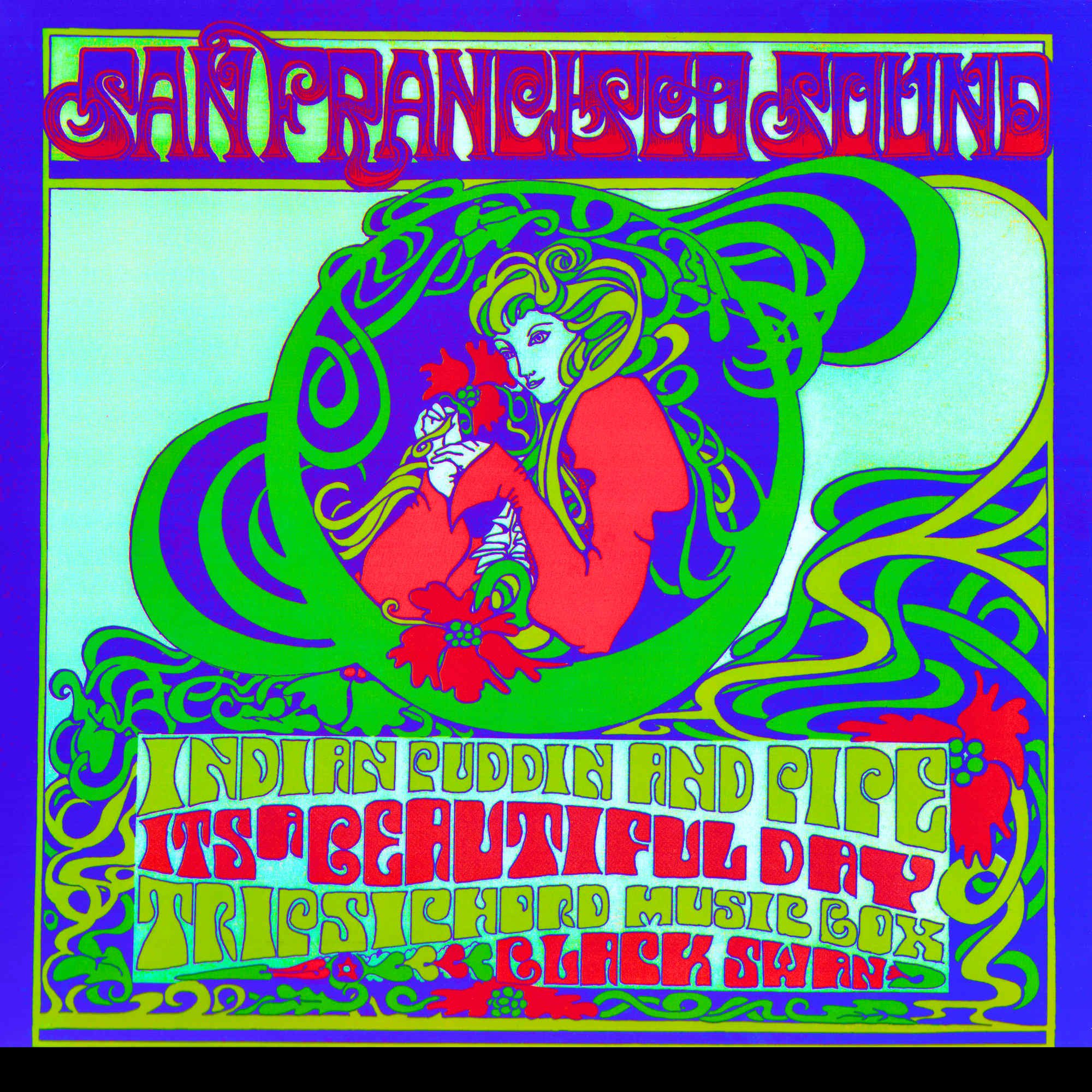
Fifth Pipe Dream — Volume One was released on November 15th via World Pacific Records, under Matthew’s own ‘San Francisco Sound’ imprint. The front and back covers showed a striking art deco-style drawing of a female by Donna Wallace, while the gatefold contained a complex collage showing his acts alongside ephemera, other photographs and even Amelia Earhart. (In its original form much of the design is too small to make out, hence being reproduced as large poster here.) Matthew later recalled that three hundred promo copies were sent out in black-and-white sleeves, while the larger commercial pressing was housed in colourised sleeves. At the same time, he boldly issued both tracks credited to It’s A Beautiful Day on a single. Unfortunately, neither release had the impact he desired; in fact, not a single review of either has surfaced. Matthew later contended that David LaFlamme and CBS had done what they could to scuttle the enterprise, including dissuading radio stations from touching the discs.
The sleeve stated that ‘All the songs are available on single records and reproduced on song posters and in the San Francisco Sound Music Book,’ but that was surely a fabrication. (Only two of the tracks were on a single, and the song sheets and songbook appear not to exist.) The notes continued: ‘If you like hearing four groups on one album, write us, as the musicians would dig to continue this idea…’
San Francisco Sound | Matthew Katz

Alas, take-up was minimal and no follow-up appeared, though for this release we have gathered numerous other tracks pertaining to the San Francisco Sound concept in order to create another volume.
As well as devoting much of his time to legal tussles with his earlier clients, Matthew continued to cultivate his SFS roster. West Coast Natural Gas had splintered in the summer of 1968, but he remained committed to Tripsichord Music Box (and they to him), and in early 1969 he started managing a group with the bizarre name of Phananganang (almost certainly coined by him). Their guitarist Mark Quinn later characterised him as ‘A kind of charming guru type of guy’.
As 1969 dawned, Matthew’s dream of establishing a commercially viable business under the ‘San Francisco Sound’ heading remained elusive, but he had no intention of abandoning it. As of January he was the leaseholder of the city’s Straight Theater, just off Haight Street. ‘Opening at 8:30 Friday night, the 17th, the theater will have a dance concert going until 1:30 am, (admission $2), with a three-hour jam session set to follow that,’ reported the Berkeley Barb. ‘In the spotlight will be the San Francisco Sound Revue, including Indian Puddin’ and Pipe and Tripsichord Music Box. The orange and green San Francisco Sound tickets that have mysteriously appeared in the SF area marked ‘Fifth Pipe Dream’ will be honored for half-price for the dance concerts.’
According to the same article, ‘Katz hopes to eventually have it going every day and night, with a constant happening going on. Katz, the builder of many rock groups, notably Moby Grape and Jefferson Airplane, reminded me of an old riverboat-era New Orleans type, with his curling mustache, flat broad-brimmed hat and dark frock coat. He is really a turned-on guy, and has faith in the Straight, the San Francisco Sound Revue, and reviving good vibes in the Haight. In turn, the bands, the people working with them, and the Straight itself reflects his faith, so this weekend, and those to follow there, should be pretty heavy.’
The Los Angeles Free Press, meanwhile, added that `Matthew Katz, who has mostly broken into the news when hassling with his musicians, is planning to turn the old Straight into a membership club for musicians, equivalent to the Press Club for journalists, open to them and their guests 24 hours a day.’
“That’s where we got a name,” recalls Tripsichord’s David Zandonatti. “The place was always jammed. It was happening. One night when we were playing, someone said Hendrix was in the crowd…” With a regular venue to play and rehearse in, Tripsichord —boosted by the aid of guitarist Bill Carr, also a fine songwriter — were able to prepare material for an album, which was recorded in a dope smoke fug in San Francisco in the summer of 1969. “There was a studio on Howard Street owned by Francis Ford Coppola,” according to Zandonatti. “He was good friends with Matthew, and we recorded there. There was a studio downstairs and an apartment upstairs. We would smoke dope and sleep up there, and Coppola would come in every once in a while for a toke.”
San Francisco Sound | Matthew Katz

The result showcases a leaner and less overtly psychedelic sound to the group’s Fifth Pipe Dream recordings of the previous year, its lyrics reflecting some of the members’ conversion to Mormonism. The absence of organist Oliver McKinney is immediately obvious, though part-compensated for by fine piano and organ parts from Pat Craig of West Coast Natural Gas.
Matthew had recorded the album speculatively, and seems not to have had any immediate plans for it. Instead, Tripsichord spent the remainder of 1969 gigging around the West Coast, typically with Indian Puddin’ & Pipe. “That was the band we played with the most,” confirms Zandonatti. In the fall Tripsichord returned to the studio for the last time, to record two further songs, ‘Times And Seasons‘ and ‘Sunday The Third’.
No one had shown interest in releasing Tripsichord’s recordings, but Zandonatti recalls a major opportunity coming their way as the year drew to a close: being invited to participate in a Rolling Stones gig, to be held at Altamont Speedway in Northern California on Saturday, December 6th. Alas, however, they didn’t make it there. “While we were driving, we started hearing about the riots,” recalls Zandonatti. “And then they blocked it off and wouldn’t let anyone in, because the Hells Angels had killed someone. It was really bad — that was the end of the peace and love and good vibes… We left San Francisco and that was it. Tripsichord ended when we left in 1969.”
By then San Francisco’s musical gold rush had tapered off, not to mention much of the city’s former hippie idealism. “Marijuana, hashish and organic mescaline never caused any problems,” commented Matthew in 2013. “As long as everyone was on the same trip at the same time, there was no problem. The booze and the cocaine was the downer. That’s what ruined the San Francisco music scene…”
Although the group had gone, Matthew pressed ‘Times and Seasons’/’Sunday the Third’ on his San Francisco Sound label, which was now being distributed by Janus. The single was released in March 1970, but had limited circulation. He continued to promote shows by Phananganang and Indian Puddin’ & Pipe, and around September he pressed singles by Phananganang (‘Clown Song’ / Two A Little One’) and Tripsichord (Fly Baby’/’We Have Passed Away’, mistitled ‘She Has Passed Away’ on the labels).
He also cut a few copies of a demo LP by Tripsichord, featuring recordings they’d made well over a year earlier. These came in plain white sleeves with a large band bumper sticker on the front and a smaller one on the back, in different colours. The intention appears to have been to interest a larger label in picking it up; either way, Janus (with whom Matthew already had a relationship) obliged. In August the music press announced that the album would be appearing in October, but that month came and went, and it finally crept out in June 1971.
By then Matthew had relocated to his hometown of Lynn, Massachussetts. A local newspaper article declared that he was ‘now a missionary in quest of a musical holy grail for America. The producer of a long list of rock bands, most notably the Jefferson Airplane, Katz has embarked on an altruistic mission to advance the cause of contemporary classical music… His dream is the establishment of a national musical colony, a place where musicians can meet and live and play music.’
The article went on to reveal that Matthew had `already taken a step in this direction with the production of an album, Games, which features several rock bands with the combined name ‘Fifth Pipe Dream’.’ Matthew was quoted as explaining: “We just combined these bands and had them play arrangements of contemporary classical tunes. The kids loved it and the music is great.” Alas, no copy of these mysterious recordings is known to survive.
In January 1971 Matthew had attempted to launch a club named ‘San Francisco Sounds East’ in the unlikely location of Tottenville, Staten Island, NY. “I’m not interested in how many tickets I can sell,” he explained, “but in having an audience expressly interested in music, not people there to hit on chicks or get stoned in a corner and sell some speed.”
Such an audience proved elusive, and the venture quickly foundered. Thereafter, Matthew later explained, “We loaded [the bus] up with equipment and musicians and played for free. We called it the `Looking For Your Long-Lost Mind Revue’, and people would always follow us. We would bring a generator and people would come from all over the place. There would be three or four thousand people there. We just went down the road doing as many free things as we could.”
He eventually settled in Malibu, intermittently promoting live shows and re-releasing material by Jefferson Airplane, Moby Grape and It’s A Beautiful Day over the ensuing decades, as well as maintaining lengthy litigation with them all. The labyrinthine proceedings tended to end with decisions in their favour, and he suffered a terrible setback in November 2018 when he lost his home and most of his possessions to a fire.
Matthew Katz died of old age on September 30th 2023, having been active in both politics and litigation to the end. His legacy is complex. He possessed an undoubted talent for identifying and encouraging rock groups, but an almost equal one for falling out with them. He generated some remarkable recordings, not least those on this album, but never quite realised his grandiose visions.
Asked to summarise his own career and reputation in 2013, he stated: “I’m very proud of the contribution I’ve made to music — the spirit and the feeling… I’m not looking for praise or bouquets or pats on the back, but I don’t deserve the bad PR. It hurts me in my private life wherever I go. I have great love and affection for all the people I’ve worked with, but people find out on the internet that I stole money from groups — and there’s no truth in it. If I had I’d be in jail!”
Despite his notoriety, some of his artists remain staunchly loyal. “He gave me personally more than I could ever repay him — in fellowship, in goods and services and in love,” says David Zandonatti.
“He’s eccentric, let’s put it that way, and the people who were divisive could turn it against him, but he’s like a brother to me. He’s the quintessential Jewish sage.”
(Richard Morton Jack, May 2026)


Leave a Reply