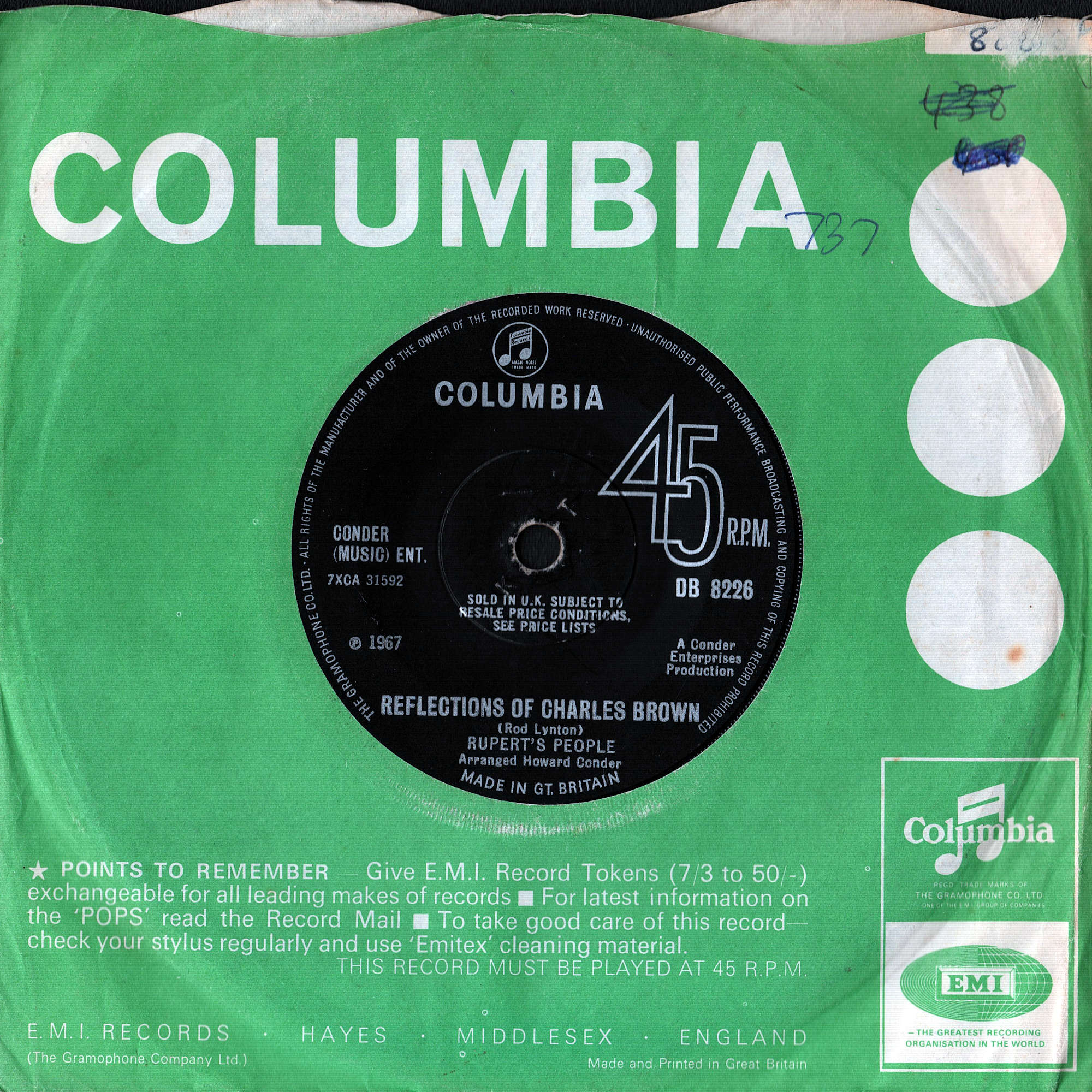
Rupert’s People – ’Reflections Of Charles Brown’ / ’Hold On’ (Columbia DB 8226) July 1968
Rupert’s People | Reflections Of Charles Brown | Columbia| 1968 | “Reflections Of Charles Brown” by Rupert’s People is a four-minute-plus track with a reflective lyric and Procol-type organ , and is a disc you really ought to hear because it’s good . . . (NME, 08/07/68)
I do not know whether “Reflections Of Charles Brown” by RUPERT’S PEOPLE was recorded before or after Procol Harum came on the scene. I will not ask. All I will say is that it bears a striking resemblance to “Whiter Shade Of Pale,” but it didn’t stop me liking it, even though it felt perhaps I shouldn’t because it IS a good production and there’s some really nice guitar sounds at the end. (Penny Valentine, Disc, 08/07/68)


The story of Rupert’s People
Released in July 1967, “Reflections Of Charles Brown” was a single credited to a band that didn’t exist, and was itself a rearrangement of a flipside issued only weeks before by a group who would eventually adapt the moniker of that non-existent outfit. Confused? This situation was only the start of the mystery and conjecture that has surrounded a group who, for decades, have been the subject of speculation among beat and psychedelic enthusiasts —Rupert’s People.
The tale began sometime in early 1965 when future Rupert’s People stalwarts Rod Lynton (guitar, vocals) and Steve Brendell (drums) were members of a north London band called the Extroverts, a five-piece beat combo inspired and influenced by local heroes, the Kinks, with whom they became friendly. In fact, Dave Davies sat in with the Extroverts on a fun home recording taped on a couple of reel-to-reel tape recorders, although this initial foray into the pop world presumably hasn’t survived the passage of time.
One-time members of the Extroverts included future session man Phil Palmer (nephew of the Kinks’ Ray and Dave Davies), who later played on some of Eric Clapton’s albums, and also Phil Harris, who later formed Ace (featuring former Action guitarist Alan “Barn” King).
By the end of 1965 the Extroverts had split and Rod and Steve’s next venture was a short-lived group called Hard Edge, whose bassist was an employee at the Tiles club in the West End, where Hard Edge rehearsed and played a few gigs in early 1966. After the demise of this group, Rod Lynton continued with his day job as a trainee commercial artist, which required him to trudge around London delivering artwork to various establishments (a familiar scenario to Quadrophenia buffs, perhaps?).
On one particular trip to a studio he encountered ”a very nice guy, about my age, who looked like a musician”. Within weeks Ray Beverley was playing bass with Rod and Steve in their most serious musical venture yet — the wonder fully-named Sweet Feeling.
While Rod and Ray continued to pursue their careers in commercial art, drummer Steve landed an enviable job at Brian Epstein’ NEMS Enterprises, enabling Sweet Feelin to penetrate the highest echelons of pop. The trio soon felt confident enough to approach the Robert Stigwood Agency with a view to possible management deal. Rod and Ray arranged an appointment with one of Stigwood’s understudies, a man called Howard Conder. At the meeting, the duo played several self-penned songs that suitably impressed Conder into offering Sweet Feeling a management deal with himself rather than Stigwood upon which he handed in his resignation and immediately became their manager.
Flattered and astounded by this measure of faith in them, the trio soon found themselves at Regent Sound Studios recording a one-take demo album which was cut onto an acetate. Unfortunately this acetate is no longer n Rod’s possession and may be lost completely, although a single-sided acetate of a rough run-through of “All So Long Ago” does exist, which probably originates from that Regent Sound session.
Rupert’s People | Reflections Of Charles Brown | Columbia | 1968
Condor then secured a deal with Columbia in early 1967, and in May of that year Sweet Feeling’s only single appeared, coupling “All So Long Ago” with `Charles Brown”. “All So Long Ago” is an absolute gem of a song, very reminiscent of Paul McCartney’s work on “Revolver” and in particular the anecdotal observations of “Penny Lane”. A couple of interesting facts about the single are that both sides are credited to ‘Brosse” (Rod’s real surname) and that demo copies have mislabelled sides. Incidentally, the band bears no relation to a European Sweet Feeling who were active on he Continent in the late 60s.
Sweet Feeling continued to gig, now placing more emphasis on volume than they had done previously, inspired by the leading power trios of the time such as the Jimi Hendrix Experience and Cream. By then, Howard Condor had come to regard Rod as his principal songwriter, and asked him to work with the budding songwriter Chris Andrews (aka Tim Andrews) of the Fleur de Lys, which saw the creation of a new song, “Hold On”.
Rod also introduced his re-arranged and retitled “Reflections Of Charles Brown” . . . The writers also worked with organist Peter Solley (ironically, later of Procol Harum) recording the two songs with Rod present, but not contributing to the finished masters. As he’d done previously with “All So Long Ago”, Conder presented this new work to Columbia and secured a deal for Fleur de Lys. However, the band decided against signing with Condor and pulled out, leaving him with an investent but no band. He did have a new group name dreamed up by his wife Annette, however — Rupert’s People.
Although the split only temporarily delayed he release of “Charles Brown” it was a serious obstacle, as the similar “A Whiter Shade Of Pale” was racing up the charts and selling by the lorryload. “Charles Brown” still garnered airplay, however, and sold reasonably well, though its late issue prompted obvious Procol Harum comparisons in the music press. Rod insists that he had never heard “Pale” while composing “Reflections”, and it must be remembered that the source, Bach’s “Air On A G String”, was an often heard tune at the time, through adverts and other sources.
As Columbia now had a Rupert’s People record in the shops, Condor obviously needed an actual group to capitalise on any success. With the Fleurs out of the picture, the logical and ideal candidates were Sweet Feeling. Furthermore, Rod had been closely involved with the record, his vocal manner and style was similar to Chris Andrews’, and Sweet Feeling were a solid band who only required a keyboardist. However, despite repeated requests, the band would have none of it, leaving Condor with the task of assembling a band himself, or facing the loss of his investment.
Condor hastily put together a new band, quoted in a Record Mirror article from August 1967 as ex-Merseybeat Johnny Banks, John Tout, Adrian Curtis and Paul Curtis (aka the Gurvitz Brothers) and Tony Dangerfield, a veteran of the beat scene with a 1964 Pye single under his belt. Paul Curtis was quoted as the replacement for “Reflections” vocalist Chris Andrews, and Adrian Curtis spoke of a follow-up, a Rod Lynton tune entitled “Weird And Wonderful” — of which Rod has no memory.
This line-up only lasted a matter of weeks, and some less-than-successful gigs resulted in the band being fired by Condor, though it’s possible that during that short lifespan they may have recorded the mysterious “Love Opus 193” which appeared on German pressings of “Reflections”. Co-written by Condor and an associate, Gerry Gill, it’s fair to say that it’s the least inspiring track issued under the Rupert’s People name.
Rupert’s People | Reflections Of Charles Brown | Columbia | 1968

With “Reflections” still displaying encouraging signs, Condor once again pestered Sweet Feeling. With one perfectly-timed phone call, immediately following a particularly good gig with the band in high spirits, Sweet Feeling finally agreed to become Rupert’s People. John Tout was drafted in as keyboard player and Condor found a second guitarist in Dai Jenkins, who had recently parted company with the pre-Badfinger outfit, the Iveys. Money to finance the new Rupert’s People came from the afore-mentioned Gerry Gill, and paid for equipment, stage clothes and transport.
The band then set to work rehearsing a repertoire markedly different to that of Sweet Feeling’s. Although the period of reshaping Sweet Feeling into the five-piece Rupert’s People was brief, it was nevertheless too late to capitalise on the interest that “Reflections” had generated. It had by that time lost its impetus in the UK (though the single had been released in the USA and Europe, and had sold fairly well on some parts of the continent).
Howard Condor pushed Rod to pursue more esoteric subjects in his songwriting and the idea arose for the Lewis Carroll-inspired “A Prologue To A Magic World” whose Alice In Wonderland theme typified that avenue of British psychedelic which saw groups draw upon children’s fiction for inspiration. Though regarded by some as being too twee, “Prologue” (co-written with Howard Condor’s wife Annette) is a beautiful slice of quaint pop psychedelia, and like “Reflections” contains light pop on the topside and an uptempo rocker on the flip. Incidentally, some copies of “Dream In My Mind” credit the song as “Dream On My Mind”, although the former is in fact the correct title.
fter Dai Jenkins quit the band to get married, Rupert’s People undertook a tour of France, before going into the studio to record what was to be their last 45, “I Can Show You I’ve Got the Love”. The song ploughed a similar furrow to their previous A-sides, and was a warm piece of wistful flowery pop, with Rod’s light-as-air lead vocal placed over a tight rhythm section and John Tout’s flowing organ patterns, with the whole production richly phased.
A rarely-glimpsed promotional film for the track exists and is a fascinating document of the period, showing the group in their finest psychedelic regalia, playfully frolicking around Carnaby Street and Hampstead Heath, interrupted intermittently by the obligatory shots of a Swinging 60s dolly bird. “I Can Show You” earned nationwide exposure in the press, thanks to a Rupert’s People visit to Buckingham Palace to present a young Prince Andrew with a copy of the 45, a fan-club badge and a Rupert book! Sadly for the band, this publicity didn’t really help sales and it’s now their rarest 45.
Lebanon trip
The band then embarked on a stint in the unusual setting of the Lebanon — as had Episode Six before them — although Steve Brendell had to return home early and was replaced by a drummer, Abi, who stood in for him. Their spell in the Middle East was eventful, to say the least, and problems with the promoter provoked a disgruntled Rupert’s People to sever relations with Conder. On their return to England, the band decided to appoint a lightshow engineer whom they had met in Lebanon as their new manager, a man by the name of Miles Copeland (elder brother of Police drummer Stewart). While waiting for him to arrive in the UK, Howard Conder reclaimed the group’s van and equipment!
Sometime in late 1968 or early 1969, the band recorded a track called “With Love”, which is similar to both “Born To Be Wild” and “I’m A Man”, and which was produced in “mock stereo” by none other than the Beatles’ roadie, Mal Evans. The rather muddy, distant feel to the song proved that Mal was no producer, although four young hopefuls without a hit were hardly in a position to question one of the Beatles’ entourage! Nevertheless, it is a great track and it survives on a scratchy acetate.
With Copeland now handling the group, they continued gigging, though Ray became increasingly disillusioned with the band’s musical policy ana decided to leave in 1969. A replacement was found in Dave Casey, though he was soon to be substituted by Terry Pooh best known for his work with Bakerloo Blue Line.

Leave a Reply