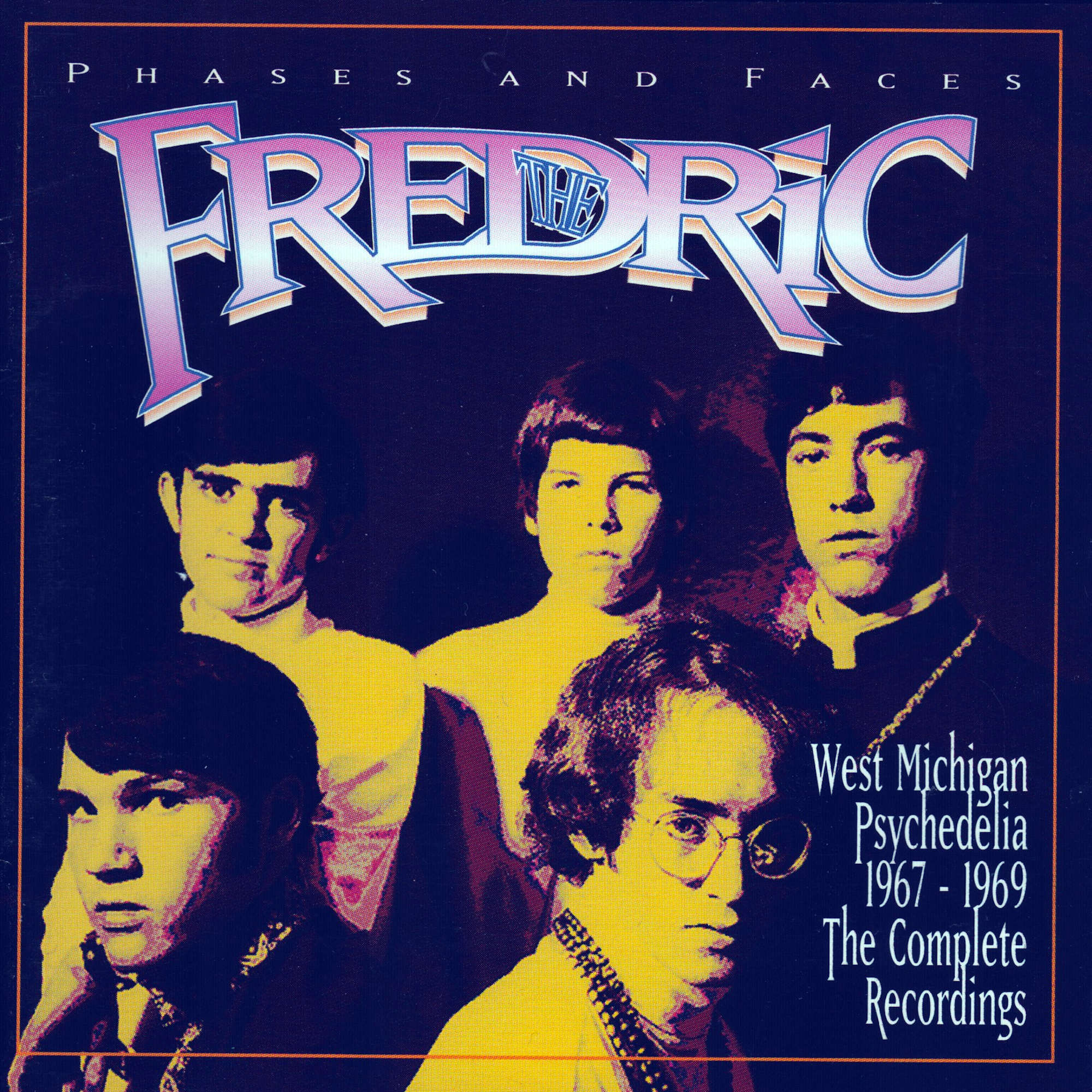
West Michigan Psychedelia 1967-1969
The Fredric | Phases And Faces | Phases and Faces, the only album by Grand Rapids Michigan quintet, The Fredric, was released in 1968 on Forte Records. Long considered a masterpiece by fans throughout the world, this once-in-a-lifetime merging of diverse elements is one of the most magical and extraordinary musical offerings in all of sixties music.
Any longtime fan will tell you, there is nothing like The Fredric in the history of recorded music. Nothing!
Lead vocalist Joe McCargar and Guitarist Bob Geis were high school mates in the mid-sixties, playing in a band. One of their first shows was a booking on historic Mackinac Island, playing the Grand Hotel in the summer of 1966. Several days before the show the band lost their guitarist and drummer, but quickly found guitar-vocalist Steve Thrall as a replacement through the musicians grapevine. This move proved to be the genesis of what was to become the legendary Fredric sound.
change of name
This revamped trio, minus a drummer, managed to play the show successfully and decided to enhance the group with additional musicians. Drummer-vocalist David Idema was the son of a family friend of McCargar’s parents. Ron Bera was added on keyboards, making use of his excellent skills. Extensive rehearsals were held throughout 1967. A unique and inviting sound began to take shape.
At this point, the band approached a booking agent. Greatly impressed with the diversity of the original material, he encouraged them to develop and record. Soon afterwards he secured the band a position backing Harper and Rowe, a British vocal duo on a promotional tour. However, the duo’s label did not want a locally recognized band backing their act. In need of a new moniker, the group changed their name from Yesterday’s Children to The Fredric, on the way to their first show in Fredric, Michigan.
The Fredric | Phases And Faces

Mackinac Island, located in the northern part of the state, became the paradisiac setting for early songwriting efforts, including “The Girl I Love,” “Morning Sunshine” and “All About Judy” In the summer of 1967 Steve’s parents, in a vote of encouragement, let the band occupy their summer cottage on Lake Michigan as a retreat to perfect their sound. “Red Pier,” and “Cousin Mary Knows” were written there. Constant playing and exchanging of ideas had tightened and fine tuned a most unique sound. The Fredric was on their way.
In the late 60’s Grand Rapids was a growing city. Despite expanding suburbs and major malls, Grand Rapids was still localized enough that The Fredric received a great deal of attention in an already active and size-able music scene. The first choice of local promoters to open for headlining acts, The Fredric shared concert bills with The Boxtops, Tommy James and the Shondells, The Yellow Balloon and other artists of the time.
The Fredric played extensively throughout the Midwest and enjoyed an extensive fan base in West Michigan. In 1967 they formed their own label, Forte Records. In reality this was nothing more than means of copywriting their original material for presentations to major labels. For concentration purposes various practice facilities were rented over the life of The Fredric, including an unused priests’ rectory at a Catholic church and an isolated farm house, some twenty miles outside Grand Rapids.
The Fredric | Phases And Faces

Phases and Faces was recorded intermittently over a four month period. Perhaps the most striking aspect of the music is the coupling of great songwriting and sophisticated arrangements, all belying the young ages of the members. With no two songs sounding alike, The Fredric fashioned a work that more than holds its own with any major work of the 60s. Blessed with three strong and distinctive lead singers, a richly woven harmonic sound was born. The arrangements were well-planned, carefully discussed and critically rehearsed. Harmony parts were matched to each individuals vocal quality and range, resulting in a vibrant and sincere delivery. The songs are concise, impeccably arranged and never fall into the trap of cliched blues riffing or extended solos that hindered many of the era’s releases.
“The most exciting part of the music was being able to listen to each other’s ideas and unite them into our sound,” said Steve Thrall. “There was never any internal bickering. We were too young to let our egos get in the way of our composing, and I imagine that the sincerity of the material account for the longevity the music. The true nature of our work was honesty and introspection. Writing :came about so naturally that we never considered it a chore. Our commitment to the music came from the need to write, rather than the need to be accepted.”
The Fredric | Phases And Faces

The entire album emits a warmth and deep humanity that is no accident. “We were a brotherhood. The music, as well as the social aspects of the group, became so united that few friendships were formed outside our circle.”
The group’s unusual closeness was manifest not only in their music, but in strange everyday encounters. On one occasion the band was returning from a late night engagement in northern Michigan and in the silence of the drive, both Steve and Joe broke out singing a verse from Procol Harem’s ‘A Whiter Shade of Pale,” in the same key at exactly the same spot in the song. Uncanny!
“Federal Reserve Bank Blues,” “Henry Adams,” and “My Yellow Tree” all stemmed from the pen of Steve Thrall and capture his introspective views of life in the late 60s. Just as Steve was the socially sharp witted soul of The Fredric, Dave Idema was the group’s penetrating intellect. He influenced the band in directions that added far deeper meaning to the songwriting process. Bob Geis’ direct unobtrusive guitar work gave the group its foundation. His songwriting reveals a young man who believed strongly in the virtues of lasting love. Lead singer Joe McCargar was the heart of The Fredric.
Phases and faces


With his good looks and charm he captivated audiences with his gorgeous, honeyed tenor. Joe sings lead on a number of Fredric tracks. His vocal contributions cannot be underestimated. Ron Bera was a formally trained musician of natural affinity early in his teenage years. Classically trained, his sense of excellence, along with a stern perfectionism, pushed other members to do their best. Ron would accept no less. Everyone would strive to seek his solemn approval.
Phases and Faces had a limited printing. No one is sure how many copies were pressed or sold. The reason for this being the band’s own naivete and blind trust in management. The trust was soon to vanish.
Says Thrall, “One day I went over to our manager’s house to pick up my gui-tar and found him in the basement laun-dering and pressing the band’s stage clothes, putting them away in a local dry cleaner’s bags.” The band paid for this service and believed their clothes were being professionally laundered. Soon afterwards, the manager abruptly moved to San Francisco, taking the ledgers and funds from the album with him.
The Fredric | Phases And Faces


Surprisingly, the band held no long term deep grudges.
Thrall continues, We knew deep down in our hearts we would have never gotten as far without him. Years later he returned to Grand Rapids and we rekindled our friendships. He was an older gentleman and I saw no need to punish him for past mistakes. As sixteen year old kids, he taught us a great deal about the world. I came to look at him as the proverbial uncle who had done some bad things, but remained a relative you treasured.”
Around this time the band was picked up by Stereo Dimension Records and released the superlative rocker, “5:00 Traffic,” backed by “Red Pier” in January 1969. The unreleased tracks included here: “Postmarks,” “Bob’s Songs,” and “Lori Lee Loveland” were written shortly thereafter as the band had begun compiling material for a second album. These tracks will delight fans and contain all the elements that made the Phases and Faces album so successful.
In June of 1970, The Fredric signed with Capitol Records and was promptly rechristened The Rock Garden by label ex-ecutives. Their single, “The Winds of South Chicago,” was released that fall. Reminiscent of the work Glen Campell did with Jimmy Webb in the mid-60’s, Thrall considers this the apex of his writ-ing collaborations with Idema.
the Garden
Says Joe McCargar: “The Winds of South Chicago is one of our finest efforts. In fact, it’s one of the best songs I’ve ever heard.” Capitol released this single under the moniker “The Rock Garden” to avoid bootleg copies of Fredric material should the song prove to be a hit. Sadly, this began the decline of the band. Capitol saw the group as a pop hit unit, which caused great frustration among the members who wanted nothing to do with this com-mercialization of their music.
With the release of “Johnny’s Music Machine,” the band, now billed simply as the “The Garden” was nearing a breakup over creative issues. Explains Thrall, “It seems unbelievable as I look back, bowing out of a contract with Capitol Records. We were scheduled for several releases when the decision was made to dissolve the band. A decision had to be made between my conscience and the money. Capitol employed extra musicians and songwriters and they were spoon-feeding us. I wanted no part of it and as I look back, it was one of the most difficult decisions I have ever had to make.” (Ben Maxwell, August 1996)

Leave a Reply