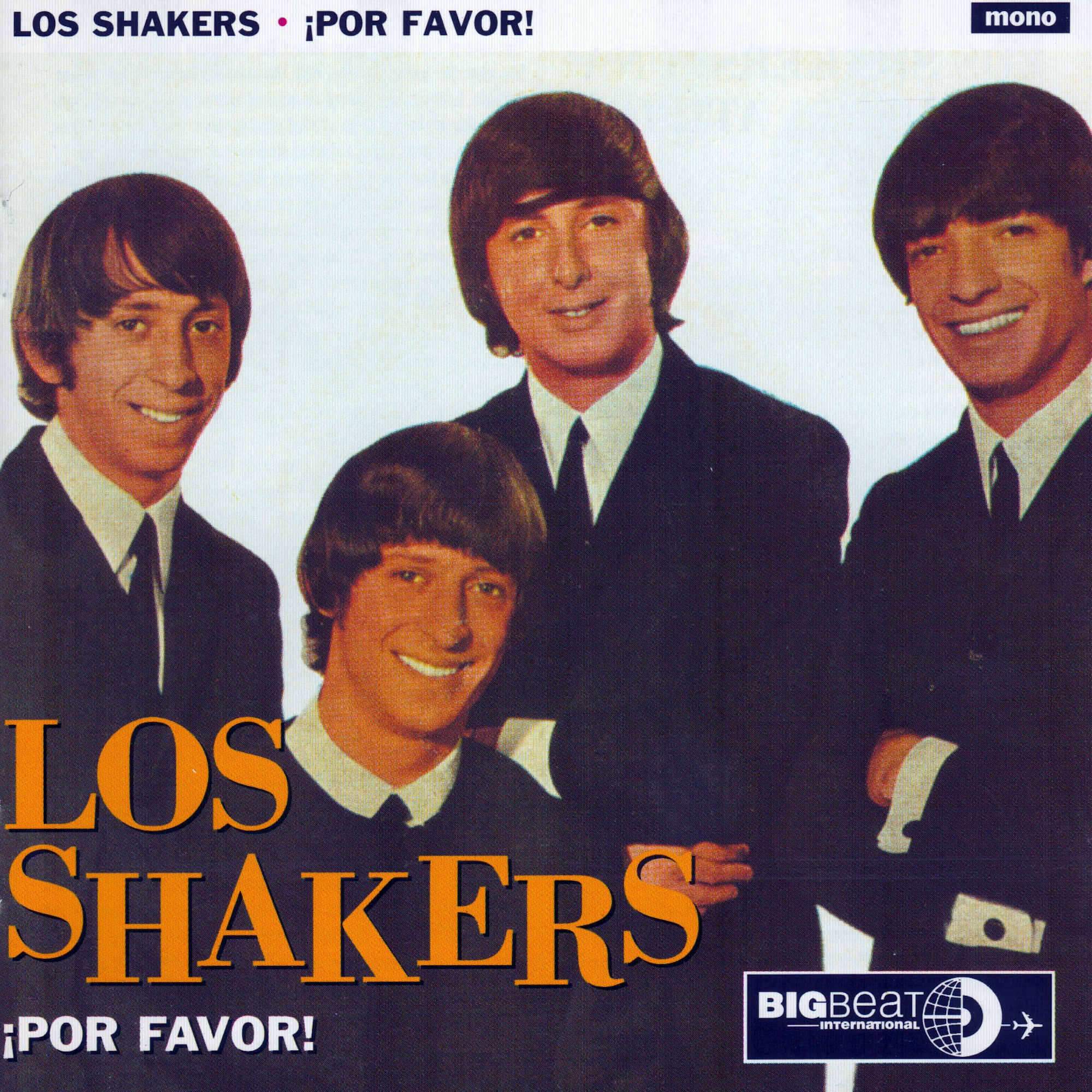
LOS SHAKERS: UNA ORQUESTA ATIPICA by Alejandro Palao
Los Shakers | Por Favor! | (Big Beat) 2000 | In recent years, the breadth and remarkable quality of South American 1960s rock has become common knowledge amongst foreign devotees of the wilfully obscure tributaries of pop. Previously derided as the domain of inferior covers and weak imitators, Latin groups such as Brazil’s Mutantes and Peru’s Traffic Sound are nowadays feted as significant artists on a par with the rest of the world.
Despite the continent’s size, the visibility of South American rock has only really emerged since the 1980s. The third world status and oppressive political climate of some South American countries may be part of the reason, but such factors would – and did – encourage youngsters to pick up a guitar in order to escape their environment. As the amazingly prolific mid-1960s South American scene comes into focus, in terms of achievement, four young musicians from Montevideo, Uruguay, tower over the continent: Los Shakers.
Even though they appropriated the mantle of the Latin Beatles, it was perhaps less Los Shakers’ huge success and more their inventive example, that gave South American rock a confidence of its own. To write and sing in English took some guts, but Los Shakers made it look easy. A little later in their career, as artists and musicians in other South American countries began to openly draw inspiration from their cultural roots, Los Shakers proved themselves further pioneers by incorporating elements of their own Uruguayan ethno-musical background into their style.
In the years since their demise a growing appreciation has spread abroad for the Shakers’ sound, which with hindsight, could be cited as pure an expression of the innocence of the era as has ever been encountered. Though they also were known at the time in South America for their singles-only covers, this chronologically sequenced collection focuses on Los Shakers own superlative material, and the recordings that were the original hits in their native land.
The core of Los Shakers was always the Fattoruso brothers: Hugo, and five years his junior, Osvaldo. With the encouragement of their father Antonio, both siblings started on musical instruments at an early age, as Osvaldo explains:
Los Shakers | Por Favor! | (Big Beat) 2000
“Hugo started playing piano, and later accordion, at the age of four, whilst I started on drums at eight years old. At fifteen Hugo began doing professional jobs, and I joined him at twelve or thirteen. Show bands. We used to do all kinds of jobs, from recording jingles to night-club work, where you played the top of the charts or dance music.”
Schooled in the urban musics of Uruguay such as tango, merga and candombe, Hugo moved to upright bass to join The Hot Blowers, a swing outfit that toured throughout Latin America in the late 1950s, giving the youngster an early taste of the music business.
Osvaldo: “We enjoyed rock but we dedicated more time to playing jazz. Bill Haley, Presley or Little Richard, they were famous but their music was too foreign for us in this country.”
A venue the Fatturoso brothers frequently worked during the early 1960s was the popular Hot Club in Montevideo, where they encountered two similarly precocious musicians, Roberto “Pelin” Capobianco and Carlos “Cain” Vila. Cain had received awards for his jazz drumming, whilst from age of twelve Pelin played bandoneon (accordion) in an ‘orquesta tipica’, before moving to double bass.
Osvaldo: “They had these nicknames way before the Shakers, and I don’t know how they got them. We met them through music, through working together at jobs here in Montevideo. Pelin was also a member of the Banda Sinfonica Municipal de Montevideo.”
Hugo later organised a trio with Pelin at the Hot Club, and all four youngsters gained considerable experience playing jazz, pop and traditional styles such as the tango. However like so many other young musicians across the world in 1964, they could not help but notice the immense popularity of a certain Liverpool quartet. After seeing A Hard Day’s Night, the friends walked out of the cinema ready to form a band in the Beatles image, and Los Shakers were born.
Los Shakers | Por Favor! | (Big Beat) 2000
Osvaldo, only sixteen years old at the time, switched to rhythm guitar as Caio filled the drum seat. Hugo played lead guitar and keyboards while Pelin took up the electric bass, and all four sang. The band began playing in the bars and clubs of Montevideo (including the city’s very own Cavern, La Cueva) and the nearby coastal resort of Punta del Este. They quickly gained a reputation for their uncanny knack at replicating the Beatles, down to the de rigueur long hair and collarless jackets.
Osvaldo: “Just about the only thing we listened to was the Beatles. We knew very little about groups like say, the Animals or the Dave Clark Five, but we wouldn’t have paid attention because we didn’t even like them anyway. The only other group that we followed for a couple of albums was the Byrds (an influence most evident later on Caio’s The Child And Me’). We probably didn’t even know who the Who were. We didn’t have that kind of rock influence. But we followed the Beatles very much and were very influenced by them. We were Beatle fanatics.”
Reportedly recordings were made at this early stage, which may include the crude cover of ‘My Bonnie’ that was later issued as a single.
Osvaldo: “I was learning to play guitar – the lead was mostly Hugo, though I had some too. We started writing music for the band almost from the beginning. Most of the music belongs to Hugo, most of the words are mine. I made up stuff.”
The group caught the attention of the A&R department of EMI’s overseas division Odeon in Buenos Aires, across the River Plate in Argentina. Duly signed to Odeon, Los Shakers‘ first single, the infectious ‘Break It All’, was an instant success in early 1965. Argentina and Uruguay quickly took to the quartet and in imitation of global reaction to the Beatles, scenes of Shakermania occurred wherever the band went.
Osvaldo: “Fans chasing us – yeah, that kind of thing used to happen, it was different. Most of the time we enjoyed it. We were very young. We always dressed in suits, travelled in limousines, which took some work from us but it was enjoyable.”
Los Shakers | Por Favor! | (Big Beat) 2000

A cover of Del Shannon‘s ‘Keep Searching’ was issued at the same time, as the group relocated to Buenos Aires.
Osvaldo: “Argentina was our base. All our recordings were done in Buenos Aires. At the beginning we had a personal manager named Pedro Zimet. But our producer for Odeon, Yanos Kolmos, was almost our personal manager. He used to go everywhere with us and took care of our business, even though he was an executive with EMI. But he never had anything to do with the music. He was tone deaf. Once or twice he might have written some words and asked Hugo to put the music to it. He just wanted to have credit.”
Los Shakers’ eponymous first album appeared in the middle of the year, comprising the A-sides of the two singles and a dozen new recordings, mostly composed by the Fattoruso brothers, and sub-titled in the typical style of the day as ‘shake’ or ‘slow shake’.
Osvaldo: “We didn’t quite know what the ‘Shake’ was, it was just a gimmick, we didn’t pay attention to what was shake or not. It was to push the name only, to kind of promote the product.”
Nevertheless, “Los Shakers” remains one of the strongest albums of the beat era from anywhere in the world. There is probably no better encapsulation of the trans-global appeal of the Beatles than in Los Shakers’ interpretation. The combo distil the rush of Beatlemania in a natural and wholly convincing way. As capable musicians in their own right, the band were able to dissect the harmonic elements of Lennon and McCartney’s “Beatles For Sale”/”Help”-era writing, adding their own jazzy pop sensibilities and a healthy dollop of the infectious joie de vivre that made the Beatles so attractive.
Los Shakers | Por Favor! | (Big Beat) 2000
Highlights on “Los Shakers” abound, from the chanting ‘What A Love’ and the plaintive ‘Forgive Me’, to the Caio-penned ‘Thinking’ and the remarkably assured ‘The Longest Night’. Despite a reverberating non-production, the band made the best of their surroundings with some unusual touches, such as the koto-like guitar that introduces ‘Don’t Ask Me Love’. The accents and odd metre (and subject matter!) of the lyrics prove to be less distracting than charming, and as a whole there is an unselfconscious air to the record that makes it a lot of fun.
The album was a predictable success and was released in several countries throughout the continent.
Osvaldo: “As well as Uruguay and Argentina, we played in Paraguay, Bolivia, Peru, Brazil and Venezuela, though not Chile or Colombia. We worked a lot live for quite some years with plenty of success all the time, shows from 2,000 to 10,000 people. Big for around here. We’d perform 99% of our own material; we might have done one Beatles song in the whole set but nothing more. These were thirty minute shows, and sometimes we used to do up to seven a day. We could move around, because we had very small kind of equipment and used mostly amps specially made for us in Argentina, made for publicity. We did no tours with foreign artists, though we happened to share a couple of stages with (visiting French stars) Johnny Hallyday and Sylvie Vartan.”
Word of these “Beatles del Rio de la Plata” filtered through the United States, and in early 1966 Audio Fidelity, a New York-based label with a fetish for stereo, issued “Break It All”, long-player that featured re-records of much of the first album, as well as songs such as ‘Do Not Disturb’ and ‘Won’t You Please’ that had been released as singles. Though not a big seller at the time, the numerous reissues of “Break It All” make it the record most foreign Shakers fans are familiar with.
Osvaldo: “If I recall properly, Audio Fidelity asked us for new versions: they had to be stereo, or something had to change there. There’s something weird about those recordings, because Hugo was kind of hoarse or couldn’t sing, and I ended up singing a lot of the songs he used to sing. It was very weird to see that album. We only ever played in South America. There were talks about going to the States but personally I didn’t believe that we would ever make it up there. Even though I might not have liked their music or what they did, I had a lot of respect for foreign rock’n’roll groups. I knew somehow that they were better for the American public. We didn’t even know how to speak English -though we could sing ‘fake’!”
From the same Buenos Aires sessions for Audio Fidelity came further singles such as ‘Let Me Go’ and ‘Hallelujah’ that were marked by a growing musical progression.
Los Shakers | Por Favor! | (Big Beat) 2000
Osvaldo: “The album that sold the most was the first one, though EMI was never clear to us on sales numbers. I think we had more of a campaign on the first one, and were more of a novelty. Then we started getting a bit more sophisticated, and so you lose a little bit of the public from the first big wave.”
Therefore, Los Shakers’ constant presence on the Latin American charts was guaranteed less by their strong originals and more by the record company’s insistence upon Beatle covers like ‘Michelle’ and ‘Yellow Submarine’.
Osvaldo: “It was very simple – the record company used to get the new Beatles songs before anybody, so we got to put the record on the street before the Beatles, even though it was EMI also. That way they ensured a big sell by the Shakers, and then they released the Beatles’ version, and they sell again a big amount of records of the same tune. We enjoyed doing it, but later on we realised what they were doing. And they were very successful, mostly in Argentina.”
As rock in Latin America became more confident, Los Shakers proved tremendously influential, and their popularity even inspired clones like Los Seasons of Buenos Ake& Also from Montevideo, Los Mockers played Stones to the Shakers’ Beatles, but were never quite as popular.
Osvaldo: “We were the biggest stars in South America. We had fan clubs, very much imitating what was going on in the States and Europe. We were very popular in Argentina, and we were very popular in Brazil at one point because `Never Never’ was very high on the charts. In Paraguay we had a moment of sales, some kind of campaign, Venezuela also. But the craziness was in Argentina and Uruguay.”
The single ‘Never Never’ marked a turning point for the band as it had an overt bossa nova/samba feel, and was very much in their own style.
Osvaldo: “The thing is, from a young age we were playing bossa nova and jazz, so harmony-wise and instrumentally we had an advantage over a regular rock group, the kid in the neighbourhood who picks up a guitar and tries to imitate somebody. We were playing bossa nova which is kinda hard, complicated. That’s a little bit of where the sound comes from, we fake it very well, we sound solid sometimes! (laughter) It starts to show on “Shakers For You”, and on the third album, there’s more craziness, more Uruguayan stuff.”
Los Shakers | I Hope You” Like It | 1967

Released in late 1966, “Shakers For You” is definitely the crown jewel of the Los Shakers discography. It is a record brimming with confidence and a willingness to explore new directions. Though outwardly the group were still wearing the suits and there are the usual Beatlesque flourishes in the arrangements, the production is cleaner and more dynamic, and the group’s songwriting has acquired a knowing sophistication.
Additionally the harmonies and the bands performance as an ensemble are outstanding. Lyrically there are some intriguing moments as on ‘Picking Up Troubles’ and ‘Got Any Money?’ (the latter with its joyous refrain “yes I got job!”). ‘Too Late’, ‘Smile Again’ and ‘Let Me Tell You’ are all classic Shakers, but by far the most unusual track is ‘I Hope You’ll Like It’, which with its wriggly backwards guitar and dissonant intervals, is unlike anything else emanating from South America at that time.
Osvaldo: “I have no idea why we called it ‘I Hope You’ll Like It’, but [that song] is a beauty. Just some crazy stuff. At the time we were listening to a lot of Coltrane and stuff; our heads were not regular, y’know?”
Despite such uncommercial moves, Odeon made sure Los Shakers’ profile stayed high with endless personal appearances and television exposure. “Escala Musical was the Sunday night TV programme in Argentina that we were on weekly, as the main attraction, for a year or so. Eventually they made a film about the same people. It was terrible but we were there!”
The band are seen performing two new songs, ‘Always You’ and ‘Oh My Friend’, in colour, and several clips of their appearances on the television show exist, but most interesting of all is the apparently unfinished Shakers movie from late 1966, directed by Rodolfo Lest. The soundtrack features most of “Shakers For You” as well as snippets of John Coltrane and a bizarre instrumental version of ‘Break It All’.
Los Shakers | Por Favor! | (Big Beat) 2000
Wacky visual romps around Buenos Aires are combined with exciting concert footage and scenes of Shakermania, and at one point the band appear to be actually mocking their heroes the Beatles. A surreal cross between Help and Charlie Is My Darling, the film is a must-see.
Towards the end of 1967 Los Shakers were continuing to absorb more influences from the outside and further expanding upon the indigenous Latin rhythm and melody styles in their music in latter-day singles like ‘Adorable Lola’.
Osvaldo: “‘Lola’ was shooting for the ‘Never Never’ follow-up, some kind of Brazilian influence there. We liked to play samba a lot. We listened to a lot of classical and a lot of Piazzolla at the time. On the last record we had Pelin playing bandoneon, which was what Piazzolla used to play.” The nuevo tango of Astor Piazzolla, which flaunted tradition by encompassing jazz and modern classical influences, was to have a great effect on the final Shakers album, “La Conferencia Secreta Del Toto’s Bar” (The Secret Conference of Toto’s Bar), released in 1968.
“La Conferencia” was inspired by a real life conference, when the American chiefs of state met in Punta del Este in April 1967 to formulate economic assistance programmes for Latin America.
Osvaldo: “It was a big summit meeting with Johnson, Fidel Castro, and Che Guevara. A big thing with all the security and all the bullshit when those things happen. Toto’s Bar was a place in Punta del Este where we used to gather after playing, before we were the Shakers. For some reason we found it kind of ridiculous that all these presidents were getting together in Punta del Este, and we were getting together to have a drink and talk about bullshit at Toto’s Bar. It was kind of mocking it therefore. I guess “La Conferencia” is a concept album. We were a little bit older, more mature thinking in some other directions, and that was one – a whole thing, not just songs. We enjoyed recording that album very much. Something was taking shape there.”
Los Shakers | Por Favor! | (Big Beat) 2000
Much has been made of the obvious debt “La Conferencia” owes to “Sergeant Pepper” (sonically the record is actually closer to “Magical Mystery Tour”, albeit performed by the “Rubber Sour-era Fabs). But just a cursory listen reveals a synthesis of ideas that are very much the bands own; whether they be the folkloric Afro-Uruguayan rhythms of ‘Candombe’ or the well-arranged orchestral accompaniment that features on several cuts. There are some great chunky psych-pop gems like ‘On A Tuesday I Watch Channel 36’ (featuring more outstanding bass work from Pelin) and the anthemic ‘The Shape Of A Rainbow’. The bright ‘BBB Band’ – “the title is just for the sound, it sounds good, like someone stuttering” – is a high point, as is ‘Higher Than A Tower’, a mournful pop symphony made only more so by Pelin’s use of the cello and bandoneon.
“La Conferencia” was a major achievement but it was also recorded with the knowledge that the record would be the band’s last.
Osvaldo: “We were kind of tired and didn’t like what was going on. We were growing up. We wanted to change our style more to the Toto’s Bar situation and we knew that wasn’t going to be accepted, because it’s not popular music, or easy stuff like the first album. So you might lose some public through that, but we were mostly fed up with the record company and the people who managed us. We had gone on our own after the second album and had an agency just to sell us, not manage us. So we got fed up with the whole thing and decided to stop. We didn’t think of the Shakers as a way for the future. We would get together for a drink, sing a little bit, get a lot of money, but not as a job, not as a career.”


Leave a Reply