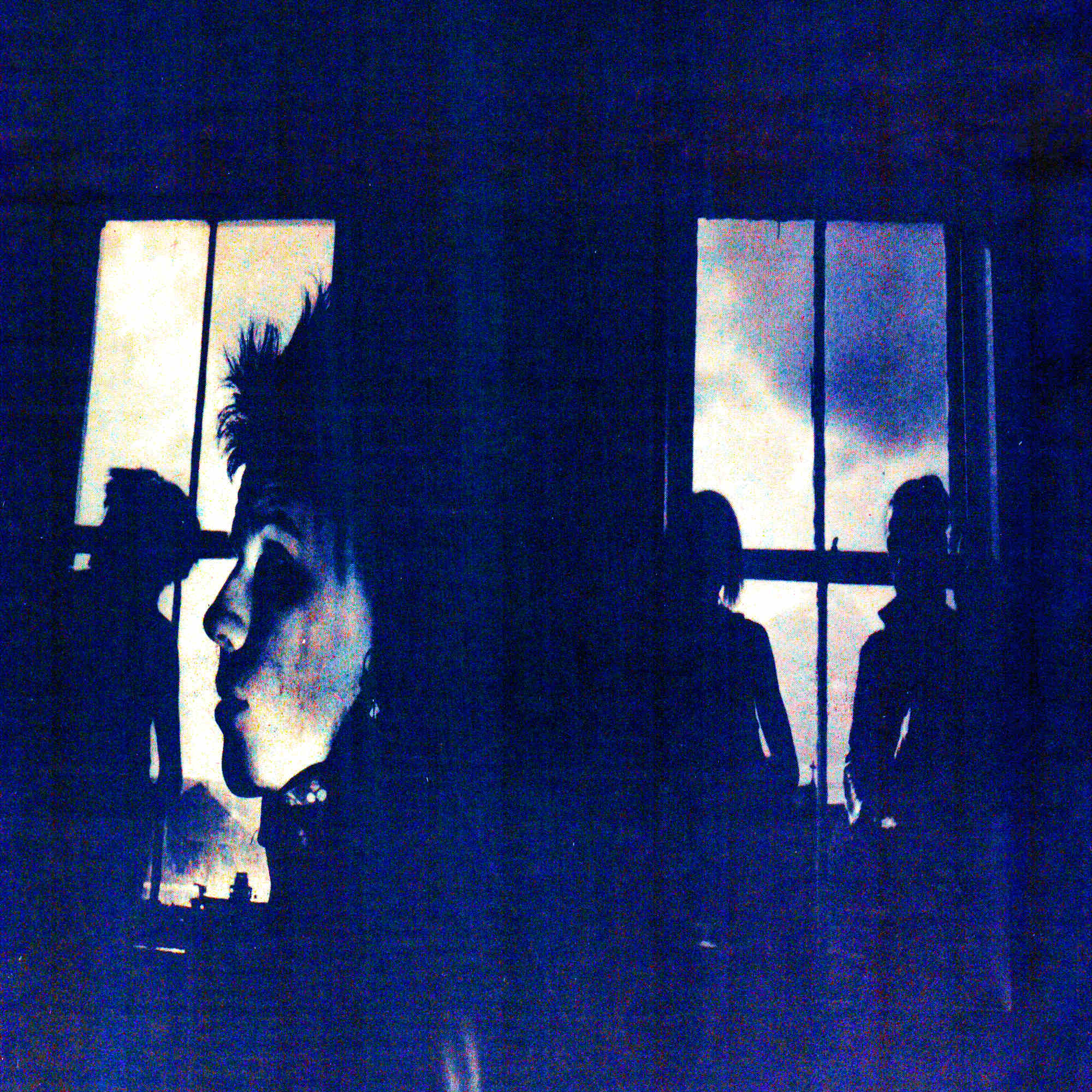
Post-Punk comes the last tribe, Southern Death Cult, a Bradford group who attack the centralisation of media and political power in London.
Article published in NME, 2nd October 1982
Southern Death Cult | On The Peace Warpath | IAN SAYS: “I was in the army for a while, and then I came out, and I was a punk, and I thought, right, fucking anarchy, this is it for the rest of my life. This has got to last forever.
“And then when it died down, I just sat there, and I thought . . . what the fuck was all that about?”
TRACEY THINKS: “What to say what to do I don’t know why I’m on this earth and I don’t know why I’ll leave it.” She wants to live.
Tracey Bigger is 17, and wondering what it’s all about. She lives in Stockport, Cheshire, and as with the rest of her family, she’s on the dole. She wants to work with animals, or something. Soon she might move to Rochdale with her best friend Carol, but she’s not really sure.
Hesitant, helpless, her hair is bright white, and she likes her clothes to be black. Her favourite group is Bauhaus, maybe because there’s a black-ish magic, maybe because of Murphy’s body. There’s no group that really lifts her into the wild beyond; or drops her innocent blue soul into an ecstatic trance.
Her illusions are great and simple. The only thing that’s vivid about her is her vagueness. She gets uncomfortable walking down the street, alarmed at the awful, obvious oddness of her arms and legs, feeling that all the passers-by in the mud around her are sniggering at her awkwardness. Some would simply call her ‘shy’, but it’s a lot more profound than that. She’s completely lost; at a loss.
One thing that really makes sense to her is going to The Hacienda with Carol; even with only a few pounds she still finds ways to get there two or three times a week. Inside the Hacienda building she senses that somewhere distant there might be a purpose, something to find.
At The Hacienda last Friday she met a great boy called Buzz; looked like he’d emerged from the shadows of a Bauhaus song, crimpled fringe-over-eye, clipped eyebrows, powdered face, piercing eyes, gorgeous, and he’s even in a group. A group that are going to be supporting Bauhaus on a few of their dates, and even playing with the Banshees.
She thinks of Buzz, and she thinks that maybe any group with him in must be fantastic. She writes down for him her phone number, on the inside of a cigarette packet in pink lipstick: and adds two kisses. He promises to call her. The next day Tracey’s smiling all the time, and telling Carol that she’s in love. Tracey remembers the name of Buzz’s group.
Southern Death Cult. She even loves the name. SOUTHERN DEATH CULT.
IAN: “It’s a catchy name! It’s not that it’s just weird or anything. It’s not really talking about London . . . perhaps the impression you get from the word ‘London’. The control that comes from such a place. All the main branches of government are in London, all the main branches of the military, the media, the music business, the multinational companies, so in a way London is a source of all the discontentment.
“But the Southern Death Cult isn’t specifically ‘London’ . . . I’ve got a lot of friends in London! The name is a subtle hint about those people who have control.”
IN A REHEARSAL room above Roots record shop in Bradford, we talk. Five voices, some unfinished sentences, the usual intrigues interpreted and translated with a tiny distortion, a tiny irregularity, which alters everything.
Southern Death Cult do not produce the conversations and claims familiar in all such interviews; they go further, their view is fresher, they’re acceptant yet infuriated . . . as if telling off people is a waste of time. At a loss, full of doubt, but getting ready to take you on. I’m impressed by the way Southern Death Cult present themselves to me; with a consideration that’s more thrilling than the word suggests.
I take Southern Death Cult to be: free of pettiness, craving for sensation and experience, always gathering strength, always surprised by what comes next . . .
Barry: “I never imagined it meaning anything to anyone other than ourselves. The fact that Southern Death Cult is meaning something outside of ourselves amazes me even now.”
Southern Death Cult are 18 months old and started showing off in public-last October. Aky, drums, 20. Barry, bass, 20. Ian, vocals, 20. Buzz, guitar, 21. A ‘fame’ is taking them by the hand.
Barry: “We didn’t have a plan of action. We didn’t intellectualise about the name or anything. It didn’t occur to us. We just wanted to be in a band blah blah blah . . .”
Ian: “We wanted to play the Queen’s Hall down the road. That’s all we wanted to achieve. Then one day we played with Chelsea and Gene October got onstage and said, Right this group is gonna be supporting us down the Marquee, for two days, and we just shit ourselves.
“Fucking hell, the Marquee, amazing! Cos we didn’t realise what we had . . . it was just something that we’d put together. It just happened. People thought we’d tried to manufacture something. It wasn’t that. How this group came about is a complete accident.”
Above all else I take them to be: convincing. Not ready to die of hunger.
AKY: “The Sex Pistols were probably the one group that meant something to all of us, and the first punk thing was what I personally loved. But now I’ve like grown out of it. I definitely don’t like any of that stuff now, The Exploited or any of that because I don’t think they’ve done it right, they’ve done it in a way that has no meaning. I do like Killing Joke and can sit in my bedroom and listen to them over and over again and they really do something for me. They make me feel aggressive, the Banshees as well. Aggression not in like smashing something, but a personal power, an inspiration.”
AFTER WE’VE finished, I ask the group how honest they’d been during the interview. Buzz grins: “I’ve been more honest than everyone ‘cos I didn’t say owt.”
This is true, but not due to that risible hostility you can often associate with ‘such’ groups, that immature grimness. Buzz was just a little slow, too slow to edge in a word before Aky or Ian eagerly diverted the conversation down their favourite channels, or Barry felt around a question with a shrewd caution.
Buzz’s is the most obvious friendliness of the SD Cult, his smile the most indestructible. Those who feared that SD Cult were a unit perfecting the grudge techniques of K Joke should have a cup of tea with Buzz. No greasy chip on his shoulder; a sparkle in his eye. Not even a tough hangover can extinguish that sparkle.
Buzz had been at The Hacienda the night before and got incredibly drunk. “I met this girl,” he tells me, pulling a piece of cardboard out of his pocket. It’s the cardboard with Tracey’s phone number on. “I wonder if I should ring her?”
Buzz is the one in the group who will look the most responsive when you mention the delights (or not) of being at the centre of attention. When he thought that not all of his face was going to appear on the cover of this newspaper he was horrified. He doesn’t read New Musical Express, but he knows that there are those who do. New Musical Express buys him some make up for the photo session.
“Ay,” says Aky, joking, “you should have had a shave this morning.” There’s the slightest hint of an unruly bristle. Buzz brings to Southern Death Cult a useful vanity, a belief about the self based in firm narcissism. Tracey waits for his call, and a whole lot more.

IAN: “We’re not an aggressive protest band. We don’t want to be any sort of Gods. Stimulating thought, bringing people together, entertaining people, creating an atmosphere of sheer exhilaration and enjoyment. These are the main things. It has to be a way of breaking through all the cliques, break it down. I’ve got people writing to me who are into Toyah, The Associates and ABC. I think that’s fucking excellent. Cos we want to break down all the fucking barriers. This is how it should be, a coming together.”
SOUTHERN DEATH Cult are not to be taken as ragged, haughty, even sordid, despite their name and the way they’ve been slotted onto the outside of the pop mess. Don’t read here what to read into them. Don’t be misdirected when I say they are a group of romantic expectations and vagrant energies, that there’s not a lot of morbid suspicion, that there’s a disquieting fragility mixed in with the severe inventiveness. Such words are written in the mist on a window.
So; blood-puffed, parched throat, a rush of spirit into the world, a novel awareness of danger and light . . . the words, the claims, become bland. Only ‘action’ can prove that something special is forming, something as relevant to the times as a fine poem or a lonely girl, something that isn’t too angry, too distraught, too concerned, something that doesn’t feel that to be harsh is enough, that the ‘action’ has to be prefaced with a snarl and accompanied by a fist. The action is something that works despite ‘the things that get in the way’. Things — bias, business, cynicism, that are put there, or things that just materialise.
SD Cult know a lot about the things that get in the way, that interfere with and scratch at the natural dash that exists pure and simple at the start. As soon as the group were written about there were tags and labels and comparisons — never just an abstract emotional response! — and pretty soon it seemed as though it was all going to be sucked into the black hole of big business and small minds.
All those busy bodies with the sticky labels, date stamps and boxes for the new toys, turning a new energy into just another name. Record labels moved forward with their brat-traps, but SD Cult are not brats; they scoffed at these companies careless attitudes towards what has to be very special to the group.
It’s an ancient dream that the type of energy generated by SD Cult — back through Banshees, Associates, J D and back beyond and round and through — will remain uninfected. But nothing can stop it coming.
Already with SD Cult the labels and comparisons sprout like hair.
Ian: “The group is just an extension of ourselves, our experiences, what the four of us are interested in. We’ve looked like this for years, not just because here’s a group and some kind of new wave we want to lead or anything. When we started people were calling it redskin rock, and I just felt sick. My interest in North American Indians is nothing so superficial and it doesn’t speak for the rest of the group. That was the first cult tag that we had to steer clear of, and we got past that, and we were chugging along and now there’s some new ones coming at us and you think, Oh Christ!”
Barry brings to the group a sly hardness, a neat watchfulness. When he mentions that Bauhaus — “especially the slow songs” —have had quite an impact on him, he pauses and then adds “I make no apologies for that.”
For him it is certainly the music papers who, in their endless quest for diversion, create the divisions, the fences, who miss the point. For him it is dreadful that inexperienced writers suddenly have an audience of thousands. He talks carefully, listens with a distant interest, and he always looks very sure of himself even when he’s expressing doubt or admitting to a contradiction.
Barry: “We respect what Sex Gang Children and Danse Society and those other groups we are being attached to are doing for what it is, but we’re not a part of it, we don’t feel that it’s the same.”
Ian: “I don’t think they feel that they’re part of anything either. ‘It’, this thing that’s apparently about, it’s just some guy’s been sat at a typewriter and he’s decided there’s a new wave.”
Southern Death Cult | On The Peace Warpath

Perhaps it’s enough to indicate; there’s an audience falling about waiting for something that is solid and directly related to their experience, something that comes in at an angle, inside out, all skin and nerves, and (here it comes . . .) I suggest, blandly, to Barry that what ‘it’ is could be the most logical, the purest extension or fulfilment of the energy The Sex Pistols unleashed and he will say, in his way: “Possibly . . but that might well be a high thing to lay claim to . . .”
Ian: “Oh god, they might think of some shit name for whatever it’s supposed to be . . . “
It’s inevitable, and SD Cult know it. They scratch their heads; but carefully. Have to watch the wonderful hair. I would say — a label, disposable — that SD Cult play music ‘for God’s sake’.
BARRY: “Sitting here and talking about it, it can seem pretentious. We’re trying to intellectualise things that . . . that we just do! It just comes naturally. We go onstage and play songs that we wrote and it just comes natural, we just do it. Trying to rationalise it and its direction, its motivation, and the force that comes behind it, er, doesn’t sit right. We just do it.”
BARRY: “Look at TOTP now . . . I think to myself, where’s the progression I thought there was two years ago?”
Aky: “Have you seen TOTP lately? It’s like it was in ’73, ’74, it’s all come back, the pop star thing.”
Barry: “It’s slipping back into its traditional roles.”
Do you not see any value in subtlety or a kind of literacy and comparative adventure surviving amidst the crass flash?
Barry: “Well, it would be an important thing if it was happening, but I don’t see that it is. You might think of some examples to prove me wrong, but I don’t think so.”
The bland thing for groups to say is right when we get through there it will be different, and the day comes and nothing happens; as in the Joke getting on TOTP and being as menacing as the theme tune — are groups who claim to be outside the identifiable pop tradition more controllable than they’d like to think?

Aky: “It depends how you do it, what kind of band you are. I mean, The Exploited have been on and they haven’t lost the hard core punk following.”
Exactly . . . surely you have to align yourself to some extent with the gloss of the format, its sophistication — in such a context The Exploited ‘alternative’ is laughable, it doesn’t relate to the experience of those who haven’t chosen punk or who are outside, nothing is particularly dislodged, no defences beaten.
I suppose we’re talking about an impact that transcends everything. If you could go on and translate your faith with fierce impact it would ‘work’, a communication outside what you would expect anyway. An impact like Bowie and ‘Starman’ on TOTP, and the Pistols on So It Goes.
Barry: “It would revolve around faith in ourselves and whether we have it or not. If we had that complete faith we could come across on TOTP and make such an impact, achieve that transcendence and break the barriers . . .”
Ian: “People shit in their pants when they see examples like you’ve given. That had to come across. Whether we’ve got that much faith in ourselves . . . at this point in time I don’t think that we have. It’s happened so quickly. We haven’t had a chance to totally assess everything.”
Such an impact would enable you to wriggle free of any kind of controlling labels.
Ian: “I don’t think that we’re ready yet.”
So is this sudden exposure harmful?
Barry: “Certainly when it first happened. We haven’t explored all the possibilities adequately to see how far it can go, so how can we have that complete faith in ourselves?”

Ian: “We haven’t even found the perfect form for writing our songs yet. Right now we’ve got 11 songs, with four waiting to spring out. I feel that the material we’re beginning to do makes me think, All fucking right, instead of thinking, Oh, well maybe we’ll be able to do it next week, the new stuff makes me think, Well, I’m just going to go and shit in someone’s face. I’m getting that confidence . . .
“I keep talking about shitting myself, but that’s just how I felt when I saw The Sex Pistols, I just couldn’t believe it. That’s the impact you’re talking about. I dunno whether we’re all too modest to fully explain what the band means to each one of us, it’s hard to look down on . . . If we were to get all the confidence possible and make that impact it may filter out after that and reach through to all kinds of people, but we’ve got to wait for the right time and when, and if it happens we’ll be able to get past it and just keep going and going and going . . .
AKY: “I personally have now a lot more confidence in what I do. Being a Pakistani . . . I’ll explain . . . before it was really hard because I hadn’t really achieved anything . . . But now that this is working its way up I don’t really care what other people in our community think. I’ve done something and it’s like a lot of them won’t ever do anything like it. We used to have relations come round and really take the piss out of me, but I have the last laugh because I am really achieving something. They all thought that I was moving away from my community, becoming westernised, but I don’t think that’s true at all.”
AKY BRINGS to Southern Death Cult a great gentleness. During the interview he’s extra-keen to explain how he’s connected with the three other individuals: he’s a little jumpy, but pleased to be trying out his thoughts. He says that he’s lost a lot of his friends within his community: the group are his only true friends.
“If it wasn’t for this I would probably have been a normal Paki . . . ten foot green flares, yellow blazer, 15 foot high heel shoes. Actually, I think I just told you a lie there. I think I would have been some sort of rebel even if it hadn’t have been for punk, still thinking much the same way even if I was listening to disco music. I would have tried something else, but not just for the sake of it.”
Why is it not possible for you to move out of your home?
“. . . Erm . . . in a certain way I respect the way that my parents have been brought up. I respect what they say, and obviously they do want the best for me. To leave home would be sacrificing a lot, which I just don’t think it would be possible to explain to an English person. The effects it would have on my sisters, my parents, that is a feeling I have that I don’t think many people have, a very good feeling. I try to hang on to that little bit of my culture. I don’t want to rebel against it just for the sake of it. That feeling has kept me at home.”

Does Aky bring to Southern Death Cult some slightly shifting value?
Barry: “I think yes, something important. I think it’s another perspective within the band . . . Aky’s situation has made me think a lot actually . . . but we’ve decided that we didn’t want to dwell too much on Aky being a Pakistani . . .
Aky: “When I’m just called Aky the Pakistani drummer it really pisses me off, as if I’m the token wog in the band or something. I hate it.”
Does he sense that people are following him through in a way?
“I think something is happening. It’s really shit to say but I have like really ordinary kids . . . they worship me, I know it sounds horrible, but little Paki kids, they all see me and they laugh at me, right? But they go back to their parents and say, Oh I really like Aky’s style, I want to be like that. And their parents just smack them over the head with a chapati. I’m not saying that they should all totally break out of it, I want them to hold onto that something. They have got something that a lot of English kids haven’t got.”
I detect from the group’s conversation a refreshing lack of tight cynicism towards other people and the way they choose to live their lives.
Barry: “Aky’s taught us that. His attitude is a healthy one to look into . . . it’s not like mine . . .”
You admit to a cynicism?
“I am probably less disposed to be reasonable. And he tells me.”
Aky: “It’s really good, because I have come from a really solid culture, the kind of background of morality or something that is really fucking lacking in this country.”
Barry: “You don’t really realise how much.”
We get confused, a mass of information is thrown at us crudely ordering us how to organise our lives but nothing that really fits in with our own spiritual needs; maybe it’s why young people grip onto pop music so much.
Barry: “Yeah, if we had one single thing it would probably be as strong as Aky’s, but we get five or six things just floating around.”
At the heart of the group there’s a call for a coming together, a cry that all our experiences and anxieties are similar so why be split up, a strong searching; yet you will be interpreted the easy lazy way as dark, menacing, the usual cliche. I’m not saying you should smile all the time.
Barry: “It revolves around the fact that despite what we are and what we want to do when we get onstage, the emotion that comes through is a very powerful one. It doesn’t really interpret itself gleefully. There’s no point in skipping around.”
Ian: “But I do smile at people, and they smile back! I’ve had these clothes on for two and a half years.”
IAN BRINGS to Southern Death Cult a fierce sense of destiny.
Ian: “I don’t have to do this. I could bugger off back to Canada. I would really really like to go back to Canada. Not in the cities, but just disappear, because a little while ago I just thought that I’d had enough. It’s a long story but I just wanted to get out. But now I’ve been given a direction . . .
“It’s really strange how I got into this group. I can’t believe it really because I was travelling round with The Poison Girls and I went to London and stayed with all these kids who were taking heroin in West Hampstead and I was just sat there shining my pants. It wasn’t great because I didn’t know where I was going to go.
“I went back to Liverpool and I met this friend from Bradford, a place I’d only ever passed through, and he said come and live with me. So I went. And I was just sitting in this house and the group were practising downstairs and they just asked me to join. It just happened. I just got shifted around, different events happened, and I got shifted to Bradford of all places.
“I’ve always thought that it’s destiny or whatever you want to call it throwing me about. To arrive in Bradford really makes me believe that. I don’t feel that what’s been pushing me around is going to take over and make me into the Messiah or any of that crap . . . it’s just really special us four people being together. It’s something really strong.”
So Southern Death Cult will be hard to resist?
Ian: “I certainly hope so.”
Faith. And hope. No charity. Watch for them. Tracey is. She can’t wait. She’s waited long enough.
(The first record — ‘Fat Man In The Moya’ —will be released in mid October on Situation 2. The group will tour soon; some dates with Bauhaus, some on their own. An early alliance with Terry Razor, Theatre Of Kate’s manager has fallen through.)


Leave a Reply