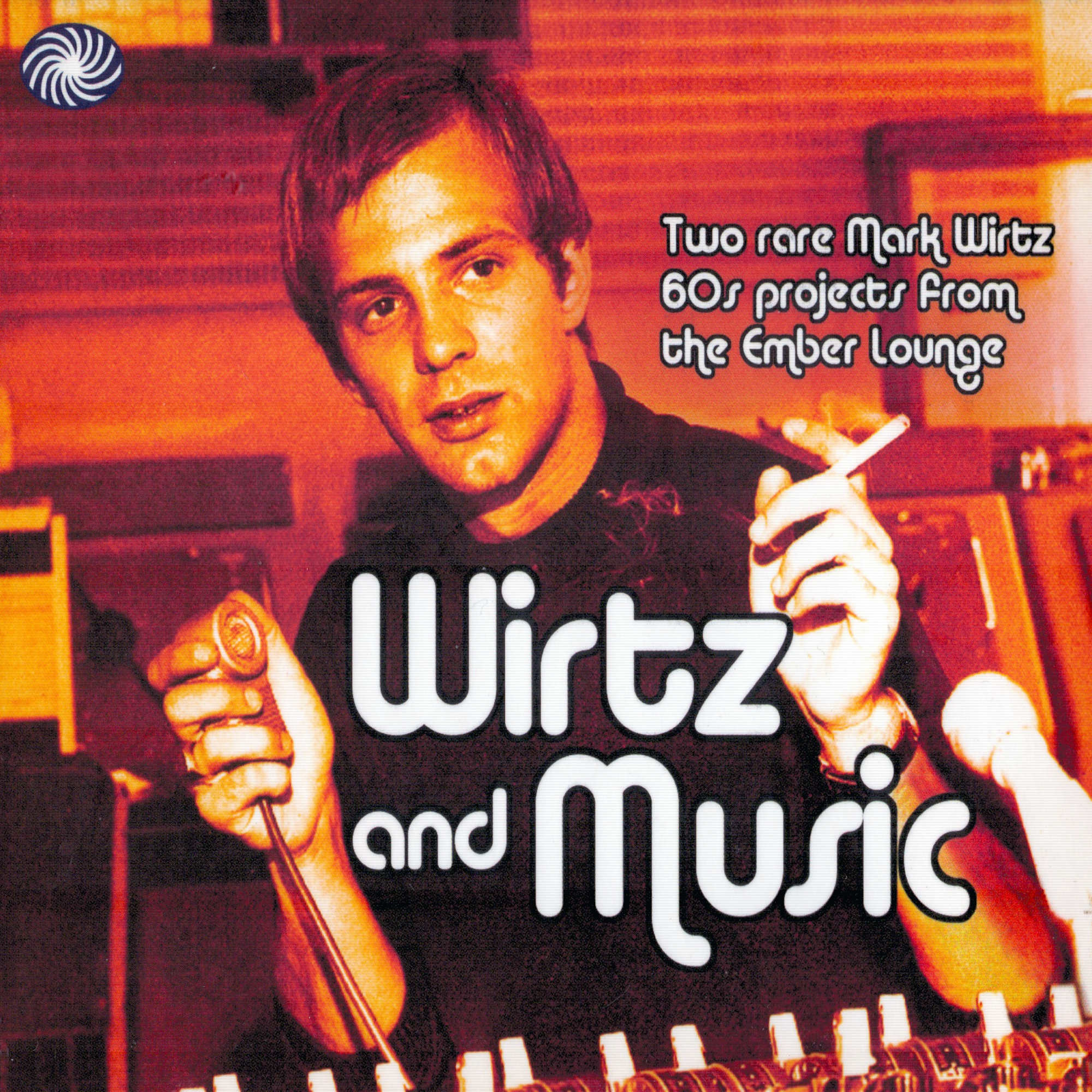
Two rare Mark Wirtz 60s projects from the Ember Lounge
Mark Wirtz | Wirtz And Music | (Fantastic Voyage) 2009 | One of pop’s polymaths, Mark Wirtz could just as easily have been a stand-up comedian, an artist or a pianist. Instead he became known for a unique production sound that Mojo magazine described as Phil Spector scoring Camberwick Green. Comedy’s loss was definitely pop’s gain in 1967 when Wirtz began the never-to-be-completed Teenage Opera, giving us some of the sixties’ most enduring and involved singles in the process.
Before the Teenage Opera came to life, though, Wirtz’s catalogue is intriguing and involved; he had a predilection for mood albums, and you are now holding a pair of them, released digitally in their entirety for the first time.
Mark Wirtz was born in Strasbourg on September 3rd 1943, and first came to England in 1962 to study at Croydon’s Fairfield College of Arts and Sciences (later a launch pad for students Jamie Reid and Malcolm McLaren’s own pop-art adventure), moving a year or so later to the leafy Surrey town of Reigate’s School of Art.
There he was offered a deal with EMI publishing arm, Ardmore & Beechwood, receiving the less than handsome advance of ten pounds for a bunch of songs. No matter, it was a start. Fired with enthusiasm, Wirtz formed his first band.
Mark Wirtz | Wirtz And Music | (Fantastic Voyage) 2009
The group was christened The Beatcrackers. They played the Surrey scene – supporting Monty ‘Petite Fleur’ Norman in Carshalton, headlining at the Guide Hall in Wallington (where Wirtz lived at the time) – and, via Ardmore & Beechwood’s Sid Coleman, caught the attention of EMI producer Norman Newell.
A man dubbed ‘The Professor’, Newell was impressed with the German lad’s charm and enthusiasm; he wanted to sign Wirtz but wasn’t interested in the group, and the Beatcrackers soon disbanded without releasing a record.
In 1963, a few tracks were recorded at Abbey Road, most written and arranged by Wirtz with Professor Newell presumably smiling sagely in the background. A single called Bubble Pop, a slightly updated take on the Russ Conway formula (Newell was behind Conway’s long run of hits in the late fifties), was issued under the name Mark Rogers and the Marksmen that summer.
In spite of an appearance on Radio Luxemburg’s Friday Spectacular show (presented by Shaw Taylor, later of Police 5 fame), and a subsequent mobbing by fans, Wirtz’s debut didn’t sell.
The Buzzer
A Mark Rogers follow-up 45, The Buzzer, remained locked in the vault, but Newell kept his new protegee on as his arranger (the previous holder of this position was John Barry). This set-up was over almost as soon as it started – Norman Newell had written the words to an MOR song called, appropriately, More which became a huge intemational hit, and he quit EMI to concentrate on songwriting.
Luckily, Wirtz’s quirky arrangements had been noticed by others at Abbey Road and offers of work began to surface. Under Newell’s benevolent guidance, he had gained confidence and his focus quickly shifted from performing to producing: he formed his own recording company, Colinio Productions, in 1964 where he began to develop his unique sound on a series of recordings by Dany Chandelle, Peanut, Russ Loader and Jan Panter.
Mark Wirtz | Wirtz And Music | (Fantastic Voyage) 2009

Some of these recordings had pricked up the ears of Ember Records boss Jeffrey Kruger. He had already poached John Barry from Norman Newell’s nest to make him the label’s A&R man; in Mark Wirtz he heard a similarly distinctive and dynamic new voice. Kruger asked With to record the Latin A Go-Go album.
The opening track, Mongo Santamaria’s “Watermelon Man”, includes a fabulously cute breakdown which showcases the vocals of both The Ladybirds (who With also used to great effect on Dany Chandelle’s ‘Lying Awake’) and their sometime accomplice, Barbara Moore. The album then shifts neatly into the aforementioned ‘More’, without Norman Newell’s lyrics but with woodwind and pizzicato touches that could have been the work of his erstwhile assistant John Barry.
Scat vocals
Barbara Moore’s breathy voice lends the album weight. She also worked as a vocal arranger whose library records are very highly regarded, especially in Japan. Her speciality was a light breezy jazz/bossa sound, and her scat vocals weave in and out of Wirtz’s instrumentation (the arrangements on Latin A Go-Go, by the way, are all his).
Wirtz had superb musicians at his disposal – Vic Flick (the man behind the James Bond Theme riff) and Big Jim Sullivan are the guitarists. Pianist Reg Guest was later an arranger for Scott Walker and reckons he has played on upwards of 3,000 sessions. “People have often said that I’m in the clouds” he once said, enigmatically. “All it is, is that I’m into my music; you can’t come in, nobody can.”
They were a tight bunch of musicians, used to playing together. Bassist Eric Ford was “a mentor” to Sullivan: “Every time I was on a session with Eric he would help me with either reading or how to behave.” They were both in a session group with Reg Guest called the Nashville 5, playing on a weekly radio show called Cool Spot. Drummer Dougie Wright, meanwhile, can list Hi Ho Silver Lining, Je T’Aime, World Without Love, Make it Easy On Yourself, My Coo Ca Choo and Adam Faith’s What Do You Want on his CV.
Mark Wirtz | Wirtz And Music | (Fantastic Voyage) 2009

The music box/nite club arrangements and sense of playfulness lift Latin A Go-Go away from the mulch of easy listening cash-ins and budget albums that flooded the mid-sixties market. Flick utilises his John Barry Seven background to turn Mel Torme’s ‘Comin’ Home Baby’ into a frothy spy music groove, while Sullivan moves into Hank Marvin territory on the Wirtz-penned ‘Sunday Night’ and ‘Beyond The Horizon’.
‘Don’t Do It Baby’ – with a full, soft focus Ladybirds vocal – is one of the highlights, reminiscent of the Paris Sisters’ whispered sensuality. The handclap-led ‘Riviera Carnival’, meanwhile, conjures up visions of Lady Penelope sipping champagne in a Mediterranean, modernist hideout.
Severe Crush
“Without doubt, those days in 1965 and ’66 were the happiest and most exciting days in my entire production life” Wirtz told Lee Connolly in 2001. He also revealed he had a “severe crush” on each of the Ladybirds, who helped forge his trademark sound.
Also cut at the Latin A Go-Go sessions but squirreled away from Ember was A Touch Of Velvet, A Sting Of Brass, a Ladybirds-led Wirtz composition strong enough to earn a release on a Columbia single in ’66 which was picked up by DJ Dave Lee Travis as his signature tune.
Judging from the tape boxes, recording for the Latin A Go-Go album had commenced by June 1965, and it was mastered in October 1965. It was released by Ember in early ’66, resurfacing in the States a year later as Wirtz And Music on the tiny Mardi Gras label. Five tracks also appeared on an Ember Mood Music Library album called Sweet And Moody.
Mark Wirtz | Wirtz And Music | (Fantastic Voyage) 2009

There’s a possibility that Smooth And Easy was also issued by Ember as a library record, later in 1966. It officially appeared for general consumption on Mardi Gras in ’67 in a neat, off-the-peg psychedelic flower child sleeve. Unfortunately, that didn’t really reflect the music which was certainly smooth and somewhat more easy than Latin A-Go-Go.
Wirtz reckons the two albums are worlds apart in genre.” Highlights are ‘Chip Chip’, which evokes the charming image of David Niven in a safari suit; Suddenly is perky, too, a “shoulder shrugger” led by a penny whistle and upbeat percussion; ‘Love Is All Around’ (not the Troggs song) luxuriates in a harp and Shadows-guitar arrangement.
The album was a one live-session project” says Wirtz, “specifically designed for the background / lounge / ambience music market, and intentionally did not have my stamp on it in order to keep it neutral and obscure.”
Tomorrow
Smooth And Easy was mono mastered in February 1966, and later that year Mark Wirtz was headhunted by EMI and invited to become an in-house producer. He got to work with the genuinely psychedelic Tomorrow before commencing on his unfinished masterpiece, the Teenage Opera, in spring ’67.
Wirtz would continue to create albums of instrumentals (a Mood Mosaic collection in ’67, plus two German-only releases, Come Back And Shake Me and Fantastic Teenage Fair) all of which had much the same stellar line-ups and a good few fine moments. But none was as thematically strong as Latin A Go-Go, which remains a perfect after hours, Swinging London period piece. (Bob Stanley)


Leave a Reply