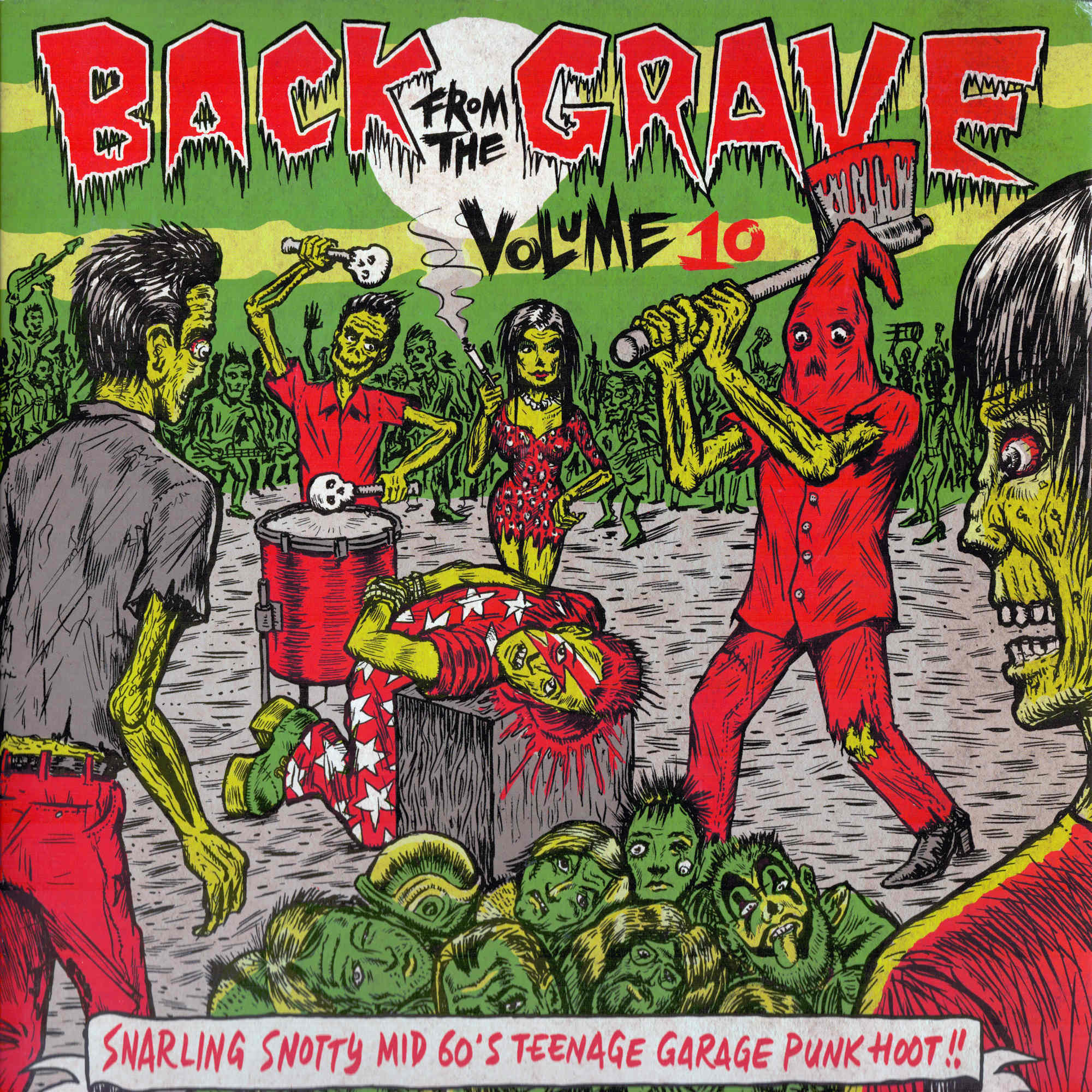
Snarling Snotty Mid ’60s Teenage Garage Punk Hoot!!

JAMES BOND & THE AGENTS “Wild Angel” (Gold Label 183) September 1965, Sand Springs, Oklahoma
Monstrous pulsating, driving fuzz-blasting Sept 1965 pounder from this Tulsa-area combo with the leader actually having the name James Edward Bond! They formed in early 1965 as the Esquires but the name change came quickly. Hank LaCroix started learning guitar with James, a brother of one of Hank’s friends, then quickly formed as The Esquires, with James’ brother Buddy (Leslie) Bond, Kenny Miller on rhythm guitar, Bill Norse on guitar, keyboards & harmonica, Hank on bass, Sonny DeGraw on drums. (Plus 2 gal dancers: Glenda Nye and Terisa Rod-gers.)
James’ father acted as manager —AND built the bands’ fuzzboxes, and each Wednesday night The Agents would blast away rehearsing in the Bond’s living room. Additional help from James’ dad was the loan of the family station wagon, which the band would attach a trailer with the band logo painted on each side.
Tulsa was a very conservative area, so it was up to Sonny’s mom to go to sweet-talk the High School principle to let the Agents grow their hair out. Local bands were the Infernos (who cut a 45, “Road Of Life/Your Love For Mine” in April 1967), the Rogues Five, the Great Danes, and played the teen rec centres, school dances, and Battle of the bands all around Tulsa.
Local station KELY hosted frequent Kelly-Hop dances and the Agents played many a Kelly-Hop. At one BotB they used their Sears amps and another band arrived with three Vox Super Beatles and blew the Agents off the stage, so for their next gig they splurged on new amps; James bought a Super Beatle, Hank bought a Standell with 15″ woofers.
In August 1965 they headed into Gill Fallini’s studio and recorded this, the flipside (based slightly on the traditional “Greensleeves”) plus an unissued original, “Gypsy Girl”. Sonny’s father worked for RNM Music Company servicing all the local jukeboxes, so when their 45 was released it was featured in all the local jukes. Around this time drummer Sonny DeGraw joined the Marines and was replaced by Kenny Wagner.
A cool memory the lads have is the night in 1965 when The Animals, Ronnie & The Daytonas, the Sir Douglas Quintet played at the Continental skating rink, and the Agents snuck into the show via an open rear window.
Sadly, the Agents’ end came about when James was sent off to Vietnam with the Marines, and his 11 months there really took a toll upon him, and he finally put an end to his post-Vietnam torment via suicide in the mid-1990s.
Back From The Grave | Volume 10 (Part One) | (Crypt) 2014

JOHN ENGLISH III AND THE HEATHENS “I Need You Near” (Sabra 5556) May 1965, North Hollywood, California BRUTAL, raving-to-the-max CA monster that fetches quite the dosh on the eBay circuit/circus, IF and WHEN it ever turns up for sale, so ENJOY it HERE and in maximum rip-ass fidelity!
John English played a small but very vital role in the Los Angeles band scene of the mid-60s. He was born in Kensington, London. His mother was British and his father from Oklahoma. Growing up he listened to skiffle, and later R&B and country music.
His father always liked music, and bought him a harmonica when he was nine or ten years old. His favourite harp player was Sonny Boy Williamson. When he was twelve the family moved to San Antonio, Texas for one year, and then to Los Angeles one year later, where he lived until he joined the service at 21.
In high school he started taking music seriously. While enrolled in college at San Fernando Valley State College (now California State University, Northridge), he met the Heathens, initially sitting in as a guest during their performances. John told me he performed with the Heathens at Pandora’s Box, around Orange County and the legendary Retail Clerks Union Auditorium with the Crossfires.
When English was in the group, the Heathens included Dirk Acree (aka Vern Acree, Jr., former guitarist for the Blazers of “Beaver Patrol” and “Bangalore” fame), his sister Char Acree (Sharon Acree?) and drummer Johnny Rogers. Vocalist John English joined them while he as a student at San Fernando Valley State College (now California State University, Northridge).
English wasn’t with the band for long, as he doesn’t seem to appear in any photos of the group, at least not that I can tell. The first mention he receives in the press is from the May 13, 1965 edition of the Valley News of Van Nuys, California. “Dance, Show Event at College”:
“NORTHRIDGE Zeta Beta Tau Fraternity will hold a dance and show, A Go Go Continental on Saturday, May 22, from 8 p.m. to midnight in the college gymnasium at San Fernando Valley State College, 18111 Nordhoff St. The entertainment will highlight nationally famous recording artists, including The Parlays, formerly with Round Robin who made the Slauson popular.
Their records include “Dance to the Slauson” and “Kick Your Little Foot, Sally Ann.” Also on the program will be Bobby Day who made “Little Bitty, Pretty One” and “Rockin’ Robin” which was once No. 1 all over the world. Direct from England and the first time in Los Angeles, John English and the Heathens will perform and sing a number of songs soon to be released. Finally, a surprise group will be featured doing many of its million sellers, it was stated. The dress is school dress and tennis shoes.”
John English told me the Heathens performed at Pandora’s Box, around Orange County and at the legendary Retail Clerks Union Auditorium (8550 Stanton at Crescent in Buena Park) with the Crossfires. As John related the story, someone named Brian who had done PR work for the Beatles brought Lelan Rogers to see the Heathens show at Pandora’s Box.
According to John, Lelan had them record three or four sides, but only two were ever issued. “I Need You Near” has a slashing rhythm from Acree, who takes an excellent solo early in the song. John’s singing is gravelly and cutting, and he has a great shouted bit, something like “Alright Vern, now step for me, c’mon give me that stroke (?) now!”
John’s singing on this record and his later ones shows not a trace of an English accent. Both songs are English originals with the flip, “Some People” co-written with Vern Acree, publishing by Rattan Music, BMI. The record was produced by Lelan Rogers and arranged by Glen Spreen.
Sabra released it in May, 1965, just after another disc produced by Rogers: “I Want My Woman”/”And Then” by the Emperors. It’s hard to say why the single of “I Need You Near” is so rare now (literally only 4 or 5 copies are known!). Other 45s on the Sabra label, like the Emperors are not as difficult to find. The Heathens (master numbers S-5009 and S-5010) was actually ready to release before the Emperor’s (S-5011 and S-5012) but was given the next catalog number (5556 compared to the Emperors 5555).
Glen Spreen was hired by Leland Rogers to coordinate the session that resulted in the John English III single. I would guess Sabra thought the Emperors disc was stronger, and once it started making an impact, LeIan and Sabra put all their promotional efforts into that record and let the John English & the Heathens record wither on the vine.
Another reason could be Lelan soon left Sabra and then returned to Texas. John told me that the Sabra record received some good reviews, and the band was offered a deal to tour, but some of the Heathens were still in high school. John left the Heathens and signed on with Sabra and went out on a 1965 Shindig summer tour as a solo artist. That Lelan Rogers booked.
The tour had a nine piece band that backed all the artists on the tour. John performed the songs on the Sabra 45 and a couple cover songs. The September 18, 1965 issue of KRLA’s Beat paper has an interesting “personals” letter from one Chris Jones asking: “To John H. English of the used-to-be Heathens: What happened to the group? Will we never hear your beautiful London accent again?”
John English’s Sabra single was released in May, 1965, the same month the Preachers, another Los Angeles group, issued their first great single, “Who Do You Love”/”Chicken Papa” on Moonglow. After the Preachers released their second single, “The Zeke”/”Quit Talkin’ Bout Him” in August ’65, they’d realized their mistake in replacing their first singer, Richard Fortunato, with the smoother vocalist Burke Reynolds.
Fortunato had a commanding R&B voice which helped make “Who Do You Love” such a classic. Unable for whatever reason to bring Fortunato back into the group, the Preachers auditioned singers before their live crowds. John English did well with their audience and had the tough-sound-ing vocals the band wanted, and John told me he was also good friends with the Preachers’ bassist, Zeke.
At this point the Preachers consisted of John English III (vocals), Hal Tennant (lead guitar), Rudy Garza (piano), James “Zeke” Ca-marillo (bass) and Steve Lagana (drums). English also wrote lyrics and song on two songs that would become the Preacher’s third 45, “Stay Out of My World”/”Pain and Sorrow”. Rudy Garza wrote the music for each song. As usual for Moonglow releases the production credit goes to the company’s owner Ray Maxwell. Recorded at R.J. Recorders in Hollywood it was released in October ’65.
“Stay Out of My World” is a fantastic record, featuring dual harmonicas played by guitarist Hal Tennant and organist Rudy Garza over Steve Lagana’s catchy drum beat. John’s distinctive trebly rasp is even more expressive than it was on “I Need You Near”. “Pain and Sorrow” is a gentler track, sung in a quiet voice just above the whisper he used on “Some People”. Moonglow later released another version of “Pain and Sorrow” by a singer named Wayne Dai-ley, but using the identical instrumental track recorded by the Preachers. It shows up on the flip to “Wreck of a Man”, Moonglow 5010.
While John English was in the band, the Preachers appeared on American Bandstand, the Lloyd Thaxton Show and KHJ-TV’s 9th St West dance show. The Preachers returned to the studio and recorded two more songs, “Moanin” (originally written by Bobby Timmons for Art Blakey, with lyrics by Jon Hendricks) and another English-Garza collaboration, “Just Don’t Complain”. A nihilist look at nuclear war, the music is full of tension. English’s vocals are snide and his lyrics unforgiving: the best advice he can give is “you got to maintain”.
The Preachers also cut a demo of “Hey Joe”. Rudy Garza said to Jeff Jarema: “We heard Arthur Lee and Love. He was doing “Hey Joe” in his nightclub act. We thought, man, that is a good song. Those other versions, like the Leaves‘, weren’t out yet. We wanted to demo it for Moonglow Records. We had only heard it once or twice so we didn’t have the words, but we wanted to show them what the song was like.
So Johnny English put some lyrics to it. They are completely different. He always seemed to write those doom and gloom, anti-war lyrics. We just did a demo for them, really. They didn’t like it!”
After only a few months with the Preachers, John said, the FBI showed up at his door to make sure he would see to his induction, and he was drafted in December of ’65. The Preachers were falling apart in any case, and Rudy Garza soon left the band because he felt Moonglow had buried his piano in the mix on “Moanin’”, and also that Moonglow was not producing the records as the band would like.
Lacking a band to support the new single, Moonglow thought they could promote John English as a solo act and released the single as by John English III and the Lemondrops in May, 1966.
John’s solo career would have to wait until his stint in the Army finished four years later. After the Preachers, Richard Fortunato and Zeke Camarillo joined the Vejtables in time to cut their great 45 “Shadows”/”Feel the Music”, both sides co-written by Rich Fortunato.
Hal Tennant joined the Bees, who became the WC Fields Memorial Electric Guitar String Band and then was part of both ESB and Fields. Steve Lagana found a gig playing drums for Johnny Rivers and Rudy Garza went to work for Lockheed.
John English served four years as an officer in the Army, stationed at Ft. Lewis in Washington, where he had bands. After leaving the service in 1969, he became a songwriter, writing “I’m Going Home” for Buck Owens who he toured with. His songwriting collaborators include Terry Clement, Larry Collins, Bryan Garofalo, Bob Moulds, Steven Diamond and David Wills.
John signed to Warner Bros in the mid-70s, then went back to Cal State for a graduate degree. In the ’80s, he went into production, first at Record One in Sherman Oaks and then in Nashville. In 1981 he hit the country charts with “Your Daddy Don’t Live in Heaven” and in 1989 produced Michael Ballew for Liberty Records. He now works as a communications consultant and lecturer.
One last note by the Crypt crew: Mark Crocker has an UNISSUED tape of John English blasting out a raving cover of Manfred Mann’s beastly R&B humdinger “Hubble Bubble”, recorded at a studio in Monterey CA in 1966. The Lords shall await this seeing the light of day!
Back From The Grave | Volume 10 (Part One) | (Crypt) 2014

THE 4 – “69” (Sam Phillips Recording Studio acetate) 1966, Brownsville, Tennessee
Brutal kinks-guit-led CRUNCH with rather sexual connotations lyrically. And some great chuckling as the song ends. Mike Markesich: “Group was from Brownsville, Tennessee. Their first single was released on the Clark label in January 1965: “Now Is The Time”/”Lonely Surfer Boy” from a recording session in Nashville. The following year, 1966, the guys cut some tunes at Sam Philips studio in Memphis, which unfortunately do not seem to have been officially issued. Members included: Paul Crider; Gregg McCarley, George Parks.”
Back From The Grave | Volume 10 (Part One) | (Crypt) 2014

THE EXPRESSIONS “Return To Innocence” (Tennelega 941) February 1968, Ringgold, Georgia
Killer “fuzz stun on 11” tune written by the late (R.I.P) Randy Treadwell, founder and lead guitar player. Be sure to check out the equally great lament flipside, “One More Night” on a soon to arrive new series on Crypt!
Mike Markesich: “The group formed in the northwestern Georgia town of Ringgold. While in high school, Randy worked at a music shop in Chattanooga, Tenneesse, helping people with musical instrument purchases and giving guitar lessons. He also found time to rehearse and get gigs for his group including a regular booking in town that held teen dances on Sunday evenings during the summer months, and Friday nights during the school year).
Randy’s boss at the music shop decided to enterprise via promotion by offering recording sessions for interested musicians and groups throughout the tri state area (Tennessee, Alabama and Georgia = Tennalaga, the house label).
The Expressions were one of the first to make recordings. Randy recalled both songs were recorded late at night in a back room at the music shop. The engineer for the session was a friend of the shop owner, and he had no clue how to record a rock & roll group.
After getting frustrated, someone decided to call a friend who was also a local DJ in the area. While waiting for him to show up, Randy showed the guys a new tune he was nearly finished with, called “Return To Innocence.” The guys dug the tune and an arrangement was roughed out by the time the DJ arrived. After a few minutes of repositioning mics and resetting levels, the guys did another take of “One More Night” (Randy recalled “We tried that at least ten times before realizing it sounded lousy and we needed a new producer/ engineer.”) and then cut “Return To Innocence” at 1AM — in one take.”
Back From The Grave | Volume 10 (Part One) | (Crypt) 2014

THE ORPHANS “Without You” (Herbst 527) 1967, Cedar Lake, Iowa
Pardon the buzzing, weirdly compressed sound on this — Tom Hankins of the Orphans STILL would love to strangle the engineer that flubbed their recording session! — but YOW: talk about brutal, Pretty Things-inspired R&B yonk!
In 1962, 14 year old Tom Hankins (bass and vocals) started a rock band with Scott Bascom (guitar and vocals), Mike Sexton (guitar and vocals) and Mike Curley (drums). The band was formed in Cedar Rapids, IA and named themselves The Belvederes. Personnel changes were made at various points and the final version was Hankins on bass, keyboards, guitar and vocals, Dick Douglas on lead guitar and vocals, Bruce Nunamaker on rhythm guitar, Eddy Hood on 12 string guitar, bass and rhythm guitars and vocals and Ron Bressler on drums.
They were having moderate success when area manager Al Huntzinger called Tom and asked him if his band would become Al’s Untouchables, as Al’s band of that name had all quit over money issues with Al. Hankins accepted and The Untouchables were born. Al still insisted on putting his name on the band, but they were just known to their fans as The Untouchables and Al no longer performed with them, as Hankins made that part of the deal [which is why “Hankin’s” is included in parentheses underneath the band’s name on the second Hunt single — ed.].
They quickly became Iowa’s top group with the backing of Darlowe Olsen, owner of Danceland Ballroom in Cedar Rapids, where The Untouchables became the house band and backing band for touring acts like Sam The Sham, Ike & Tina Turner, The Hullaballoos and dozens more top national and British Invasion acts, driving to shows in an old hearse with their name painted on both sides. They also toured on Olsen’s circuit of venues in the Midwest with Chuck Berry, The Dave Clark Five, The Animals, Johnny Tillotson and others.
In December 1965 The Untouchables recorded what turned out to be a double-sided hit in the upper Mid-west in 1966 with the songs “Come On Baby” and “Stick Around”, both penned by Hankins and Douglas writing under the name of Thomas Richards. This was recorded in Chicago at Sound Studios, the same studio used by The Stones and also with their engineer Stu Black.
Hankins and Douglas produced the songs, but manager Huntzinger listed himself as producer when the record was pressed. Hankins: “The whole band was incredibly hung over when we recorded this. We’d been up all night in Chicago drinking non-stop (even though we were only 17 and 18 years old) and somehow got to Sound Studios on time down on Michigan Ave at 10a.m. and it took about four hours to cut both sides. We made up the lyrics right before and during the recording, so a lot of the lyrics are ad-libbed, and they are pretty tame I must admit, but the sound we got was good and it was all about the sound for us. We were real lucky with the big push we got from some of the Midwest radio stations, which lead to tours and shows with the Animals, Dave Clark Five, Yardbirds and lots more.”
They began drawing packed venues. In 1966 Tom Hankins and Dick Douglas and Jimmy Carroll were kicked out of high school because the school board deemed their hair as “unfit”, as it covered the top of their ears and almost went over their collars. It turned out that Jefferson Senior High School principal William Paxton found out that the boys in the band were making more money than he was and he developed a grudge against them, doing his best to make sure the boys wouldn’t get their diplomas, but he failed. This put The Untouchable’s name in the headlines nationwide and they drew record crowds at all of the big ballrooms in the Midwest.
Once they were out of school they immediately headed to Hollywood. They had been there during Spring Break when Liberty Records asked them to come out and sign a contract. Liberty, however, wanted The Untouchables to clean up their image and cut their hair, to which the band refused, ripped up the contract and walked out the door.
They dumped their manager Huntzinger and changed the band name to The Orphans at this point (with a few personnel changes: Ron Bressler, Dick Douglas, Jimmy Carroll, Tom Hankins, Eddy Hood) after finding out he had been pocketing up to 80% of the band’s pay before dividing the rest up with the musicians. Famed producer Phil Spector listened to “Come On Baby” and “Stick Around” and helped them get a production deal with producer Marshall Leib.
Herb Alpert was just starting A&M records with Jerry Moss and he wanted to sign The Orphans, but they lacked enough original material and Alpert needed someone immediately.
Hankins: “We recorded the Orphans single at Gold Star Studios in Hollywood, corner of Vine and Santa Monica in August of 1967 in two hours. When we finally heard the records, the production and final mastering was so bad that we forced the record company to pull it out of the stores.
All I know is that Herbst and engineer Norm Goodman did something to fuck it up, as they were both morons. I produced it and left them with a good sounding product to master, which apparently they didn’t know how to do.
It received airplay in Los Angeles and in the Midwest (mainly Iowa, Missouri, Nebraska, Minnesota and Illinois, but we got the stations to pull it as it sounded like shit to us.”
They met The Doors and toured California with them. This was before The Doors were known outside California and were not even signed yet. Dissension broke The Orphans up. The band returned to Iowa where Hankins and Douglas took over the operation of Danceland Ballroom from Olsen and ran it until it was closed for good, to be ripped down to make room for a parking garage and events centre.
They also put The Orphans back together. The duo also promoted concerts in The Midwest with The Orphans generally headlining, but other groups like The Byrds and Beau Brummels headlined some of these shows.
Douglas and Hankins returned to Hollywood and formed a new group with vocalist Aaron Brownstone and world-famous drummer Sandy Konikoff, who also played with Taj Mahal and George Har-rison, among others. They recorded a 12 song album of original material for ABC Records, but upon completion of the LP, Brownstone was killed in a motorcycle accident, thus negating the contract.
Douglas and Hankins returned to Iowa where Douglas formed Enoch Smokey and they became one of the top Eastern Iowa groups. Hankins former a power blues trio with Dan Daniels and became the house band at the all-African American club called The Cougar Lounge in Cedar Rapids. In 1969 both Hankins and Daniels started training to become professional wrestlers and became known nationwide as “The World’s Most Dangerous Wrestlers”.
Liner notes taken from Volume 10. Read more Graves here.


Leave a Reply