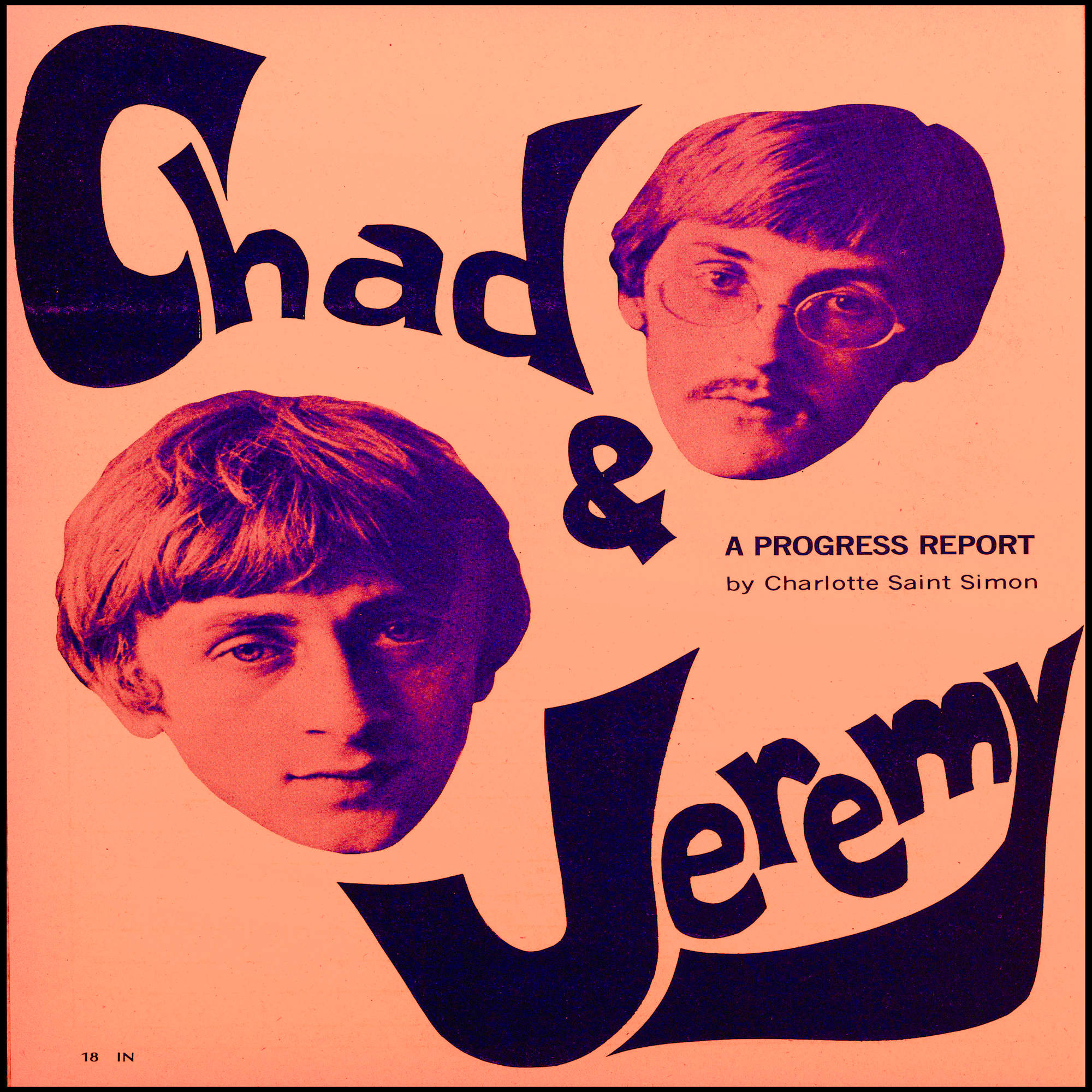
Article published in IN magazine, April 1968
Chad & Jeremy’s Transformative Journey in Music | A year-and-a-half ago Chad & Jeremy abandoned one of the most successful careers in the rock field to concentrate on creating something that was musically meaningful to them. Here, in an exclusive IN interview, they talk about the result of their efforts, one of the most discussed albums of the year, Of Cabbages and Kings.
It was about a year-and-a-half ago that Chad and Jeremy, along with several other big name pop groups, piled into a bus heading for a cross-country tour. Two months later—after an endless string of one night stands and endless hours of jogging along on that bus between destinations—the tour wound up, Chad and Jeremy got off the bus—and off the pop music bandwagon. They just disappeared into the crowd.
“We got tired of being screamed at and being stifled by the scene we were in,” Jeremy recently revealed. “We realized that it was just a question of taking the time and the opportunity of going home and saying, ‘Now, right now, we do something different’.”
No Progress
So Chad and Jeremy came to the end of their period of pretty-boy-rock images, identical suits and sure fire hits. Chad, at 25, and Jeremy, at 24, were disappointed. They felt that they weren’t getting any younger and that life was passing them by because their records hadn’t progressed.
“What happened to that marvellous, wonderful enthusiasm we had as students when we met in London?” Chad now asked. He didn’t have to look far for the answer. “Well, it got lost somewhere in the drive for earning a living and being successful and having houses and cars. Or maybe it was never really there?”
Chad Stuart and Jeremy Clyde had to know once and for all if they could make music that would satisfy them creatively—music that would have the old spontaneity, while also bearing the clear mark of the new maturity they felt as people and musicians.
So Chad and Jeremy retired from public view to work and think very hard and very quietly. The result of their work and thought was a piece of music called “The Progress Suite.” It pleased them; it had something to say; and it started them on a new album, Of Cabbages And Kings.
When Of Cabbages And Kings was released a few months ago, it caused a predictable stir. After all, it’s not everyday that a never-taken-too-seriously pop duo graduates to challenge the Beatles. Because of Of Cabbages and King’s classical references and various innovations, the comparison was hard to avoid.
Naturally, there were some critics who were not particularly impressed by the “tricks” of the new Chad Stuart and Jeremy Clyde (it’s no longer appropriate to call them Chad and Jeremy), but they still had to admit that the change of musical direction held promise.
Chad & Jeremy’s Transformative Journey in Music

To better understand the transformation of Chad and Jeremy into Chad Stuart and Jeremy Clyde I met with them for the following interview in Los Angeles. They have both been living in the area for the past two and a half years and appear to have adapted completely to the relaxed pace of southern California. Wearing beads, dungarees, Indian moccasins, Chad sporting a mustache, Jeremy long side-burns, they were obviously physically different. But most everybody looks different today from how they looked a couple of years ago. Over a good supply of coffee, we started to explore how deep the different really went with Chad Stuart and Jeremy Clyde:
Q: What is Of Cabbages And Kings about?
CHAD: It’s about the progress of a film without a film—it’s a process. We call it home movies, because you project your own movie inside your head when you listen to it. That’s the theory behind it anyway. We had no money with which to make the film in the first place—although with a bit of luck, we hope to get the money from various insane, generous people to make the film now that we’ve done a soundtrack. You can split it up as a soundtrack in the sense that it does have actors and talking and sound effects and all those other things. But the music is quite conventional and classical and quite straightforward.
The importance of sound
Q: Is it possible to make a soundtrack for a movie before you have the picture?
JEREMY: There are no rules, are there? The sound is certainly as important as the visual part. We’re now in a completely different age. First you had silent movies—just pictures—then talkies. Then you got stereophonic sound, but it still hasn’t really gone tremendously far. Sound really isn’t used. It would be nice, for example, to have your voices telling one story, your pictures telling you another and your sound telling you another. Actually, they should all relate, but they could all be talking to you about the same subject on different levels.
CHAD: I remember once watching Johnny Carson and there was a new theatre group on trying to make Johnny see something he really couldn’t see. They were fooling around with sound. A guy took off a pair of spectacles and started clattering them on a table and said, ‘Don’t laugh at me clattering my spectacles on the table. Listen to the funny sound it’s making.’ And when you divorced the picture and started listening, it was really extraordinary.
Chad & Jeremy’s Transformative Journey in Music

Q: How do you as collaborators work out problems and stumbling blocks in the recording of something as large as “The Progress Suite”?
CHAD: Well, I just sort of keep going . . .
JEREMY: I’m the devil of despair. I’m the person who loses faith. I’m the one who gets uptight and says this is the biggest piece of rubbish I’ve ever heard and stalk out of the studio at the end of the session.
CHAD: I wouldn’t say Jeremy was unfaithful, because he didn’t know what was going on in the beginning. I said then, ‘Look, it’s going to be all right in the end.’ And that was an enormous presumption on my part, but I’ve always been taught that nothing ventured, nothing gained. You have to have a bash at it first.
Dubbing a Sitar
JEREMY: No, no, I knew what he was trying to do. I knew which movements were going to be which. I knew how he tied the songs together, because we’d both talked about it. But what I didn’t know was . . . he’d mumble vaguely that I’d be dubbing a sitar, but that would be three weeks from now. This is very unnerving after a bit, because you began to wonder as he dropped these little hints of things to come if he really knew what he was talking about.
Q: Is this type of collaboration possible only between two people who know each other well?
JEREMY: No. I think it probably helps, but let’s not forget that what it really takes is common aims. In any long term affiliation, you have bad moments and good moments, and the better you know a person the less upset you get if he shouts at you or something.
Q: Can you describe what it was like making the recording?
CHAD: Making “The Progress Suite” was very difficult because we couldn’t simply do it, you know, score it and then go in and say now we’re going to do part one. We could hardly ever get enough session time for that, because we were cold at Columbia Records in terms of hit records, which is a sure fire way of not being able to get studios when you want them. And so we would have one session one week and then have to wait a couple of weeks and so on and so on. By the end of it, we had two rows of tapes in the archives divided into Parts One, Two, Three, Four, Five, and then Part One was subdivided into takes, and we practically went insane. It was really almost impossible to keep track of it. How it all came out into one record I shall never know. It took us about 14 months in all because of one difficulty or another.
Chad & Jeremy’s Transformative Journey in Music

Q: How did you unwind during this time?
CHAD: I swam a lot. I’d go home, put it all away. Home for me is two acres of shambles. The point is it’s a retreat. You just shut the door and nobody can reach you. I just go and look at the sky and things like that. But then that in itself helped me create the music, and I hope to be able to create a lot more in that environment. I can’t work in an apartment.
JEREMY: I also like the shambles that Chad has going for him. His dogs are allowed to do just whatever they want to do, and if they want to dig up the carpet, it’s fine you see.
CHAD: There’s no carpet to dig up. We threw the carpet away. Jeremy also has a very beautiful retreat in which he retreats. I sometimes feel guilty about attaching such value to, you know, material things, but I get a very good feeling from Jeremy’s house and everything. I think certain material things can give off a good feeling like that. That makes it worth it. It’s not like you’re sitting there saying, ‘Wow, my floor is made of solid gold!’
Q: Are there many friends who share this life with you?
JEREMY: There’s sort of a big group always at my house. Twenty or so, who can, without my being there, and not having even met each other, find something in common while just meeting each other on the way around. There’s sort of an atmosphere. This being able to feel very close to people, it’s a new development.
Q: What has broken down the barriers for you?
JEREMY: It’s something to do with living here—the West Coast. “The Progress Suite” is a definite result of our living here. I’m now going through a revolution. If you sit down with me and you are totally open with me, I will be automatically open with you. It takes an effort on the first person’s part, of course. But a lot of people are making that effort, and a lot of good has been achieved from it. Twenty people all making the same effort at the same time in the same place can produce some interesting results. I don’t think it’s necessary to go through a series of rituals to achieve this. I think the love-in as an idea proved that. You don’t have to have everybody chanting. You don’t have to have everybody hitting things. Just by being there and being open, it will all get achieved.
Q: Are you interested in meditation?
CHAD: I think everybody’s been meditating since time began.
JEREMY: If you mean are we part of a general search for something above and beyond—a search that is being taken very seriously very suddenly by this generation, the answer is yes. We are part of it. It doesn’t necessarily mean that we are chanting the Mantra and facing the East every morning. Both of us, I suppose, are in our own way looking for something that will work for us or for him or for me.
Chad & Jeremy’s Transformative Journey in Music

Q: Is Of Cabbages And Kings in a way looking for an answer?
JEREMY: It’s showing some possibilities and some probabilities, if not an answer.
CHAD: It’s a very worldly answer. It’s concerned with everyday things.
Q: Is this an album that should be judged?
CHAD: Yes, very much so. I’d like it to be judged. I’d like people to panic or just react. I would be offended if people did the thing you sort of expect from the trade papers, sort of ‘another set of tunes from the boys. Great Sales.’ You know, that sort of thing. That would be kind of insulting, because it would imply that it didn’t mean anything. I’d much rather that somebody said this is a terrible load of rubbish from start to finish. Then, at least, they’d taken the trouble to listen to it and form some sort of conclusion.
Q: Would you care to defend against that type of criticism?
CHAD: Yes, very much so. I would say they’re privileged to think that. But one can’t expect to succeed all the time. Having done a suite—it’s a classical thing—we know what’s wrong with it. We don’t know probably all that’s wrong with it, but it’s only a start. The trouble is that most people flip out and say it’s breath-taking, it’s wonderful, you should be conducting the New York Philharmonic. That’s nonsense. The problem with Pop is that there are no real standards of criticism. Just because Jeremy can string together three words, everybody says, “Wow, Shakespeare.” In other words, the standards are on an absurd level in this country and are only just coming up. I know this personally because I have a 14-year-old sister-in-law in school in this country and she’s in a class with 16-year-olds and, you know, hardly any of them can read and write. It’s really distressing. I don’t get it.
Q: Could this be possible because of our electronic age?
CHAD: Yes, I think so. The reading and writing thing is fairly obvious because the kids have all been brought up on TV and they sit and watch Bugs Bunny.
Q: Could your music be possible at any other time?
JEREMY: No. I was just thinking about that today. With 27 pieces at the most in some parts of the Suite, one is doing things which, because of the recording techniques and that sort of thing, you could only have done years ago with a full symphony orchestra. It would not have been possible before this time because of the over-dubbings, the occasional tricks and so forth that went into it. But we aren’t electronic people. We were talking to the Byrds last night, who are always making little electronic gizmos to enhance their sound. Sadly, we aren’t that sort of people. We probably should be because we are now dealing in an electronic age.
Q: Was there a special reason behind omitting any written notes from the album cover of Of Cabbages And Kings?
CHAD: Because who needs them?
JEREMY: The music should say it all.
CHAD: The Of Cabbages and Kings thing really doesn’t need explaining if you’ve read Alice Through The Looking Glass. And if you haven’t, that’s tough. It’s really not very important. We have enough gaudy liner notes on our other LPs if anyone misses them.
Q: What do you want to do most now?
JEREMY: At the moment I want to do and be and create anything and everything that I can possibly put my hand to. In a minute I’m going to find out what the balance is, what I can do best, and what I’m just fooling myself at. People will let me know what’s good and what’s lousy.
CHAD: I think recently I’ve learned several lessons and the most dramatic, the one that’s stayed with me, is the whole idea that whoever the real me is and the different selves I see in other people will die one day. This is what progress is all about. There’s a song in the album, ‘Rest In Peace’, which reflects this. I want to devote all my time to going beyond and transcending this feeble physical world and see nothing to be gained from looking at myself and analyzing myself endlessly and saying, ‘Well, you can do this and you can do that.’ I think in the end it’s all supremely unimportant. I think this is motivating everything I do. It’s motivating the music. I think music is the ultimate language when you come down to it.


Leave a Reply