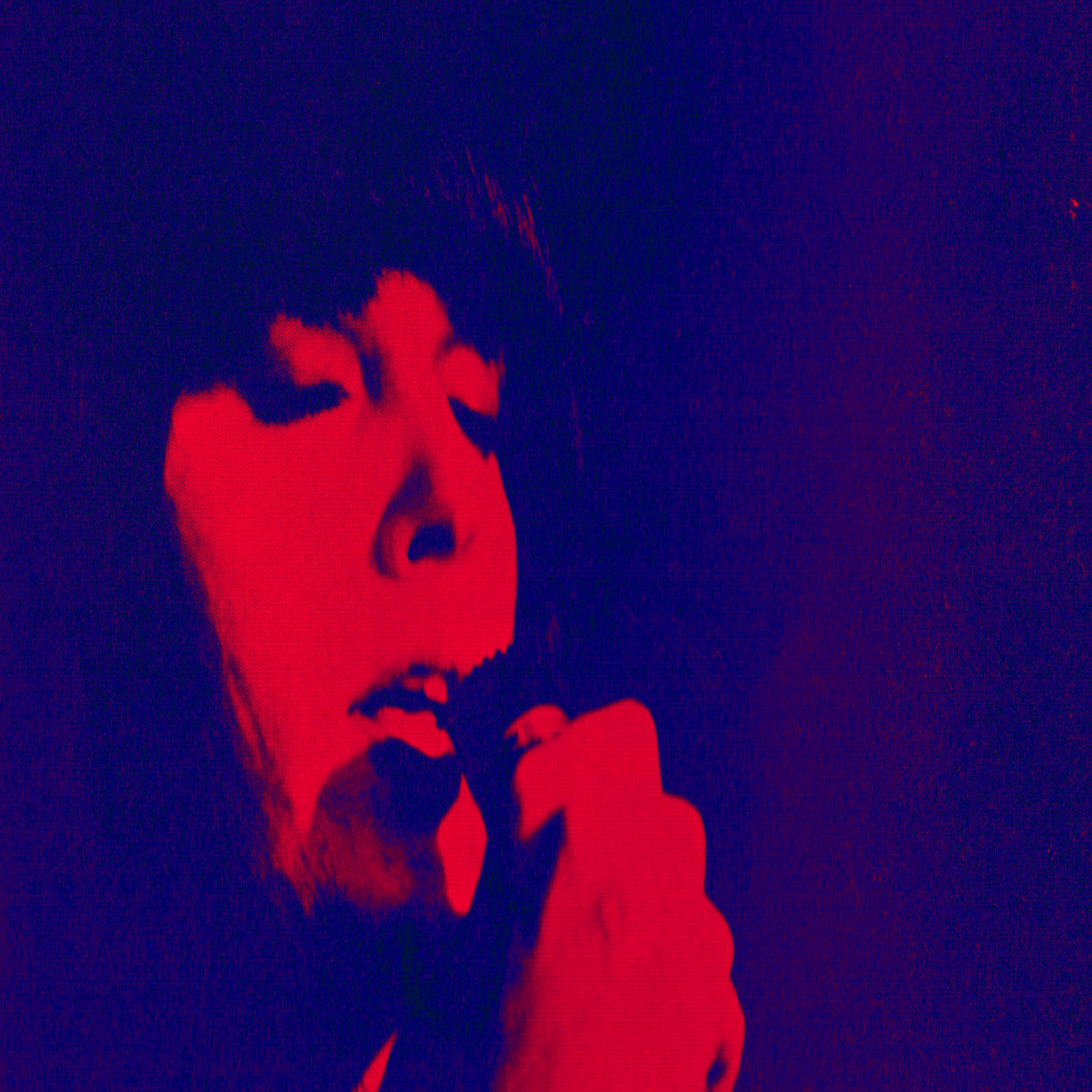
“Embryonic Journey” is my pick from the LP | Jefferson Airplane – ‘Surrealistic Pillow’ (RCA Victor LSP-3766) February 1967
Article published in Crawdaddy!, May 1967
Jefferson Airplane | Younger By Far | They’re pretty youthful. Peering out from their Surrealistic (but really pink and purple sepia) Pillow, they smile, they look blank, enigmatic, tired, they even turn left. But, then, they’ve still got the mark of youth. In comparison, the Rolling Stones, who are no older, seem to have lost their youthful glow. Maybe it’s the business? But on ‘Between the Buttons’ the Stones dare – not only to be absolutely fearless in the face of the cliche – but also to look absolutely knocked out.
At one time the Rolling Stones were mean and they never lost their dignity. The world’s best photographers saw to it. But now, they take an outdoors shot, expose themselves to nature’s whims, and lose Brian Jones’ entire dignity. Only the Rolling Stones, who are no longer young, could go and do such a thing. But on this same album they prove not only – as R. Meltzer has pointed out – that Rock contextualizes everything, but also that Rock is a matter of clichés.
And, of course, so is all art. That is, all art either manipulates clichés (i.e. old or new-passing-as-old cultural ready-mades), or turns – via the process of exposure to a public – its creations into clichés. Art is concerned with the overly familiar, what looks like the overly familiar, and with turning things into the overly familiar.
Jefferson Airplane | Surrealistic Pillow | (RCA Victor) 1967

And so here comes Jefferson Airplane, influenced by, or merely sounding like they’ve been influenced by: themselves, a lot of San Francisco people, the Lovin’ Spoonful, “My Grandfather’s Clock Was Too Large for the Shelf” (a song), the Byrds, the Early Beatles, Lewis Carroll, drugs, the Fortunes, the Mamas & Papas, the Bonneville Salt Flats (the place), the Seeger brothers (Mike through Pete), Mike Douglas and Sal Mineo, Tolstoy, lots of chamber music, classical music, Dylan through Donovan and Simon & Garfunkel, Dylan alone and through him the Tennessee Stud, etc, etc.
And, believe me, there’s nothing wrong with all that. Too youthful to have achieved the Rolling Stones’ Creative Boredom, they resemble the, as yet, young-at-heart Beatles, who must have led sheltered lives, who still can fool around. That is, the cliché is still a little bit scary for them. And unease doesn’t generate perfection. And that means you can tell when they’ve been fooling around.
The most basic live sound of Jefferson Airplane is dense and complex, often highly turbulent. Typical of this sound is the already legendary, although unrecorded, “Other Side of This Life,” as are most of the songs on the first album, like “Let Me In,” “It’s No Secret,” “Let’s Get Together,” “Bringing Me Down.” Surrealistic Pillow, perhaps because it is more studio-than live-oriented, has only three songs of this sort; it is atypical.
These typical songs are textured. They are complex and sound complex, with their many complementary lines that are heard, that act as audible sound threads. They are dense – not merely weighty and heavy – because these lines are, usually, interwoven, not just accumulated.
Complex texture is the aim, rather than simple volume. In these songs, neither vocal nor instrumental lines occupy a predominant position. There’s no background/foreground. Voices have an instrumental function, words and music rise as sound together. The most impressive thing about these songs is their whole complex sound.
“3/5 of a Mile in Ten Seconds” sounds simultaneously dense and clear. Resulting from, among other things, a use of the instruments and voices which relies on the very differences between their sounds to differentiate (i.e. clarify) the textural patterns. The song starts with the drums alone, playing a pattern that seems to echo itself. Percussive guitars follow. Putting out yet another echo, a mirror-image of the drums.
Jefferson Airplane | Surrealistic Pillow | (RCA Victor) 1967

And underneath the guitars a constant drum figure, with cymbals, bass, and tambourine. All building that density. Finally, after four repeats of the guitar pattern, the voices enter: “Do away with people blowing my mind.”
At last the sound is at basic density. All the instruments, all the voices. Each variation refers to this density, playing a comparative role. Now variation and selection can be introduced. For example: Since there are three different voices (Marty, Grace, Paul), they can be quite precisely manipulated to generate a sense of movement or turbulence.
Merely because the voices can exert all sorts of leverage they activate changes in the density level. When Marty sings “Maybe baby, I’ll say that you were kind,” a significant change in the density occurs out of a small – and not very obvious action.
The two other voices have dropped out, which changes the quality, the density, the volume, the vocal-instrumental relationship of the whole sound. Which not only emphasizes Marty’s voice – but, also, contributes to the turbulence by introducing a comparative movement within the texture. A seeming minor cue becomes powerful. Really amazing.
The introduction of one of the all-time Rock cliches (again at the line “Do away with people blowing my mind”), “Can I Get a Witness,” by the bass, two guitars, and drums, clarifies the texture. Demonstrating the great implicit organizational and formal power of the cliche.
Since (as taught to us by the Rolling Stones and Marvin Gaye) “Can I Get a Witness?” is a highly rhythmic tune, it here plays a rhythmic function. Since its familiarity can be assumed, it immediately orders its context, the sound texture. Familiarity causes’ the organization of the sound around this melodic and rhythmic focal point.
At the same time it is a source of variation. A new – or better, additional – sound, it complicates the texture, adds to the density. At this point, Jorma does something nice. He plays a very prominent rhythmic and melodic lead. (Jorma’s style is absolutely suited to building dense textures.) At once, he defines both the melodic and rhythmic discipline. His lead guitar fulfils simultaneous functions. Paul’s guitar is, then, freed for a set of intricately meshing accents.
Jefferson Airplane | Surrealistic Pillow | (RCA Victor) 1967

“D. C. B. A. -25” is one of the world’s great Byrds’ songs. And a good thing it is, too. Actually, it’s middle period Byrds. Not as daring as “2-4-2 Fox Trot,” wherein McGuinn completely disposed of variations, it resembles one of those indescribably delicious but unnameable (Because you cant remember the name.) songs on the Turn! Turn! Turn! album. If nothing else the Byrds have created a style, maybe even a school.
In this song density is built through the establishment of a quite constant ground, out of which all vocal and instrumental lines will rise. This includes all variations – which seem like nothing so much as a pulling or pushing of the ground theme, the theme announced in the first movement. The song divides into three movements, the first and last vocal, the second an instrumental break.
D.C.B.A.- 25″ is nicely static. It doesn’t go anywhere. There are no resolutions. Its only movement is at the surface: words may be passed from one voice to another. Turbulence is minimal. No progress, little turbulence, only a gentle cyclical repetition.
The outer movements are the opening and the closing of the cycle. As with “Turn! Turn! Turn!,” the cycle is wound by a deliberately paced instrumental pattern – ending with the same pattern unwinding (unwinding, only because it’s at the end.) The cycle itself commences with a pattern first put down by the bass, percussion, guitars. A pattern with a certain kinetic in-evitability about it. Seeming unable to come to rest. This is the fundamental ground.
Through-out the song, the drum and bass maintain the ground’s rigidity and discipline. Surface movement comes with the shifting between Paul and Grace of such lines as “We come and go as we please.” The movement appears as one voice picks up from the other.
This song is really so sad. A gentle ambience and feeling of disappointment. Although “We come and go as we please,” “Too many days are left unstoned.” At last it’s clear, “I cannot dance behind your smile.” Reminds me of Tripmaster Klein, who said the first trip had a glow, a surprise, which later ones wouldn’t. They would be, somehow, vaguely disappointing. R. Meltzer claims the Jefferson Airplane is post-acidic. Paul Kantner says no. He wrote this song and that means he knew better at one time.
And D.C.B.A. stands for the chords.
“She Has Funny Cars” is about people who are “trying to revolutionize tomorrow.” Like the first two songs, it’s also really about its own sound. In these songs sound and meaning are integral.
Here a growing turbulence is resolved in active silence, at once a dramatic end, continuation and inauguration of that turbulence. The song opens with a repetitive drum and cymbal figure, followed by maracas, guitar, bass and fuzz bass. Then the voices. “Everyday I try so hard to know your mind.” As they finish the band accelerates to crescendo, followed by silence.
Jefferson Airplane | Surrealistic Pillow | (RCA Victor) 1967

A very tiny little pause and in comes Hop-a-long Casady with his bass. He plays three notes – and they’re a big surprise. They constitute active silence. An expansion and continuation of that tiny little pause. Except they are also sound. In comparison to the crescendo they seem to equal silence.
And as both sound and silence (either of which will do), they act as a resolution for the crescendo. But being sound they also continue the turbulence they helped interrupt (turbulence is both absolute, i.e., “there is a turbulence,” and a matter of comparison). Besides which, they inaugurate (or re-inaugurate) the turbulence.
They precede the band’s return after that tiny little pause. With the band’s return, the bass drops out of the momentary foreground, adopting a contraction of the active silence figure, while the band builds the three notes into a measured syncopation.
As measured as the band, the voices follow with “You can do whatever you please.” Grace returns, alone, floating above all that stately progress. A mystic moment has passed. An unknown tongue. But maybe you can get a hint from the playing on the Buffalo Springfield’s “For What It’s Worth.” Which is a huge active silence.
“Embryonic Journey,” which forma learned on his own, is just like Pete Seeger’s “Living In the Country,” which he learned from Mike.
Grace has two songs of her own. On “Somebody To Love,” her voice is so much in the foreground that it subordinates the band. The highly dramatic and turbulent instrumental is reduced to an accompaniment. Not merely because of the volume of Grace’s voice, but, also because of her use of words.
The song comes across as taut and senuous and dramatic. To do this, Grace, faced with a native American accent far too suitable for Rock, went and invented arbitrary pronunciations for all sorts of words. As well as arbitrary non-contextual word treatments and positions.
The song starts, normally enough, as if it had been going on for I don’t know how long until somebody turned up, “When the truth is found to be lies.” But soon she becomes really virtuoso, inventing ways of saying “to be,” “you,” “yeah,” “running” – ending with a fine non-contextual “love.”
She is equal to Mick Jagger’s by-now-famous “goat-sound” repertory on “Going Home.” But it’s important that her inventions are not only sensual or structural, but also cognitive, necessary to the complete meaning of the words. Words have not been changed into things of a wholly sensual significance. Faced with the cliche of the pronunciation of words, Grace acted like an artist and did what sounded right. Just like a poet.
Jefferson Airplane | Surrealistic Pillow | (RCA Victor) 1967

Grace’s other song, “White Rabbit,” mixes the imagistic vocabulary of Alice In Wonderland with the drugged mind. And puts it on top of Ravel’s “Bolero.” It’s very popular. Who doesn’t love a drug song?
Here Grace (who wrote it) resisted the temptation to surprise us and took the most obvious images out of Lewis Carrol. Real courage in the face of the cliche that we should be surprised by a strange drug song, OR, that we should bother to say something new and disorienting.
Meaning that for a drug song this is, at last, surprisingly overly familiar. An extraordinary powerful anti-tongue principle, an extraordinary cliche density and pressure, are in operation. Perhaps too much to be palatable, except to real connoisseurs. Since the “Bolero,” for example, is one of the few antique works to have maintained an uninterrupted status since it was born (Ravel disliked it immediately – proving he wasn’t funny.)
“White Rabbit” has been called funny (“Remember what the dormouse said – Feed your head!“). But, even though the words are in the foreground you really have to toil at understanding them. And it might be that people really like it for the beat (i.e. Bolero) and not the cognitive words.
Millions have loved and enjoyed the “Bolero” for years. Now it’s a camp object. Probably the decisive turning point being the appearance on the flip side of the first “DYNA-GROOVE” record, which featured Morton Gould conducting both the “1812 Overture” and the “Bolero.” Truly an all-star line up. Anyway, I don’t know if the Jefferson Airplane, who, on two records and in lots of live appearances , have proved equal to instrumental simplicity, good light shows, bad light shows, Bill Graham, syncopation, Howard Solomon, metal sound, Ralph Gleason, complex sound, expanding silence, scary sound, Leonard Feather, all sorts of cliches, and the Beach Boys – I don’t know if they were up to just playing louder and louder.
Next, we have three songs that evidence not a bit of timidity in the face of the cliche: “My Best Friend,” “How Do You Feel?, ” “Plastic Fantastic Lover.” As everybody says, “My Best Friend” is “good time music.” But this song has a crucial historical context. The single version came out at the very end of the “good time” era, which the Lovin’ Spoonful inaugurated more than a year and a half ago.
Jefferson Airplane | Surrealistic Pillow | (RCA Victor) 1967

Appearing soon after “Winchester Cathedral” had – through mere longevity – so fearfully abused the “good time music” audience. In other words, it came out just in time to seem not only a cliche but a worn-out cliche.
So unfriendly persons didn’t say it was “light” and “happy,” but rather, “thin” and “without substance,” all of which are interchangeable depending on what you’re after. I guess it may well have been historically doomed.
But, this song is truly magnificent. Paul Williams says, “It’s a perfect realization of all its intentions.” O.K. Also it’s cognitively atemporal. The song is so immediately familiar – a prime virtue of the cliche, that you knew it before you ever heard it. There is nothing so powerful as a cliche whose time has come.
And this song was written and performed with an absolutely informed historical sense that revealed just what was necessary. So well informed, that it even contains a very sweet brand new cliche -“love stream.” If they had only known when to release it.
The song is nice precise organization. Very good timing. Some songs are held together by rhythm, some by a ground, some by a fundamental drone, some by a melody – “My Best Friend” is held together by divisions, that is, good timing. It has a multitude of different rhythms running around. Without precision they would interfere. Yielding turbulence. Which I don’t think you want in “My Best Friend.”
So by precisely differentiating the various rhythmic sections either explicitly (i.e. a pause), or implicitly (a clear, but continuous, transition), interference is eliminated and the whole gallery of ready-mades passes placidly.
This song is composed of ready-mades (materials that are pulled whole out of the culture pool). But not all are real. Some are Bizarro ready-mades (materials which give every indication of having been pulled out of the pool – but which are really some kind of invention).
That’s why the song is both old and new. It only sounds like “My Grandfather’s Clock Was Too Large For the Shelf,” which the Jefferson Airplane plays at half-time. And which everybody at P.S. 39, Queens, had to learn. There are also ready-made rhythms (perhaps even real) and ready-made wad patterns (“Are you my best friend?” . . . etc.). All held together by precision division.
Jefferson Airplane | Surrealistic Pillow | (RCA Victor) 1967

“How Do You Feel?” is another so sad song. Vague like “D.C.B.A.,” but only about love I think. The song makes the cliche palatable through positioning. It opens with Grace on recorder, a simple repetitive pattern. Followed by the band (with acoustical guitars), and, the voices, Grace, Paul, Marty: “Look into her eyes. Do you see what I mean? . . .”
Over and over the same recorder pattern. The chorus ends and things have sounded, up until this time, pretty much like any hit by the Mamas & the Papas. But now Paul’s voice drops in, silhouetted against a vocal background of inspirational “ah . . . ,” burnished and mellow, and an early Beatles “Ba-Ba-Ba.” And in a manner reminiscent of the Fortunes’ “You’ve Got Your Troubles,” he sings “When I meet a girl like that I don’t know what to say . . . ”
Here the cliche – has been positioned to become an abstracted sound structure. The words pass from a cognitive function and value, towards a sensual role. Meaning is sacrificed for pleasure. At the end of the song the cliches are completely accepted. They are repeated again and again. “Tell me how do you feel . . . ?”
But repetition is on the way to robbing them of their meaning. All the instruments have dropped out. Now there’s only silence in back of the chorus, trading lines with Paul. Then finally the chorus all alone. “Tell me how do you feel . . . ?” And “somewhere a mountain is moving . . . ” because all those words do is float there and shimmer.
“Plastic Fantastic Lover” is really silly, as silly as say the entire Love ‘Da Capo’ album, Blow Up, or anything by the Yardbirds. Marty says it’s a t.v. song, about a t.v. set. And that’s good. Machines have always been nice. The Beatles (“Drive My Car”), the Beach Boys (a tremendous canon from “409” through “I Get Around”) and Chuck Berry (Just Too Much) have all done wonders with the car song. And now maybe we’ll see a t. v. song genre.
What we have here is the total acceptance of the catchy surrealism of the ordinary which Dylan invented as far back as “A Hard Rain’s A-Gonna Fall,” which he polished up on the first two electric albums, Donovan took over on “The Trip,” which even Simon & Garfunkel have trafficked with (“Big, Bright Green Pleasure Machine”).
Jefferson Airplane | Surrealistic Pillow | (RCA Victor) 1967
After all this, here’s Marty, beginning his song with a semi-quote from the instrumental introduction to “The Trip.” The beat goes on throughout. Hard driven. The words close on each other. Marty nearing ecstasy: “My Plastic Fantastic Lover!” A freaky electronic, random oscillator, fuzzy bass (An obscene instrument. Too close for comfort to the warthog) background.
Overcome for a few minutes by some beautiful playing, we realize, quickly enough, that it’s all ready-made. The most profound and scary guitar, bass, and drums. Scariest in your whole life. And they’re meant to sound as if they’re meant to only sound scary.
This song is silly satire. Satire by implicit abuse, that is. Makes it seem as if it was really silly to try and satirize anything. The song is hardly funny. But the silly isn’t funny. It just makes things seem out of place and not worth any trouble at all.
“Coming Back To Me” and “Today” turn the Airplane into a chamber band. Without benefit of the Bizarro Baroque ready-made made overly familiar by the Beatles, Stones and Left Banke, relying on the significance of seeming minor clues, details, and their intricate combination.
On “She Has Funny Cars” and “3/5 Of A Mile in 10 Seconds,” they used volume as an integral dimension, just as some of the Abstract Expressionists used scale. Here the restricted range is a boundary condition forcing details into visibility.
With these two songs, although the words occupy foreground, the sound is extra impressive. It’s a consequence of this treatment of Chamber Rock. Which assumes intricacy and delicacy in execution, as well as dynamic restriction. Sounding like the world’s best imaginable folk playing.
Korma plays double lead, on “Today,” via overdubbing. This deep line accented by his treble. An intricate detail made significant only by the restrictions on the band. For the same reason the tambourine makes a difference. So do the words, which are, however, both obtrusive and unpalatable. Serious clichés of deepest intent, they just won’t go away.
With the volume down they can still be heard. And, more importantly, they’ve actually been emphasized, been treated dramatically. The band plays an accompaniment by accommodation. It shapes the sound to the words. Pushing them further into the foreground. At Marty’s line “To be living for you is all I want to do,” the band – still only guitar, bass and tambourine – begins to shape around the words.
Previously it had been autonomous, putting down the same repetitive pattern that opens the song. Further emphasis appears when a real freaky combination of drums, piano, and who knows what else, electronically distorted, is added at Marty’s line “Today you’ll make me say that I somehow have changed.”
Jefferson Airplane | Surrealistic Pillow | (RCA Victor) 1967
Again, we have an extraordinary cliché density. But there’s hardly enough noise to be distracting. For the first time on this album the listener comes face to face with an almost pure cliché. Acceptance of the cliché is one thing. Purity in presentation is another. This is purity. But would the Rolling Stones have been quite so uneasy as to let the material get the better of them?
“Coming Back To Me” is flat. Undramatic. Also very, very sad and knowing. It’s a song with accompaniment by juxtaposition. The words are a difficulty. Again, they are serious clichés, obviously in the foreground. But the band makes their cognitive values recede. They drop out as obtrusive verbal meaning, because they are ignored by the band. Only Marty (his voice) has anything to do with the words. Without any dramatic emphasis both their own particularity and universality make them palatable.
The band is juxtaposed beside them. It is autonomous. It plays, over and over, its very own pattern. Which has something important to do with the mood out of which those words come, but not that much to do with those words themselves. Both are meant to be expressive. But the expressive word vocabulary is less palatable than the musical.
Maybe the music is more beautiful. Anyway, variation is inconsequential. And this very gentle hand-bass, guitars, recorder – spins a pattern that is mostly figuration, coloured with the simple instrumental tonal qualities.
Marty, and special guest-star Jerry Garcia, on guitars, make intricacy a focus for the listener’s fascination. Verbal cognition has given way, not to sensual enjoyment, but to fascination with the pattern. After a while, there’s no uneasiness with the cliche on “Coming Back To Me.” It disappears. And apparently of its own accord.
The Rolling Stones wouldn’t have done it this way, because they can accept everything. The Jefferson Airplane should be proud. They’re younger by far.
SANDY PEARLMAN


Leave a Reply