
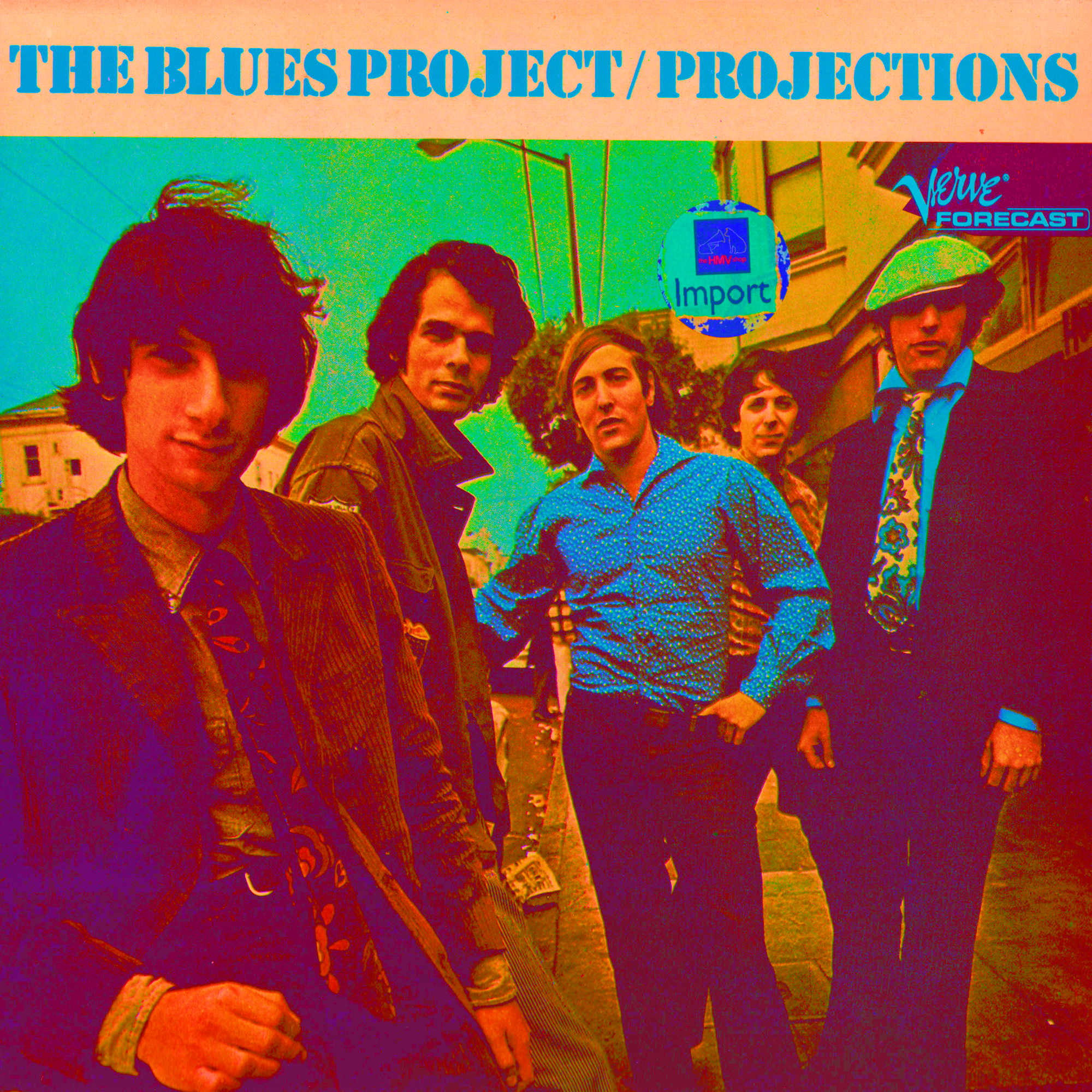
“Fly Away” is my pick from the LP | The Blues Project – ‘Projections’ (Verve Folkways FT-3008) November 1966
Article published in Crawdaddy!, March 1967
The Blues Project | Projections | (Verve Folkways) 1966 | The ultimate determinants of the quality of a record are: 1.) the level of the aesthetic concept, or “essence”, behind it, and 2.) the level of technical fluency and imagination that is used in executing that concept.
When a recording artist doesn’t really have a genuine aesthetic conception of what he’s trying to communicate (whether that conception be conscious or unconscious), then he is often tempted to make up for this lack of conception by concentrating solely on the technical aspects of his playing.
This often results in what I would call the “pseudo,” a sort of music without reason, a music that can’t fulfil any aesthetic impulse in the listener because it doesn’t contain any within itself.
To elaborate on these terms a little, at the most elementary level we can say that any musical performance is trying to express a certain type of feeling. We can call the communication of that feeling the aesthetic basis for the piece: it constitutes the essence of the music.
The Blues Project | Projections | (Verve Folkways) 1966

The artist’s technique would then, according to this little schema, exist only in the service of that aesthetic essence. If technique becomes unrelated to essence then the result will inevitably degenerate into what I have chosen to call the pseudo.
So, for example, if Keith Richard had put a hard rock solo into “Lady Jane,” that solo, regardless of how well played, would be pseudo because it would not contribute to the group’s expression of the essence of that song. Such a solo would be a gimmick, something artificial, something that just doesn’t belong.
To use still another set of terms to say the same thing: Consider that the ultimate goal of a musical piece is unity of expression, perfect integration of all the parts into some kind of emotional value to the listener.
Meaningless
To me, anything that is coming from outside this whole, anything that seems to be added on to the music as opposed to coming from within the piece is transparent and meaningless. For example, a good lead guitarist shouldn’t sound like his playing is adding on to something, or like it’s doing something different from what the band as a whole is doing: rather he should, even when soloing, be expressing the unified essence that the band as a whole is trying to communicate.
George Harrison’s playing is an excellent example of the kind of approach I think most valid. So is Mike Bloomfield’s. For in both these cases, despite the vast differences in style, the guitar playing always seems to flow naturally from the general context that each guitarists’ respective group establishes in their performance of any given piece.
The Blues Project | Projections | (Verve Folkways) 1966

In an ultimate sense every aspect of a group’s performance should be a reflection of what the group is expressing musically. In live performance, for example, the volume that a group plays at is a musical aspect of what’s going on. And, therefore, using the approach I’m out-lining here, we would ask of a group that plays at an extremely loud volume; Is the volume complementing what the group as a whole is doing or is it something that exists apart from what the group is doing, perhaps for pure shock value?
(Please don’t misunderstand. I love loud bands. But the loud bands that are good are the ones that can control and use the volume to help itself say something. Bad loud bands just make a lot of noise.)
Essence
Likewise, on records, the production is part of the musical essence of the group’s performance (even though most groups don’t produce their own records). So we should ask of the production questions like, is the mix bringing out the heart of a piece or is it obscuring it? Is, for instance, the addition of strings in the background helping to put the song across, or is it destroying the mood?
Again, every aspect of what goes on in the group’s performance, whether live or on record, should, ideally, form part of this unity of expression.
Turtling to ‘Projections‘, I think what I’ve been saying about unity and essence has particular relevance. For the chief characteristic of this record is its lack of a unified approach on the part of the members of the group, a lack of unity that ultimately results in this chaotic and superficial album.
The source of this failure lies most immediately in the incompatibility of the group’s members’ individual styles – I propose to assess these briefly below.
The Blues Project | Fly Away | (Verve Folkways) 1966
Andy Kulberg is an excellent bass man. As on the first album he is over-recorded, and the tone of his bass still lacks the hardness that most of the material requires, but he is by far the most tasteful member of the group. (Listen to him especially in “You Can’t Catch Me.”)
Blumenfeld, the drummer, is likewise an excellent musician. However, his playing is hardly powerful enough for this kind of high-voltage music. At a recent concert of the group’s, which I attended, his cymbals were all but inaudible, and this while the group was playing at extremely moderate volume (too moderate for my tastes).
On the album he simply fails to provide the necessary steadiness, the hard beat that songs like “You Can’t Catch Me” and “I Can’t Keep from Crying” require.
Steve’s Song
Katz on rhythm guitar, unlike Blumenfeld, is not only technically competent, but has a real understanding of what he’s trying to do. His playing on “Steve’s Song,” while somewhat overdone, is quite good. And he also contributes a couple of nice bits on harp.
Turning to the featured artists of the group, Danny Kalb is the lead guitarist and as such boasts excellent technique and tremendous speed in playing. Unfortunately, that is about all.
And speed for its own sake does not contribute enough to the musical performance of the group to make up for all of Kalb’s shortcomings. Basically, the problem with his playing seems to be that it’s done in isolation, done with no apparent awareness of where the rest of the group is at.
The Blues Project | Projections | (Verve Folkways) 1966

Unlike Bloomfield and Harrison, who, each in their own way, work towards the unity of whatever piece they happen to be playing, Kalb seems to be tearing down the coherence of much of what’s on this record.
For example, listen to how he seems to be fighting Kooper’s vocal on “Can’t Keep from Crying.” His guitar runs don’t fit in smoothly but are, rather, a sort of lightning fast, jarring irrelevancy.
Poor vocals
His solos are frequently worse because Kalb doesn’t seem capable of sustaining a musical thought for 12 bars, hence we get things like his solo on “You Can’t Catch Me.” With reference to that cut, just compare the Stones’ version, particularly Richard’s guitar, with what the Blues Project have given us.
Richard’s solo represents a beautifully constructed simple musical statement that is perfectly integrated into the cut as a whole. Kalb’s solo represents something considerably less. As for Kalb’s singing, suffice it to say that the quality of his voice doesn’t justify any recordings that have been made of it thus far.
Before leaving Kalb I think it important that we clear up a contingent matter concerning his playing. As noted earlier, Danny is an exceptionally fast guitarist. That comparison was made as a comparison with other guitarists.
The Blues Project | Projections | (Verve Folkways) 1966
Once we get into the field of jazz, of course, Kalb’s technique becomes nothing special. Listen to the technique of a Johnny Smith or a George Benson: people like these cut anyone in rock at a technical level.
I make the point to show the absurdity of the approach to rock and roll that judges instrumentalists on the basis of their technical capabilities, primarily. No jazz fan would consider Benson or Smith good because they play fast. They’re considered good because they can use their incredible technique to say something meaningful.
Ultimately Kalb’s problem revolves around his inability to do anything but the opposite, namely, to use his technique for no apparent purpose at all.
Finally Al Kooper, as everyone knows , is a fantastic rock organist and pianist. His work with Bob Dylan has been crucial in making Dylan’s instrumental sound relevant to Dylan’s lyrics.
Cuts like “Visions of Johanna” and “Sooner or Later” would have been far less effective without Kooper’s backing, But, oddly enough, it is just these virtues of taste and restraint that Al always shows in his playing with Dylan that are rarely in evidence in his playing with the Blues Project.
Flashy
In fact, Al’s playing with his own band has been at a level far lower than his playing with Dylan’s various back-up bands has been. Rather, with the Blues Project, Al seems to have absolved too much of the shallowness of Kalb’s style.
For example, his piano on “You Can’t Catch Me” and “Caress Me Baby” is flashy, fast, and show-offish. There’s little development of musical ideas , just a lot of notes. This type of playing can, I admit, be momentarily exciting, but becomes increasingly boring with each successive listening. Finally the listener realizes that not an awful lot is happening. To one extent or another, this criticism applies to all of the group, except Kulberg.
Looking at the record, the lack of unity and purpose that exists among the members of the Blues Project, as shown by the assessment of the individual members of the group becomes even more apparent. “I Can’t Keep from Crying” has a good arrangement and a good vocal, both by Kooper. Yet the cut is marred by two things.
The Blues Project | Projections | (Verve Folkways) 1966

The first is the aggressiveness of Kalb’s style, which has already been noted. The second is the rave-ups which come after the first and before the last verses. Compare it to the way in which the Yardbirds bring their sound up.
The Yardbirds when they’re good are experts at controlled improvisation. The Blues Project’s thing is just chaos, and irrelevant chaos at that: the build-ups in sound and, especially Kooper’s turban playing, stick out like sore thumbs, seeming to have nothing whatever to do with the song itself and keeping the piece from achieving any kind of unity.
Of the other blues-oriented cuts, “You Can’t Catch Me” is poorly sung by Kalb and is much too fast. “Caress Me Baby” is likewise poorly sung, is much too long and completely misses the eloquence of the Jimmy Reed version. There seems to be no foundation to what the Blues Project are doing here.
“Wake Me, Shake Me” almost makes it but the instruments drag on for too long and wind up killing the mood that Kooper’s fine vocal starts to create. It completely misses the excitement of their live version of the tune.
“Two Trains Running” is long, tedious, and catches none of the beauty of Muddy’s version, or even the excitement of Butterfield’s version.
“Steve’s Song,” “Fly Away,” and “Cheryl’s Going Home” are all folk-rock and are all well-arranged and well-played, except for the unnecessarily long intro to “Steve’s Song.” Katz sings “Cheryl” poorly and his own tune well. “Fly Away” is pretty all the way around.
The Blues Project | Projections | (Verve Folkways) 1966
It’s a good tune, by Kooper, and he sings it well. Also there’s a nice harp introduction. It’s really the only cut that is unified in the sense that I’ve been using the term throughout this review, and, as such, I find it to be the most satisfying cut on the album.
Finally, there’s “Flute Thing,” which is ridiculous. Kulberg’s flute is lovely, but after that it’s every man for himself. Both Kooper and Kalb play so flashily that they completely destroy the mood of what is essentially a beautiful piece, written by Kooper.
Taken as a whole, I see this album as a chaotic piece of work, unified by no central emotional or musical theme, and dominated by a shallow approach to creating music.
What I’m trying to say by all this is that there’s something wrong with this record, and that it’s not just an accident that there is something wrong. There are specific musical shortcomings with this group’s approach to their material that has resulted in this musically embarrassing album.
The way I hear it this shortcoming is the failure of the individuals in the group to subordinate their individual techniques and styles to some higher musical goal, namely some kind of unified aesthetic expression of what they feel.
For the single biggest consequence of this kind of music without a musical unity or aesthetic cohesiveness is just that: music without feeling.
JON LANDAU

The Blues Project | Projections | (Verve Folkways) 1966
THE BLUES PROJECT can be defined by those who know and understand music in different and interesting ways. I describe it as a work of determination!
Take these five young musicians and their struggles of this past year; they made it without the aid of a ‘single on the charts’ and despite the economics of an almost unbroken law that says, “no hit record, you don’t survive.”
But with these young men, you find that there is an exception to the rule. The struggle has not been an easy one, and it is far from over. But—they are going to ‘make it!’
Witness their exciting performances at the Cafe Au Go Go in Greenwich Village . . . the three times they played at Central Park this past summer to SRO crowds. These are the dates that made possible the healthy ‘underground’ movement, the ever-growing grapevine that has led them to dates in San Francisco and concerts in colleges that included Rutgers, Boston U., Kent, Ithaca, Brandeis, Hobart, CCNY, Grinnell, and others.
People are subscribing to the music and the originality of the Project. On a recent trip to Hawaii, I was asked by a number of students, “When will The Blues Project be coming over?”
It would not be surprising to find students in Europe and Asia asking the same question. The word is out, it is inevitable that whatever roads the words travel, the group, its music, and its station wagon will be sure to follow.
Expect them to appear anywhere. They have something to say. The world wants to listen to music—wants love and hope . . . and this is what The Blues Project is projecting—Love, Hope and a determination to make their sounds meaningful and lasting. SID BERNSTEIN


Leave a Reply