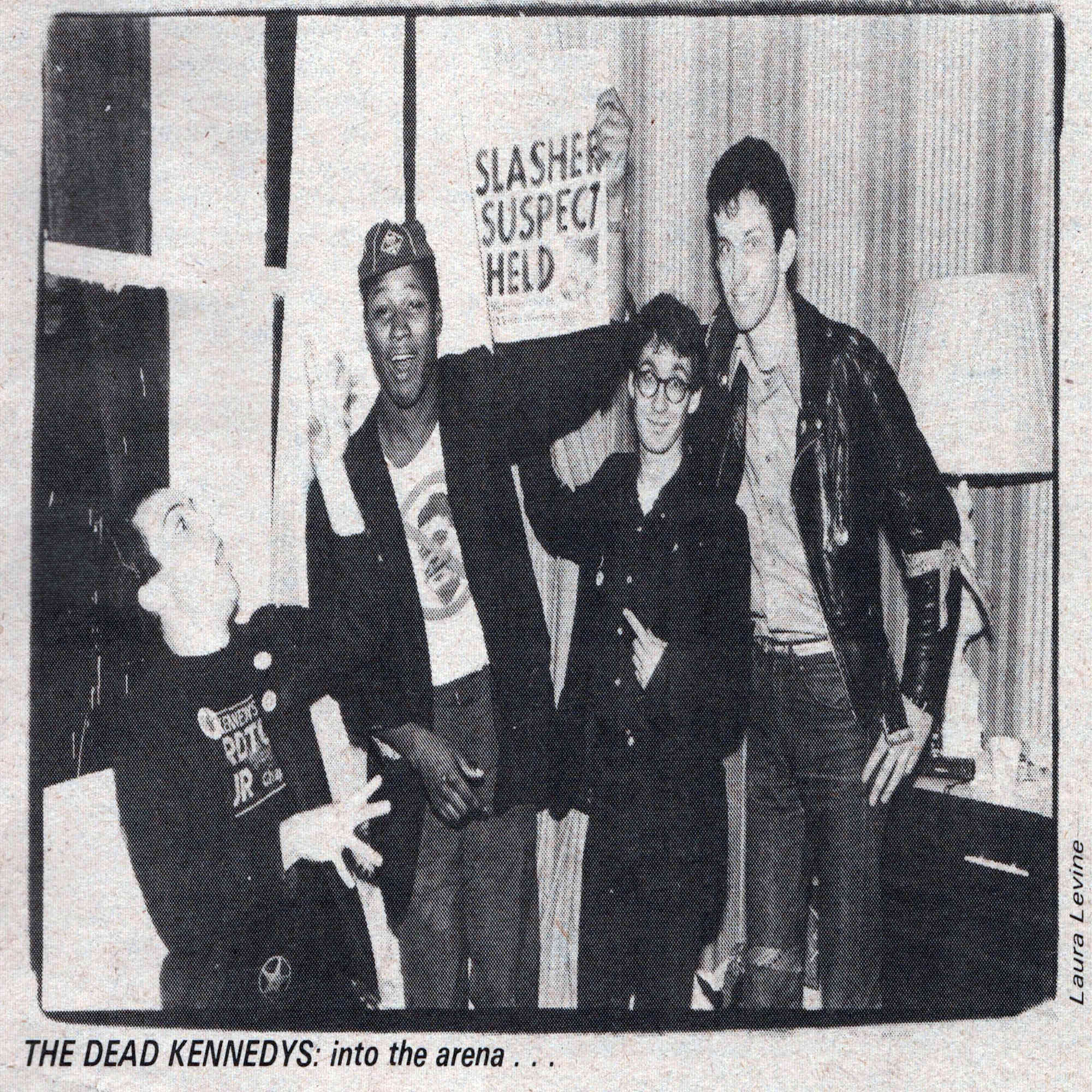
TIM SOMMER gets infected by the disease music of the DEAD KENNEDYS
Article published in Sounds, 2nd October, 1982
The Dead Kennedys | Twisted Tales | LIVING IN New York/America and at one time being part of an active punk scene, I’ve seen the tremendous amount of respect Jello Biafra commands.
Along with a choice few others (Black Flag’s Henry Rollins and Minor Threat’s Ian McKaye, most noticeably) Biafra is pretty much able to dictate his thoughts straight into the media, and the American punks will listen, will follow his endorsements, will pledge unswerving allegiance.
In England, comparable figures would probably be Crass or Garry Bushell — that is, people who are able to strongly influence mass taste and thinking (for better or worse), people who are able to get their thoughts heard, and to a degree, obeyed.
A dangerous power, this is. Whether you like it or not, it’ll put you at the centre of a million and one conflicts, especially having to do with your own ego and its place and resulting hypocrisy. For the year’s time I produced Noise The Show in New York I flirted with it myself — I saw the power and the misuse of power a captive, regular audience can give you. It takes a lot to avoid that.
Jello Biafra is a weasley little know-it-all (and believe it or not I don’t necessarily mean that in a bad way) who’s very aware that people really do listen to what he has to say.
Like anyone with a large ego, he’d like to think he doesn’t have one, but the size of his audience and the position Biafra’s chosen to place himself in dictates the existence and mis-existence of that ego. Practically no one can avoid that — given a platform, how can one seize it without indulging?
The Dead Kennedys | Twisted Tales
Of anyone I’ve come across, Mark E. Smith‘s probably the only mortal I’ve seen avoid this — the only rock star who really isn’t a rock star, the only preacher who’s not preaching his own ego. And though Biafra’s a fairly interesting and unique fellow, he’s no Mark E. Smith.
The bottom line of yer Jello Biafras and yer Steve Ignorants and yer Darby Crashes and any of yer folks who self-righteously state “We’re NOT rock stars, we’re different” is this: they preach and they know people listen, they get up on stage and face an audience and play songs that have beginnings, middles and ends, and they stop between the songs and they show off and they act and they make theatre —that’s not any different to what Buddy Holly was doing years and years before I was born. Sorry!
And if you admit you’re doing it, fine! I’ll apologise to the NME for saying this (Don’t bother — Ed.) but there’s nothing at all wrong with rock or rockist thinking, but if you do want to subvert it, then genuinely subvert it and its structure, but don’t masquerade old-style theatre as subversion.
American punk
THAT OFF my chest, let’s set this up: 1982 and it’s been six years since the Pistols ‘n’ all that, and five years since the first real American punk began popping up —and that’s a whole phenomenon and musical chapter that the rest of the world knows nearly nothing about. I’m not talking about the Ramones or the Dead Boys or Talking Heads (that’s the stuff Parsons and Burchill were talking about when they said ‘American punks don’t want to make good music, they just want to make money’), but the whole early West Coast scene of the Dils, DOA, Bags, Avengers, Weirdos, Legionnaire’s Disease, all great bands that put out great records that have been totally lost over the years.
That first American punk wave was well dead by 1980. And it’s been about two years since this animal called hardcore began spreading like a youth cancer across America — it kicked off with a few bands in each city around ’80-’81, groups like Black Flag, Kennedys, Circle Jerks, Bad Brains, Minor Threat, SOA, etc.
All of ’em had a profound effect on future US punks —it’s spread to the point where in 1982 every 14 year-old skinhead you see at a gig has a band, and most of ’em sound alike and most of ’em aspire to the same things —to play as fast as possible and sound as much as possible like their idols, usually one of the aforementioned bands. Simply put, the state of American hardcore in 1982 is a clear case of quantity over quality.
The Dead Kennedys | Twisted Tales
And despite what Biafra would like to think, most hardcore here isn’t true subversion at all but just a new way to follow the leader, a new style and pose to blindly emulate. For every Anti Pasti — a band that has such a perfect grasp on the grandeur and power of smart, evolving punk — there’s a thousand American kids who wouldn’t understand real punk if it kicked ’em in the arse, and wouldn’t want to take the time to try to understand.
And Jello Biafra is the king of the whole thing. Most US punks would be hard put to name the rest of his band —Biafra is the face and the mouthpiece, and he’s got a massive audience of very impressionable Xeroxed teen skinpunks as his listeners.
But that’s not to exaggerate the importance of hardcore here in America —it’s a relatively minor force (Van Halen can sell eight million records here, Human League can sell two million, and the Kennedys, Black Flag and the Circle Jerks probably haven’t sold 100,000 between them), but now that ‘new wave’ has been integrated into the standard ’80’s American lifestyle, I think it would be safe to say that hardcore is probably the American youth rebel image at the moment; if a TV show or a cheap film needs a real evil, dangerous young character, they’ll invariably chose a combat-booted skin.
Bleed For Me
I FIND MYSELF disagreeing with Biafra on a lot of points, especially about the relative merits of punk on either side of the Atlantic —but I admire his mission and I usually admire his band (‘Bleed For Me’, with its searing Damned/Exploited-like pulsing bash is the best thing they’ve done for ages).
But I wouldn’t want to print his thoughts and have my name on the by-line without establishing my own point of view about these things.
So now that I’ve interviewed myself (not that you asked, I know!), from here on in, now that I’ve hopefully set some perspective, it’s Jello Biafra talking.
Q: When did punk become hardcore, and when did that separation really begin to make a difference?
“Well, hardcore was just a name change to differentiate the true garage bands from meaningless stuff like the Plasmatics or Anti Nowhere League or Anti Pasti, who are more of your prototype punk bands, if you will
The Dead Kennedys | Twisted Tales
“One thing that’s been really beautiful about the whole scene since the very beginning is that every time one generation of bands begins to slack off and wimp out and start to ride on their reputation, there’s a new generation of kids waiting to overthrow them.
“And I guess hardcore started coming in first with Black Flag and some of the Orange County bands, and then when some of the LA bands began to run out of steam just as Black Flag began to tour the country and people began to catch on nationwide, the DC bands started getting some notice — they had taken very fast hardcore punk a few steps further into the extreme, and it was born all over again.”
Q: Wasn’t there a point when the Dead Kennedys or Black Flag were definitely punk bands, as opposed to being hardcore bands?
“Well, I would say so, yeah, we sure weren’t pop or new romantic bands or anything, and we weren’t ashamed of being called punks, especially when we considered what else we could have been called instead.
“I’ve liked to describe us as ‘Disease Music’ for a long time — ‘cos we’ve tried to take punk or hardcore or whatever it is you call it to its experimental extreme without losing the hardcore energy.
Repeating themselves
“One thing that’s really sad is that — especially in England — there’s been this huge split between the punks and the experimentalists, so you either have totally boring, unbearably wimpy post punk bands like New Order, who go around desecrating Joy Division‘s good name with their lousy imitations, or you have a lot of the new younger punk bands who are getting most of the attention over there, and they’re people who grew up listening to nothing but punk rock records, so they have no other musical influences to draw on and they keep repeating themselves.
“So my support is leaning now more towards the bands who are willing to take the hardcore energy but take it to new areas and new extremes, and most of that is happening in America right now, as people like Husker Du, Autistic Behaviour and MDC have taken DC or ‘In God We Trust’ style thrash and brought it to new levels of brutality. You should watch out for MDC’s ‘Millions Of Dead Cops’ album, it’s very important.
The Dead Kennedys | Twisted Tales
Q: Is there anyone in Britain doing anything like that?
“The Birthday Party, who are actually Australian, still have authentic trash appeal, which is very hard to come by over there.
“And there’s a hardcore band, if you will, called Rudimentary Peni who just put out an EP on the Crass label and they also have an earlier EP that’s just totally amazing — kind of like a cross between Husker Du, the Germs and the Feederz. It’s very hard in England to find a band that’s really twisted — unlike in America — but those guys are definitely twisted.”
Q: What’s the story with ‘Kinky Sex Makes The World Go Round’ and your contribution to the Wargasm LP?
” ‘Kinky Sex’ is actually a pseudo-dub version of ‘Bleed For Me’. The actual song ‘Bleed For Me’ is about governments that torture political prisoners and get their know-how and the funds to do it from America, and to a degree this kinda thing goes on in America as well.
“That’s one of the things that scared me so much about Alexander Haig is that he was so fond of El Salvador’s methods of wiping out their dissent that I figured I hope he doesn’t use that on us, I hope he doesn’t think ‘Oh well, we’re just practising’.
“As for ‘Wargasm’, we were honoured that the people involved wanted to hear from someone outside of England. Our anti-war sentiment is more widespread than just anti-nuke because in our backyard we also have the possibility of getting drafted and being sent over to Israel or El Salvador or wherever we have to fight to keep some oil company from not getting their tax-loss money this year.”
Hardcore Heroics

Q: What’s going on with Alternative Tentacles?
“That’s a good question! What is going on with Alternative Tentacles? Um, we’re trying to get the American branch off the ground, for the moment we’re working with Faulty products, though there’s so many things we’re hoping we can do — simply because nobody else will do them, I’d rather somebody else did, but somebody’s got to get this stuff out.
“We’re going to want to start doing things more independently, which we haven’t really had the time or the organisation to do yet. But that’s kind of our goal for the next year or so.
“There’s so many bands —coming out of San Francisco alone there are probably 50 or 60 relevant bands now. On the surface, it’s a glut, everybody and their brother is in a band, but if these bands are encouraged to keep on going they’re going to grow and turn interesting and keep the scene alive and vital.”
The Dead Kennedys | Twisted Tales
Q: Do you think a song with as strong a statement as ‘Nazi Punks’ really had any affect on people’s thoughts or actions?
“I think it’s had an affect on cutting down on the really vicious fighting that was going on on the West Coast at the time. There were people who were bringing in a very bad-assed red-neck mentality into shows — the ‘I’m tougher then you’, B.S. macho attitude — and we wanted to emphasise that we thought this had no place at a hardcore show.
“Hardcore shows are supposed to be fun, they aren’t supposed to be a PE class. And so I think it had an effect on some people, just saying that at least one band has an opinion and they don’t condone this.
“Some people, especially in San Francisco, were going ‘Nyeeaah, nyeeaah, nyeeaah, it’s too preachy, you’re telling people what to do’ — which is a total lie, We’re expressing a strongly felt opinion and if someone else has a better opinion we’d be happy to hear it, but until they do, they better think about what we’re saying.”
Nazi Punks
Q: At gigs, I see a lot of people who aren’t Nazi punks, they’re perfectly nice people, but they don’t really listen to or care about the bands — they just slam, they would slam into anything or anyone.
“That’s what I was saying about people who treat it as a video game or a disco. You can’t expect to get through so every single person who comes to a show every time you play, if one person walks out of the room afterwards with their pre-conceptions cracked open and their minds opened to new ideas again, and they’re willing to use their own heads — fine, but you can’t expect to get through to everybody.”

Q: Where does hardcore go from here?
“It’s getting bigger, but people higher up in the authority pyramid are still trying to keep it underground, but it’s catching on in middle America, even places like Crowley, Louisiana have a hardcore band now.
“Again, on the surface this means the dawning of the hardcore bar band, but on the other hand it means people getting off their butts and involving themselves in something creative, rather then just sitting and listening to other people’s records and following other people’s bands around, or whatever.
The Dead Kennedys | Twisted Tales
“One dilemma we do feel kinda caught in right now is, um, is we are getting better known and there are more and more people in different areas that want to see us, but how do we avoid doing things like arena rock shows — which we’re violently against?
“Another problem we’ve had on this tour is the last time we did a tour we went through a commercially-minded agent that in some places put us in the kind of venue we would have never played in had we known what it was like; so this time we booked the tour ourselves, no agencies, insisting on clubs or preferably rented halls with no age limits and no psycho bouncers.
“We wanted to get rid of that routine as much as possible, but the new can of worms is that in places like New York, Boston and some other places we’ve had a real bad time trying to find a place to play because of the stranglehold put on those scenes by the more commercially-minded promoters.”
Cliche?
Q: How do you avoid becoming the things you hate, like a rock star or a cliche?
“That’s one of the reasons we don’t tour that much, we don’t want the whole thing to become a job to us. Some bands thrive on touring and playing every single night for who-knows-how-long on end, and I admit I admire their penchant for hard work, I respect that, but with us we know our limits, and we don’t want to see the whole thing turn into a job.”
Q: What’s your feelings towards the British bands and audiences these days?
“I don’t dislike all British fans, just people who follow particular bands. The idea of following a band around bothers me to begin with – why write your favourite band’s name on the back of your jacket, even their logo no less, when you could be writing some slogan that could either inspire people or offend people or both?
“You could be writing your own thoughts rather than following someone else’s band around, and there are a group of bands in England that are making a conscious effort to water down hardcore punk into heavy metal dog turds.
“What I mean is making it into a formula, taking very superficial stands — I believe in Anarchy, I hate the cops, but I don’t care what it means, I just want to see people beat people up at our shows, and most importantly aiming to please rather then aiming to arouse.
The Dead Kennedys | Twisted Tales
“Anti Pasti is my favourite example of that, again, a band that even gets so heavy metal as to clap their hands over their heads, ‘c’mon everybody let’s have a good time’. Leaving things at the superficial level of ‘let’s everybody have a good time’ brings punk rock down from the level of rage and danger, brings it down from that level and into the level of safety, commercialism.
“Like, the first time we went over there we got mainly the Crass and the UK Subs fans, and we learned a lot from ’em — they didn’t just eat up everything you said — if there was something that we said that they disagreed with they’d tell us, and they’d tell us why, they wanted to know certain things and they’re interested in finding out specific information about what goes on in this country.
“Then the second time around we got a much larger percentage of the Exploited fans and the Anti-Pasti fans who just came to jump up and down and shake their fists into the air heavy metal style and leave, except to hang around and say ‘When is your next record coming out? What do you think of England? Oh. Bye.’ “


Leave a Reply