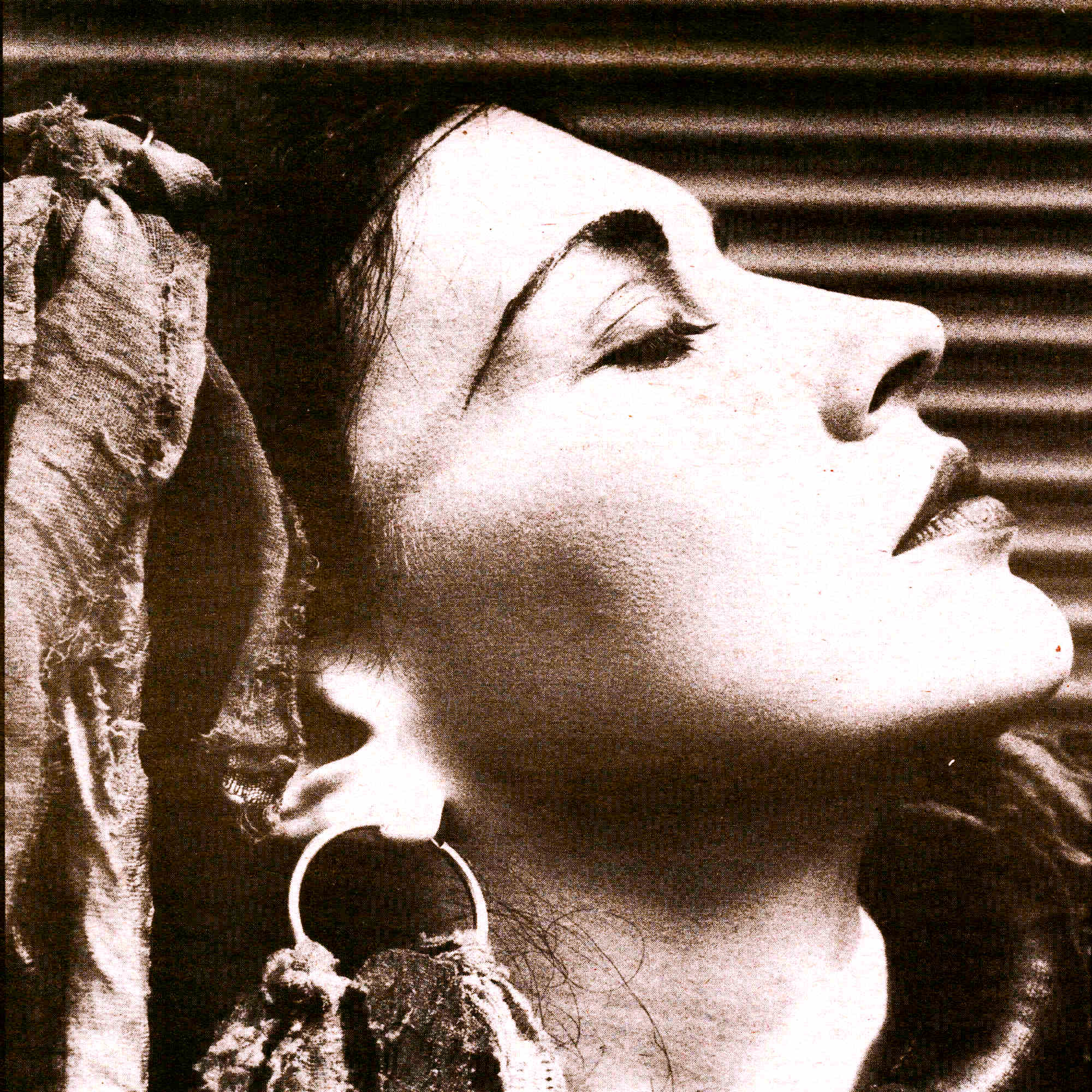
After keeping a low for 18 months, LENE LOVICH re-emerges as the star of her own musical about Mata Hari. But does she still have a lucky number?
Lene Lovich | A Slav Unto Herself | “You know who I’ve been digging a lot lately, not as a performer but as a singer? Lene Lovich. I really dig her music.” Iggy Pop interviewed by New York Rocker, January, 1980.
“Her Lene Lovich squeals ‘n’ squeaks confirm by reports from local rockophiles that the Slavette from Detroit is a big influence here.” ‘Postmark: Austin, Texas’, NME March 7, 1981.
“Half an hour or so and a demure kind of Lydia Luncholite wandered onstage to pout alongside Tom in what seemed to be a rather dewy-eyed Loft Mix of Tom Petty’s and Stevie Nicks’ Stop Draggin’ My Heart Around’.” Barney Hoskyns reviewing Tom Verlaine at the Venue, NME June 19, 1982.
THE SONG Barney couldn’t put a name to was ‘Postcard from Waterloo’ the single from that Verlaine LP which figured at number 17 in NME’s first-six months-of-the-year staff chart.
A song which — to quote the Village Voice on it in performance — “reaches ambiguity effortlessly and lyrically to become one of its author’s finest”.
The co-vocalist in question, as anyone on the dance floor could have informed him, was Lene Lovich — who contributed the exact same skills to the vinyl version.
Lene Lovich | A Slav Unto Herself
Marlene Premilovich —professionally, Lene Lovich — had been out of the stage limelight for awhile, since the January 1980 release of ‘Flex’ and subsequent tour of Ireland, America and Europe.
Now, after a year and a half of confusions and re-evaluation, Lene’s putting her revitalised energies and hard-won equilibrium to the service of something completely different: a musical about Dutch adventuress Mati Hari (executed in somewhat dubious circumstances as a spy on October 15, 1917).
Scheduled to run at London’s Lyric Theatre from October 19 through November 13, Lene is co-authoring her project with longtime partner Les Chappell and old friend Chris Judge Smith (a founder-member of Van Der Graaf Generator) who donated two numbers to ‘Flex’ and authored a previous musical —’The Descent of Wilberforce the Third’ —about mountain climbing.
I met Lene and Les for lunch before they were due to meet one of several directors interested in their musical. In her usual fashion-bandit couture — four or five skimpy patterned skirts, and a leather jerkin with rolled collar, plus a knit jumper shot through with gold lurex and topped by an embroidered Tyrolean jacket — Lene looked right at home. Les sported a two o’clock shadow on the barnet Gillett once tried to recruit for a razor-blade testimonial.
Both seemed glad to sit down after bouncing from studio to studio (The Kinks’ Konk and Visconti’s Good Earth) in the effort to finish a third album for autumn release. Lene would like it to be titled ‘No Man’s Land’ . . . a not inappropriate title for her state-of-the-heart since the beginning of ’81 —all that time during which other musicians have been citing her talents as a major influence.
Lene Lovich | A Slav Unto Herself
Beware of their promise — believe what I say . . .
They paint a pretty picture And they tell you that they need you; And they cover you with flowers and they Always keep you dreaming; they always keep you dreaming,
You won’t have a lonely hour . . .
If the day could last forever you might like your ivory tower
But the night begins to turn your head around,
And you know you’re going to lose more than you found
Bob Gaudio / Al Ruzicha, Jobete Music UK Ltd.)
‘The Night’, from ‘Flex’, January, 1980
LENE LOVICH — expatriate native of Detroit and one time sculpture student at London’s Central College of Art where she met up with Les Chappell — came to Stiff stardom via DJ Charlie Gillett and his ‘Oval Exiles’ scheme of 1977. Gillett sponsored her first demo (‘I Think We’re Alone Now’), then handed it on to Stiff’s Dave Robinson.
Formally, Lene is signed to Gillett’s Oval label, but licensed to Stiff.
“Oval survived because of the money we made from ‘Lucky Number‘,” says Gillett today. But like other fans of Lene’s 1978 ‘Stateless’ LP, Charlie Gillett felt less than convinced about ‘Flex’.
“When she first came to us, she was so up in every sense. She giggled a lot, and as soon as she started performing, she was electric. If I’ve had a disappointment in what she’s done with her music, it’s that she abandoned that effervescent side of herself for something more moody and introspective. To me that seems neither appealing or appropriate to her real self.”
Siphoning Perrier through fuschia lips, Lene — whose startling light blue Slavic gaze is as frank as her carefully modulated speech —describes her homecoming from the last tour which marketed her effervescence.
Lene Lovich | A Slav Unto Herself
“When we came back to England we had a lot of looking at our lives time . . . It was the first time we’d stopped throwing ourselves around since signing with Stiff, and it was beginning to be very difficult to see the future.
“You see, it was a bit of a shock to travel around — not staying in posh places but, like, having a reasonable roof over your head —then coming back to a rathole in Hackney. I mean (she laughs), I’m no snob, but after a while it gets up your nose to see other people making money out of you and find yourself back where you started.
“I got really wound up at the injustice of it and I thought, I’m gonna have to think of some way to see a future because I’m going to die just like this — constantly on the same treadmill, just wrecking myself. Because I haven’t made any money out of this — not at all, and it shocked me that even if I could go on a bit longer, I’d still end up nowhere. It wasn’t fun envisaging having to kind of crawl on your hands and knees to get stuff recorded . . . “
“Purely by luck,” as Lene puts it, some money suddenly materialised from the eight LPs by French disco artist Cerrone for whom she had penned lyrics in ’76. Lene and Les used the funds to establish a base in Norfolk, where they have half-completed a 16-track studio of their own.
Uplifting

IT WAS Charlie Gillett who first encouraged Lene to sing, against her original feelings and the advice of those around her. Today, with the extraordinary, extreme and honest female vocalising of Diamanda Galas and Yoko Ono attracting such press, that athleticism of the heart with which Lene sings seems at last a logical influence.
“It’s hard to know what to say about that,” comments Lene herself, “except that it’s always been very spiritually uplifting when other people mention me because it makes me feel I do exist in this music business which, as far as I can see, is often totally anti-music.
“Girls are still not expected to do anything — except maybe dress up — and they’re always suspected of ulterior motives. Plus there is always a tendency to remove the ones who are ‘different’. Yet — that’s the only way to progress, and it’s not an aim on your part to be ‘different’ . . . you can’t do otherwise.
Lene Lovich | A Slav Unto Herself
“Really I’m only just discovering my voice. I think the fact that it leaps out at you from time to time, that it’s not conventionally smooth is one reason people may not like it.
“But I can’t ignore what’s really there —that goes beyond any idea of making a living. It’s something which has hung over me for most of my life, that I just can’t ignore myself.”
Lene sees her opera style Mata Hari musical (in which she will sing, not speak, and will address only the audience rather than the cast) as “a different adventure . . . because I’m not really the theatrical person people make me out to be. With what I do musically, it’s expressive, but I’m not acting at all and I really don’t know if I have any talent for acting as such.”
The Gillett-Stiff team, however, say they “always thought of Lene as an actress. We hunted around for any lead we could find for her into TV, movies — anything.”
Breaking Glass
Gillett sent her to see Brian Gibson when his embryonic ‘Breaking Glass’ scenario still starred a boy; Lene auditioned for the secondary role of the girlfriend. And Gibson was so impressed he re-wrote his entire film to feature a female lead.
“I figured,” says Lene slowly, “OK, I could probably do it. But I was just beginning to get involved in music and I thought it would confuse everything. I thought I’d confuse myself. They did try everything to get me in that film; they used some really horrible emotional blackmail.”
Although she’s never seen the finished project, Lene concedes she thought it was ‘right’ for Hazel O’Connor to do it. “I would have taken the film a whole different way; it wouldn’t have worked.”
Lene Lovich | A Slav Unto Herself
Nevertheless, on her return to the UK she was surprised to find Hazel O’Connor flogging a pathetically bastardised version of her sound with no substance at all.
“Part of the reason she turned down the film,” contends Charlie Gillett, “was Dave Robinson wanting her to undertake this mega-tour just at that time; and since she became such a huge influence in America it would hardly be right for me to say she made a wrong decision. But I certainly think it contributed to her confusion to come back and find this person . . . cashing in with a cloned-Lene Lovich sound, even to another song called ‘Writing on the Wall’.
“I think it froze her totally as far as songwriting.”
Tom Verlaine
A major encouragement to Lene, however, was the unexpected working relationship with Tom Verlaine. In New York for a few days while he was giving interviews to support ‘Dreamtime’, Lene noticed he had mentioned her name. She went to see him at Club Left and they spoke briefly backstage.
“I’d always felt a kind of affinity with him —which is difficult to explain because on the surface we seem to be worlds apart. I had never even seen a picture of him, never heard him live. But when we spoke after the show, something came out, something showed through. It’s difficult to pinpoint these things because they’re unspoken, you either feel right with someone’s work or you don’t.”
“Anyway, a lot of time went past, but one day he called me from New York; he had an idea I’d like to play some sax on the record he was making (‘Words From the Front’). So — I answered the call!” She smiles. “It was kind of like, whatever I am, he’s it too. We outsiders have to stick together!”
Lene pauses, her dark conglomeration of lace, black braids, curtain rings and Victorian curling rags bent thoughtfully over her plate.
Lene Lovich | A Slav Unto Herself
“There’s a great pressure to be processed today, and I don’t know quite what to say about it because it goes round and round in my head and affects my life and upsets me. I don’t think it needs to be like that at all and I’m sure Tom feels the same way — that what you can do can be as acceptable as what other people tell you you should do. But often the people you’re trying hardest to be honest with are those who have your best interests least at heart.”
“People shouldn’t have to want to suffer. But when you want to do something, you often have to go through such an odd, difficult time you risk changing without even realising it.”
AT A TIME when full-blooded female singing about feeling couldn’t be more ‘in vogue’, and the saxophone is inarguably the instrument of the day, Ms Premilovich and Mr Chappell seem perfectly able to continue weathering the vicissitudes of fashion — thanks to the fact that their faith is firmly rooted in the inexhaustible potential of the imagination.
Also because—like truly individual artists since time immemorial — they are adamant about going their own way and learning from their own mistakes.


Leave a Reply