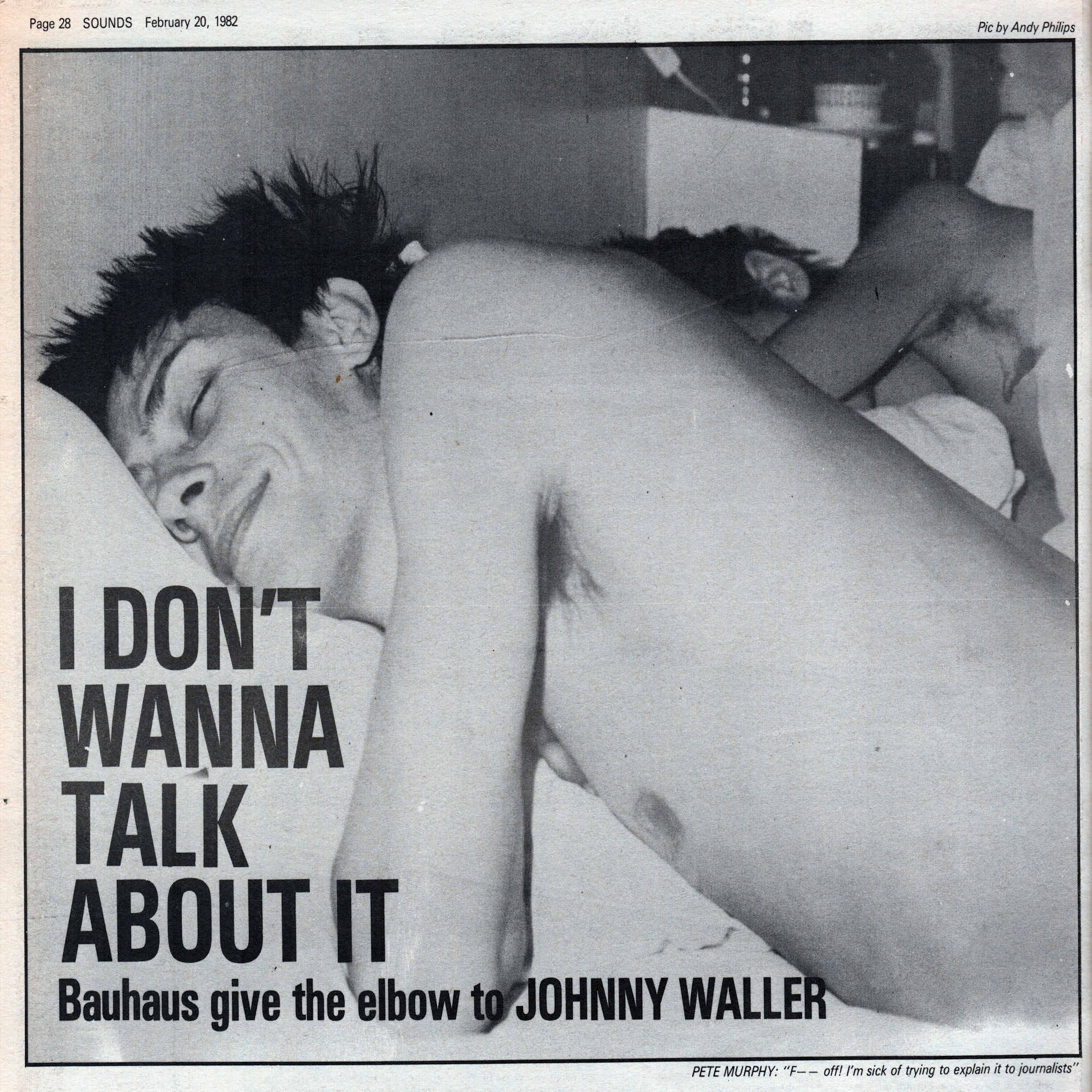
Bauhaus give the elbow to Johnny Waller
Article published in Sounds, 20th February, 1982
Bauhaus | I Don’t Wanna Talk About It | THE PROBLEM —apparently insurmountable —is to explain satisfactorily the bizarre appeal and wayward motivation of the unholy quartet revered, feared and sneered at the length and breadth of these lands. A name to be whispered in tones of awe, or hissed in contempt . . . I give you — BAUHAUS!
“This is for when the radio is broken and crackles like uranium orchids, this is for when your sex is full of voodoo, this is for when your clothes are imaginary, this is for when your flesh creeps and never comes back.” — sleeve notes from ‘Mask’, the latest Bauhaus album.
“The sensual is far more important than the intellectual.” — David Jay, Bauhaus bassist.
“F*”* off! I don’t want to talk about it any more —I’m sick of trying to explain it to journalists.” — Peter Murphy, Bauhaus vocalist.
Bauhaus | I Don’t Wanna Talk About It
In a dingy, squat hotel room somewhere, I am being kept waiting, perhaps as an exercise in unsettling psychology. The telephone does not ring, the silence becomes a stifling void, yet I cannot . . . dare not . . . ESCAPE in case the phone rings!
Eventually the contact is made, “Now? Yes, that’s fine with me . . . only David? The others aren’t talking to the press? I’ve got just 20 minutes until he has to sound-check . . . OK, I guess that’s better than nothing — I’ll be right there.” Click.
Entering the spacious room David Jay shares with brother Kevin Haskins (Bauhaus drummer) is a curious Tardis-like sensation — how can the baroque door which exactly resembles those leading to the squashed, squalid cubicles which photographer Andy Phillips and I occupy also conceal this arena of relative opulence?
Tinted spectacles
Obviously Bauhaus are doing rather better than most people (would like to) think, while their record company are rather less extravagant towards visiting journalists than Andy and I had hoped!
In the restful, dimmed lighting, David Jay eases himself into a comfortable armchair, adjusts his tinted spectacles and awaits commencement of our game.
Both he and I realise we’re merely acting out roles, but whereas I feel edgy and distinctly irritable, he exudes an enviable cool calmness, almost as though he has at will slowed his own heartbeat and pulse-rate to match perfectly the hypnotic rhythms of Kraftwerk’s ‘Computer World’ oozing from his large, expensive cassette machine.
Suddenly I’m gripped by an irrational worry that I’ve been lured into a trap; that the rest of Bauhaus are hidden, poised to pounce, to exact from my misfortune what they would see as poetic justice.
Bauhaus | I Don’t Wanna Talk About It
As if to confirm my darkest thoughts, the door bursts open and in tumble the maniacally elegant duo of Peter Murphy and guitarist Danny Ash, exuberantly bubbling and babbling about the exotic eroticism of water beds. Barely shifting his gaze from his clasped hands, Jay routinely intones “I’m doing an interview” and at once it’s as though the door had never opened.
YOU SEEM to be so much calmer and less exaggerated than those two, David —especially on stage — is that a deliberate ploy or merely the result of personality differences?
“I think we’ve grown more apart over the . . . the years now.”
He gives a hollow laugh at how long they’ve been together, then continues, “I think we started at a common rendezvous point and have all veered off in different directions . . . not just Kevin and I in one and them in another, everybody’s moved in their own way, and so it’s just moved away from that common entity.”
Ever-darkening glasses
His speech is measured and precise, often pausing to consider the question or select the exact word required . . . as one might when speaking in a foreign tongue, with the exception that David Jay appears perfectly at home in this situation.
Beneath his ever-darkening glasses — which seem to me to have somehow become a face-mask — I fancy he is grinning, if not at me, then certainly to himself.
Bauhaus | I Don’t Wanna Talk About It
Has this ‘veering off’ been magnified through being in a group together?
“Yeah, I think so . . . to a certain extent, yeah.” He pauses, then suddenly: “In one way, it’s pulled us closer together, but in another way it’s pulled us further apart.”
This cataclysmic revelation is accompanied by the merest of smiles. When prompted further, he offers only that “it’s not something you can readily define” which strikes me as odd, since I’ve always regarded Bauhaus as a band to be thoroughly self-analytical, if occasionally failing to be ruthlessly self-disciplining.
I mention that it had been suggested to me that Bauhaus had stolen their image from another group and Jay shows only faint interest.
“Who would that be?”
We influenced them
UK Decay, so I’ve been told. “Oh dear . . . er, well” (he seems genuinely perplexed and dismayed) “I would say it was the other way round — it doesn’t matter to me, that sort of thing, but I’d say it was the exact opposite, that we influenced them. We bumped into them very early on, and every time we came into contact with them after that, it seemed that they’d taken a leaf out of our book.”
And which book did you take a leaf from?
Silence. OK, let’s try again — did it take a long time to develop such an image?
Bauhaus | I Don’t Wanna Talk About It

“No, not at all, it just seemed plainly obvious, when we first started up, that was the way to present ourselves, it was just right, we didn’t have to talk about it. It was just right for us.
So why didn’t you personally participate in this demented, pagan image?
“Well, we are as we are, and I am as I am. We’ve never tried to contrive any image or diversity of image — we’re just as we are!”
Entertaining though such word-games are – and while appreciating that he probably isn’t simply avoiding answering the questions for the sake of it – I am determined to pin Jay down on the band’s visual image. I mean, are Bauhaus what the four of you now look like, or merely the four of you, no matter what you look like?
Again, he easily deflects the probe: “It would still be Bauhaus no matter how we presented ourselves – obviously.”
I press on, refusing to be side-tracked, suggesting that their uniquely stylised stage act might by now have become a parody by which they are trapped, or even haunted?
Bauhaus | I Don’t Wanna Talk About It
“Well, no, because we’re fully aware of that, so we’re already making plans to avoid that — to move into other areas. This tour is, for sure, the last tour of this type, maybe the last tour altogether, because we’re aware of that trap creeping up on us, and we don’t want to be caught in it.”
Don’t you think it’s too late — you’re already caught?
“No.”
OK, WHAT has made you aware that you’re about to be caught in it?
“Well, we were aware of that when we first started out, we were aware of that happening to others, and we always said we’d make definite moves to avoid that if we saw it approaching . . . it’s just an awareness that we’ve always had.
When we moved to Beggars Banquet, away from 4AD, we were aware that we were far more vulnerable to that happening, but then we felt we had to move, because we were caught in another sort of trap, and we wanted to move out of that and reach a much bigger audience, and we wanted to use the machinery of that side of the business” (part of which is flying journalists to foreign lands to do interviews in hotel rooms!) “and I think we have done so up until now without it interfering with how we want to develop.
“But we can see that if we follow along similar lines, it could have a blanketing effect. We don’t want that to happen, so we’re going to take off at another tangent – we’re just going to have a total re-evaluation of the whole thing.”
He declines to expand on what this total re-evaluation might manifest itself as although the topic will crop up later – so I ask how he regards the last year in Bauhaus’ career. Has it been successful, or have they felt stifled? Or maybe even stifled themselves?
Bauhaus | I Don’t Wanna Talk About It
“Only in that . . . you can fall into a sort of limbo land, if you’re not particularly successful when being distributed by WEA as we are, because you’re not recognised in the national charts, and you’re not recognised in the alternative charts either, so you can become invisible. That’s happened to us every now and then.”
Do you crave acceptance, then?
“Not necessarily acceptance — we want a big audience aware of our presence and of what we’re doing.”
How do you define a big audience?
“A diverse audience.”
Don’t you think it will be difficult to broaden your audience?
“No, because I think it’s broadening all the time.”
Does it rankle not having hits? I mean, even your bitterest detractors admit you make witty, danceable, invigorating singles.
“Yeah” (laughs ruefully) “they should have been hit records.”
Personal regret?
Any thoughts why they weren’t?
“Yeah, there are a lot of aspects to that, too multi-varied to go into. A lot of it has been to do with timing, and having the right people working on the right record at the right time —it’s just been out of sync ever so slightly every time.”
Do you feel personal regret that these songs just disappeared?
“Yeah – but we still hold out hope that one day they’ll be rediscovered, we don’t think they’ve just gone by for ever.”
Tour manager Harry annoyingly interrupts with a curt ‘two minutes to sound-check’ announcement that effectively curtails any possibility of developing the conversation or establishing any rapport.
David and I have been talking for barely a quarter of an hour hardly sufficient time to even dispense with the customary initial sparring and engage in the more engrossing and controversial aspects of what I see as the Bauhaus enigma.
AS A closing gambit, I ask if constant touring becomes wearing.
“Yeah, it’s unavoidable,” replies the detached voice behind the glasses. Then, almost wearily, “And we’ve had very little time off this year.”
Routine
Can you tell at the time when the whole thing becomes routine or is it only in retrospect?
“No, you can always tell at the time.”
Have you ever stood on stage and thought ‘I shouldn’t be here’?
“Yeah.” A lot?
Increasingly so?
“Increasingly, yeah — the more we tour, the more we find that . . . which is why we’re not going to carry on this way. It can escalate if you’re not careful, but personally speaking I’ve never been disillusioned with the moment of going on stage. I can always find something to draw strength from, even if it’s just belief in our material.”
A lot of people have remarked recently that Bauhaus have begun to look very tired and are losing their spark.
“We’ve always been very hit-or-miss,” he smiles, rising from the chair as he gets ready to go to work. “There’s a fifth member of Bauhaus, a sort of spirit entity, sometimes he’s with us, sometimes he isn’t —and when he’s there the whole performance is invested with, I think, a real magic. When he isn’t there, he’s sorely missed, and sometimes he’s waiting in the wings and we have to goad him on.”
At the gig, Bauhaus’ spirit entity is apparently in a playful mood, skipping on and off stage as the fancy takes him, thus ‘Passion Of Lovers’ is decidedly limp and wan, while ‘In The Flat Field’ is invested of a fierce, stirring power and intense, screaming energy as never before.
Overall, though, ‘he’s waiting in the wings’ for far too long, and the whole show is far too ordinary and routine . . . and I sense they know it.
Back at the hotel, I come across Peter and try to find out why he is so disaffected by the music press. He seems very tired (both physically and mentally), but gathers himself up to explain that journalists usually only encounter the band for an hour or two, then on the basis of such flimsy evidence, draw conclusions that are often wildly inaccurate.
Underhand goading
I can only agree with him, but angrily respond that allowing me only 15 minutes to interview David is hardly conducive to my understanding their position. He merely shrugs his shoulders and a cab appears from nowhere to whisk us off to a restaurant.
During the meal, I continue to badger the band for more information. I can appreciate their reluctance to talk to the press (and can respect their decision), but having flown all the way here, I’m not about to leave empty-handed!
Challenging them jovially at first, then resorting to underhand goading, at last I get results.
“Critics shouldn’t be allowed to exist!” snorts Danny, the one group member I’ve never spoken to at length before. It’s difficult to judge how serious he is.
David and I pick up the thread of our discussion on this ‘spirit entity’ and how he affects the performance.
“When the whole thing worked, it was a justification of the moment,” he explains. “It involved the audience to the extent of . . . this will probably sound pretentious, but it’s similar to Artaud’s ‘Theatre Of Cruelty’, it would be like delirium.”
I have to admit that I’ve never encountered that, and Jay shrugs his shoulders, arms extended in exasperation. Maybe he thinks to himself ‘How can I be expected to explain anything to such a philistine?’, but if he does, he’s far too polite to actually utter it.
WE TOUCH briefly on the subject of their stage lighting, which being very stark and striking, is very unlike your standard ‘rock light show’ — so how did you decide to utilise this?
Danny: “It was a natural progression, it evolved. There were no conscious decisions to present ourselves in any distinct way.”
Ah, but for all I know, it may be ripped off silent horror movies!
“Well, as it happens,” he spits back,
“It isn’t!” Peter, who up until now has concerned himself mainly with the charms of the young lady by his side, glares at me and icily states, “It just suits the music, it works and it’s relevant. That’s all.”
Sullen
Any hope of luring the band into friendly conversation is dead, and so I continue to play the potentially dangerous game of baiting them out of their sullen-ness, suggesting they’re nothing more than the new rock’n’roll establishment . . . at last Danny can stand it no longer, his professional pride has been dented —
“Look, we’re going to totally re-evaluate what we do,” he starts.
But before he can expand, Peter cuts in.
“No — don’t say anything, leave it at that.”
When I protest that I want to hear, that I’m genuinely interested in their plans, he bluntly refuses to discuss it further, telling me to “F”*” off”.
I leave the restaurant and go back to the hotel, bitter and dismayed — Peter Murphy may have a body that I’d love to have, but I don’t give a damn for his manners!
Back in arctic Britain, David and I attempt to thaw our particular cold war by a friendly phone conversation. I laugh that the band seem to feel very misrepresented by the press.
“Yeah, we do,” he says quickly. “I think it seems in the nature of the press to misrepresent and misquote, I think you’ve just got to accept that. I think there’s a lot of poor journalism, and with some journalists who write about us, they just don’t cotton on to what we’re about — I suppose you can’t really criticise them for that.”
Changes?
Do you think the press can be manipulated?
“Of course — I’m sure it can. I’m not too sure how good we are at it though!”
OK, what about this radical change that the group is planning?
“It will more or less invoke dropping the whole of our current set and moving off in a new direction entirely, but we’re also putting out a live LP” (another standard rock’n’roll move) “and a video — we want to put out the best video on the market.
“The soul of the group will still be there and that’s the main thing. I think the new phase will dispel the notion that we’re anything to do with tradition.”
In what way?
“Wait and see!”
The phone went dead, my blood went cold and from the stereo in the next room, the Bauhaus album was in the middle of a track called ‘Dancing’, as the line ‘Danang on rock’n’roll’s grave’ floated up to mock me. I took the record off the deck and put it away at the back of my collection. Perhaps I’ll bring it out again next year.


Leave a Reply