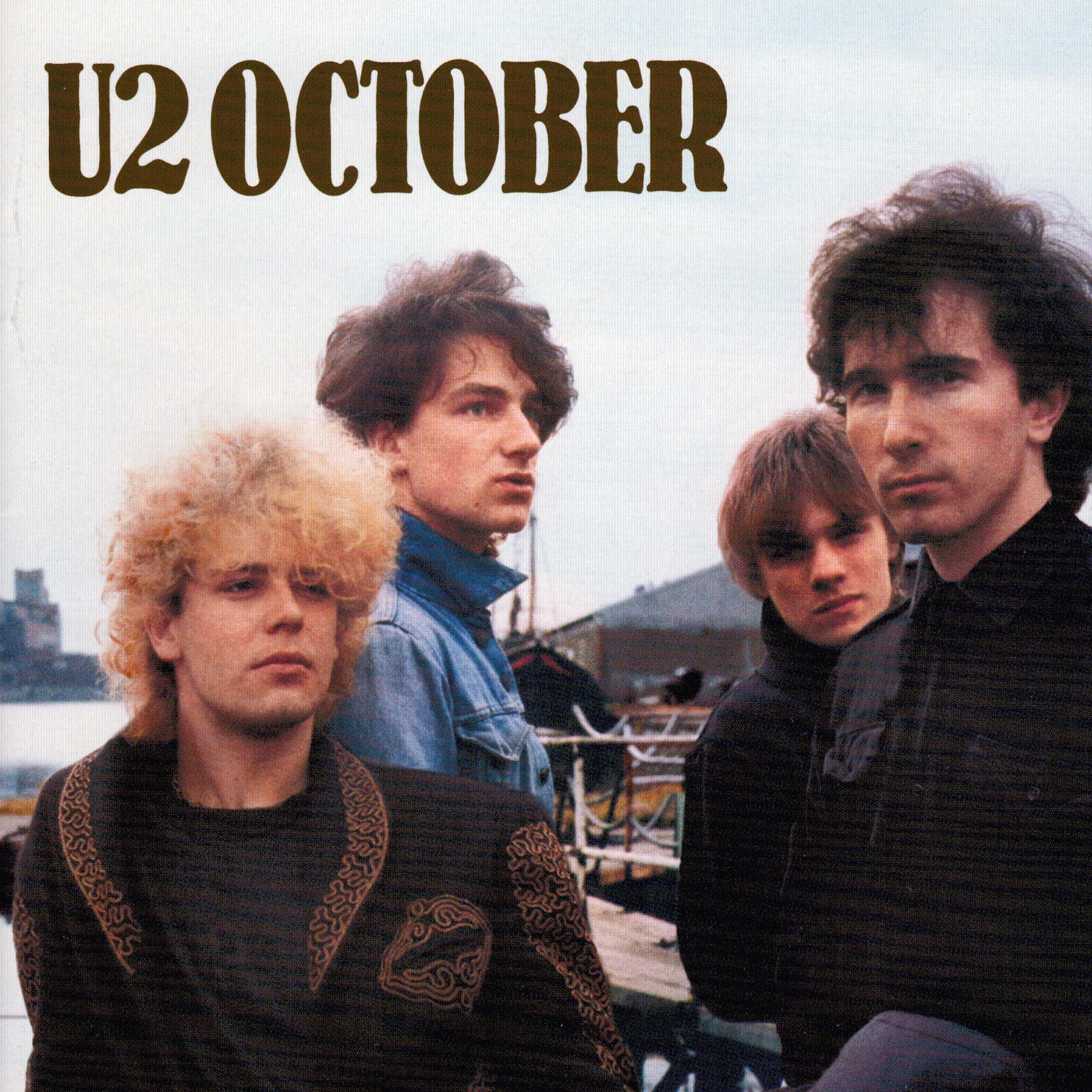
Even the awkwardly posed cover shot, a frozen moment of bad fashion in a watery wasteland (shot in the Dublin docklands, where U2 have been based ever since), suggested a group ill at ease with their identity, completely out of sync with the angular coolness of their UK contemporaries.
And yet, as the needle settled into the groove, the sheer sonic force of the music exploding from the speakers proved so wild and strange and dramatic it maintained the band’s career momentum almost despite themselves.
‘October’ may be U2’s most U2 sounding record, the one in which they fully realised their original sonic template. The Edge leads the charge, his guitars riffing, slashing, echoing, chiming, constantly multiplying into a widescreen, multi-tracked, six string orchestra.
He introduces a deep, ringing piano tone, adding melodic counterpoint to all these criss-crossing electric notes, while the rhythm section of Larry Mullen Jr and Adam Clayton operate in a dynamic three-dimensional space, breaking down into mystically atmospheric quietness and suddenly raising up into a tsunami wall of sound.
With Edge firing on all cylinders over Larry’s jack hammer percussion and Adam’s single-minded bass, the effect is breathtaking, a stirring, powerhouse modem rock of compelling originality. It’s just a pity they barely have a proper song to hang all of this on.
Much of ‘October’ is like separate yet interlocking pieces of instrumental music with vocal melodies added as an afterthought. Bono is in roaring form. His voice still has some way to go before it was to find its fullest expression on 1987’s ‘The Joshua Tree’, the album that established him as one of the greatest rock vocalists of all time, but it is blooming here, bursting out, punching against the wall of sound, finding its range and expression. The lyrics are another matter:
They say you get a lifetime to make your first album and only two weeks to make your second. This was never more true than in the case of U2 and ‘October. ‘Boy’ was fused in the white heat of U2’s explosive rise as Irish local heroes, the songs assembled, disassembled, reassembled and fully road-tested before they were recorded.
Then they took them to the world, a year of relentless touring gelling U2 into a potent live attraction. But when they returned to Dublin to start work on the follow-up in June 1981, they only had two new songs, the uncharacteristically acoustic flavoured, gently rolling ‘I Fall Down’ (which they had been performing live) and the atmospheric single ‘Fire’ (recorded during a working holiday in the Bahamas in April).
To compound problems, Bono’s lyric notebook had been stolen backstage in Portland, Oregon in March. Despite a daunting lack of material, recording sessions in Windmill Studio with ‘Boy’ producer; Steve Lillywhite, were booked to commence in July.
So U2 went back to school, rehearsing in their old music room in Mount Temple Comprehensive. Which is where ‘October’ came together, in a rapid fire burst of creativity from a band hot off the road and playing with near telepathic communication.
Bono is an essential part of that process, not just a singer but an instigator, conductor and provocateur, extemporising melodies and shaping songs with quasi-gibberish stream-of-conscious outpourings known to his fellow band members as Bongolese.
Unfortunately, by the time U2 were due in the studio, this was about all he had. Throughout recording sessions, he was still furiously scribbling ideas. Steve Lillywhite would gently chide him, “Come on, I mean, how long’s the song Bono? You can write enough words to fill three and a half minutes. That’s not much, is it?”
To turn the screw another notch, U2 were in the midst of a profound spiritual crisis. Three members of the band (Bono, Edge and Larry) were committed Christians aligned to a maverick local charismatic movement known as Shalom. There was a perceived conflict between the demands of faith and rock and roll, and they were under pressure to decide where their allegiances lay.
During recording sessions, Edge and Bono left the band (Larry, on the other hand, left Shalom). Briefly, U2 ceased to exist (and the history of flock might have been changed forever) but the crisis precipitated a reaffirmation of their belief in music as a positive force. It also somehow helped unlock Bono’s muse.
The result is U2’s most openly spiritual album, in which Bono wrestles with faith, doubt and devotion and does it all live on the microphone, calling out to the Lord like a preacher speaking in tongues, the Holy Spirit coursing through his veins.
It was a high wire act, a white knuckle affair, a musical Rorschach test. There is little polish and finesse about the lyrics on ‘October’ but they are extraordinarily alive and revealing, a genuine example of Van Morrison’s much vaunted “inarticulate speech of the heart.” it was, they all subsequently agreed, no way to make a record, but some of the results are astonishing.
‘Gloria’, the album’s opener, is a rock hymn to the act of surrender. When it locks together in the final third, turning into a powerhouse Gregorian chant, its quality of joyous exultation defies any listener not to leap to their feet and punch the air.
With little more than piano and slight, imagistic lyric, the icily elegant title track evokes a sense of worship that can survive in the frozen wastelands of the end of the world.
‘Tomorrow’ is a heart wrenching evocation of loss and grief, returning to the primal source of Bono’s pain, the mystery that drives him, the death of his mother in 1974. This is what you get when you come to the studio with nothing but the will to express yourself in the moment raw emotion.
And with evocative use of Uilleann pipes, it roots U2 in an older musical tradition for the first time, hinting at adventures to come.
Those are highlights but even where the songs are less well formed, sketches like ‘Rejoice’, ‘With A Shout’ and ‘Is That All?’, the drive and dynamism of the band and, in particular, the sheer invention of Edge’s guitar work, is awesome to behold.
‘October’ is a fantastic blast of a rock record, hand, shiny, modem and utterly unique. U2 had never sounded this single-minded and cohesive before, and, strangely, they never would again.
It is almost as if this particular sonic template made everything too easy, the style of the band covering a multitude of sins. For ‘War’, Edge would strip everything back and build from the bottom up.
U2’s ascent to becoming the biggest band in the world really starts there. ‘October’, its immediate predecessor, has come to be viewed almost as an aberration.
But put it on the stereo now, turn up the volume, and you will hear something quite special: a celebration. This is the sound of a band full of energy and spirit and quite desperate passion, in full flight, expressing themselves with urgency, intensity, emotion, invention and everything that makes rack and roll worth believing in. (Neil McCormick, February 2008)


Leave a Reply