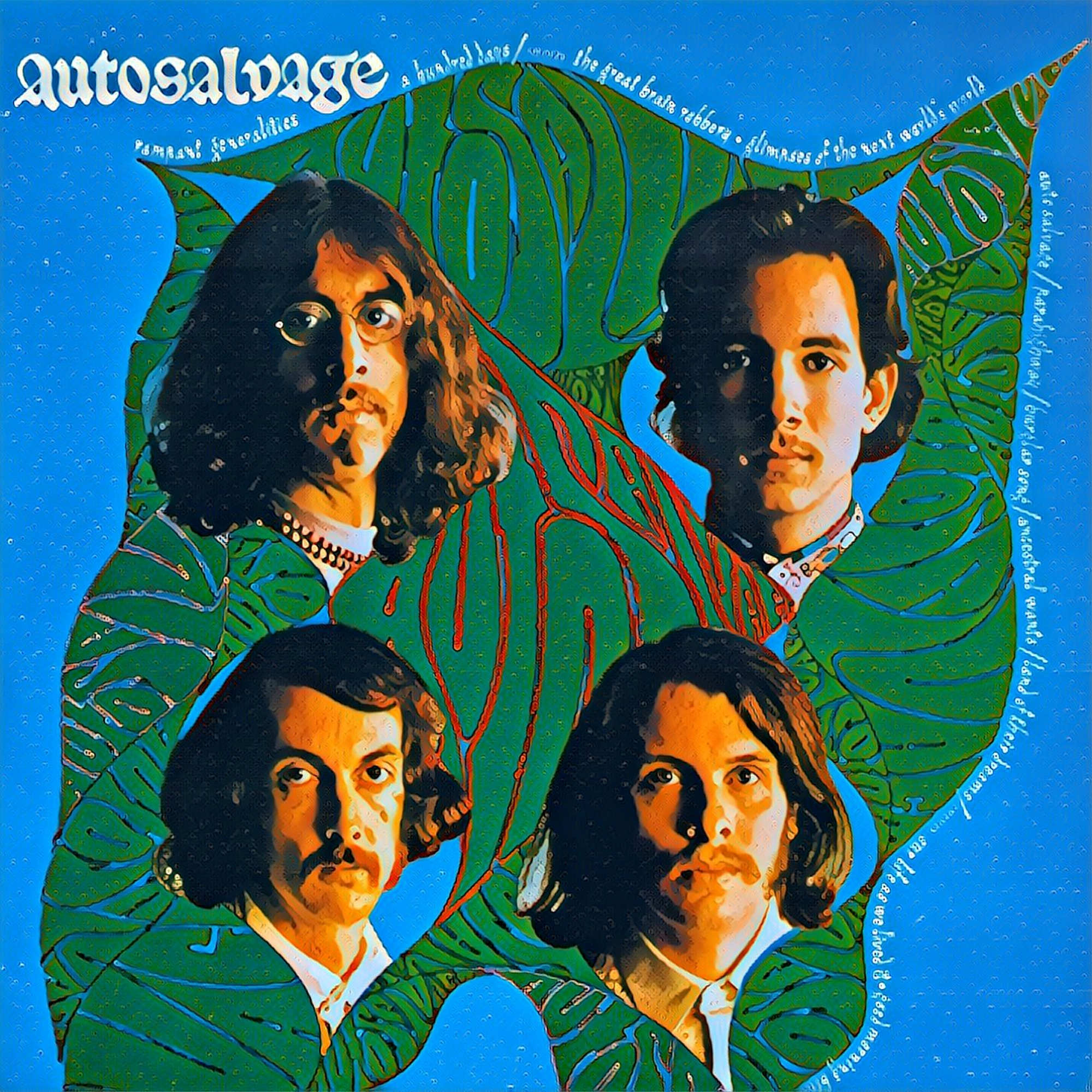
“A Hundred Days” taken from the LP ‘Autosalvage’’ | (RCA Victor LSP 3940) March 1968
Autosalvage | A Hundred Days | (RCA Victor) 1968 | “It really comes on strong, it pounds and pulsates and it still progresses.” So begins one of the few pieces on Autosalvage, first published in 1968 in ‘Crawdaddy’ 16.
Enigmatic and more than a shade mysterious, their one album remains a triumph; dazzling, twisting and inventive, hinting at unfulfilled possibilities, yet complex enough to suggest that they’d left nothing more to prove.
Their story has remained, at best, sketchy. Autosalvage were four — Rick Turner (guitar, banjo, dulcimer), Thomas Danaher (vocals, guitar), Skip Boone (bass, piano) and Darius Lalloue Davenport (vocals, oboe, piano, drums) — a combination which immediately removed them from traditional pop.
Danaher came through a bluegrass and folk music path, forming the group with Davenport, the son of a respected classical musician, around 1966. Rick Turner had meanwhile backed Ian and Sylvia, and has a prominent role on Play One More, an album released on Vanguard that year (Vanguard VRS/VSD 9215).
On it Turner was joined by Felix Pappalardi, then in demand as the bassist most likely to help New York folkies into electricity and it was perhaps through his session work that Turner began to pick up work elsewhere and would eventually team up with Danaher and Davenport.
Autosalvage | A Hundred Days | (RCA Victor) 1968

Meanwhile, Skip Boone was merely the brother of Steve, bassist in the Lovin’ Spoonful, a group whose successful patchwork of styles doubtlessly influenced Autosalvage.
Indeed Skip won a co-writing credit on ‘Pow’ and ‘Pow Revisited’, two tracks from ‘What’s Up Tiger Lily’, the Spoonful’s first excursion into movie soundtracks.
The new group played in and around New York for several months, until a down-the-bill spot at The Balloon Farm loomed. There they supported the Mothers of Invention and impressed Frank Zappa, who, says the legend, used his voice and influence to further their career.
If so it seems surprising that Autosalvage bi-passed MGM and Verve, especially as the latter had snapped up several contemporaries in Tim Hardin, the Blues Project, Richie Havens and Laura Nyro. Instead, they went to RCA.
Autosalvage (RCA LPM/LSP 3940) appeared in March 1968 and the opening bars of the title track confirm its imaginative splendour. If the roots of Jefferson Airplane lay in the Lovin’ Spoonful (and they surely did), then Autosalvage exploit the gap between the two groups left in the process.
Traces of Jorma Kaukonen’s sweeping tone can be heard in Rick Turner’s guitar work, while the rest of the group employ the playful irreverence which made Sebastian, and more obviously, Zal Yanovsky, warm, but impressive.
Autosalvage are clearly a New York group, as the first clutch of notes to ‘Our Life As We Lived It’, jarring and cheerfully throw-away, definitely show.
Yet it leads to some truly tough soloing, where Davenport’s drums thunder through the mix and hold together an effective, sustained feedback piece. It takes us directly into a version of Leadbelly’s ‘Good Morning Blues’, the only traditional song here, but a perfect avenue for the group’s idiosyncratic ideas.
Autosalvage | A Hundred Days | (RCA Victor) 1968
As with another contemporary, the wonderful Insect Trust, Autosalvage loved the traditional form and chose to work around its original shape, rather than tease it out to say, eighteen minutes.
“Ancestral Wants” is almost breathtaking, the instrumental breaks are superbly understated, complex, shifting, twisting and turning, with just a hint of 12-string raga thrown in to add a whiff of excitement.
‘A Hundred Days’ follows; its Beatles-esque melody makes it the album’s commercial showstopper, at least in Auto-salvage terms. Rick’s guitar even echoes the George Harrison sound on ‘Revolver’, as a homage rather than a copy.
But it’s the final medley, ‘The Great Brain Robbery / Glimpses Of The Next World’s World’ which positively astonishes, emerging as a bizarre mix of jugband music and Beefheartish time and tempo changes.
The second piece is mesmerising, the guitars cascade against each other, not in a loud metallic manner, but textured, building a tension which envelops rather than grabs. It was the perfect close to an album which remains as captivating as ever.
Skip and Darius also made an appearance on Greetings Children of Paradise, an album by Bear (Verve/Fore-cast FTS 3059) which was issued later that year. Bear was made up of more refugee folkies, Artie Traum, Eric Kaz and Steve Soles, and the album is something of a rough gem where moments of real inspiration (`The Hungry Dogs Of New Mexico’) settle beside others which, if not gripping, still hold a fascination.
Off-Beat changes
Several different styles were melted down; folk was, of course, the natural beginning, but traces of Autosalvage were also clear in the horns of ‘Don’t Ever Want To Talk About You’ and in the bubbling instrumental twists on several of the songs.
Of them all, ‘It’s Getting Very Cold Outside’ most resembles Boone and Davenport’s erstwhile group; it could even pass as a lost out-take, such are its offbeat changes.
The involvement of two of Autosalvage may just have been a helping hand to friends, or it may have been their breakaway towards something new. Whatever the truth, the parent group seemed to fall apart almost as soon as they had emerged into the outside world, leaving be-hind them this one, exceptional record. (Edsel liners)
Gig Report



Leave a Reply