Article published in Hit Parader, 03/67
Introducing The Chicago Loop | “We were waiting for a club to open,” said Judy, the petite blonde vocalist of the Chicago Loop. “But the opening was delayed so we just sat around in a basement rehearsing and getting discouraged. We decided to come to New York for a weekend.”
They brought a demonstration tape with them six songs they’d recorded in someone’s living room. They also had pictures of themselves and they wrote their own biography.
We walked around for days, carrying a heavy tape recorder because we weren’t sure everyone had a recorder in their office,” said Bob. “We played the tape for anyone in the record business who would listen. Bob Crewe‘s office was one of the places we went.”
The next thing that happened was a happy, free swinging groove . . . an instant 3 dimensional party in plastic . . . . an old Coasters’ song done in 1966 style. It was (“When She Wants Good Lovin’) She Comes To Me” by the Chicago Loop, one of the most fun records of the year.
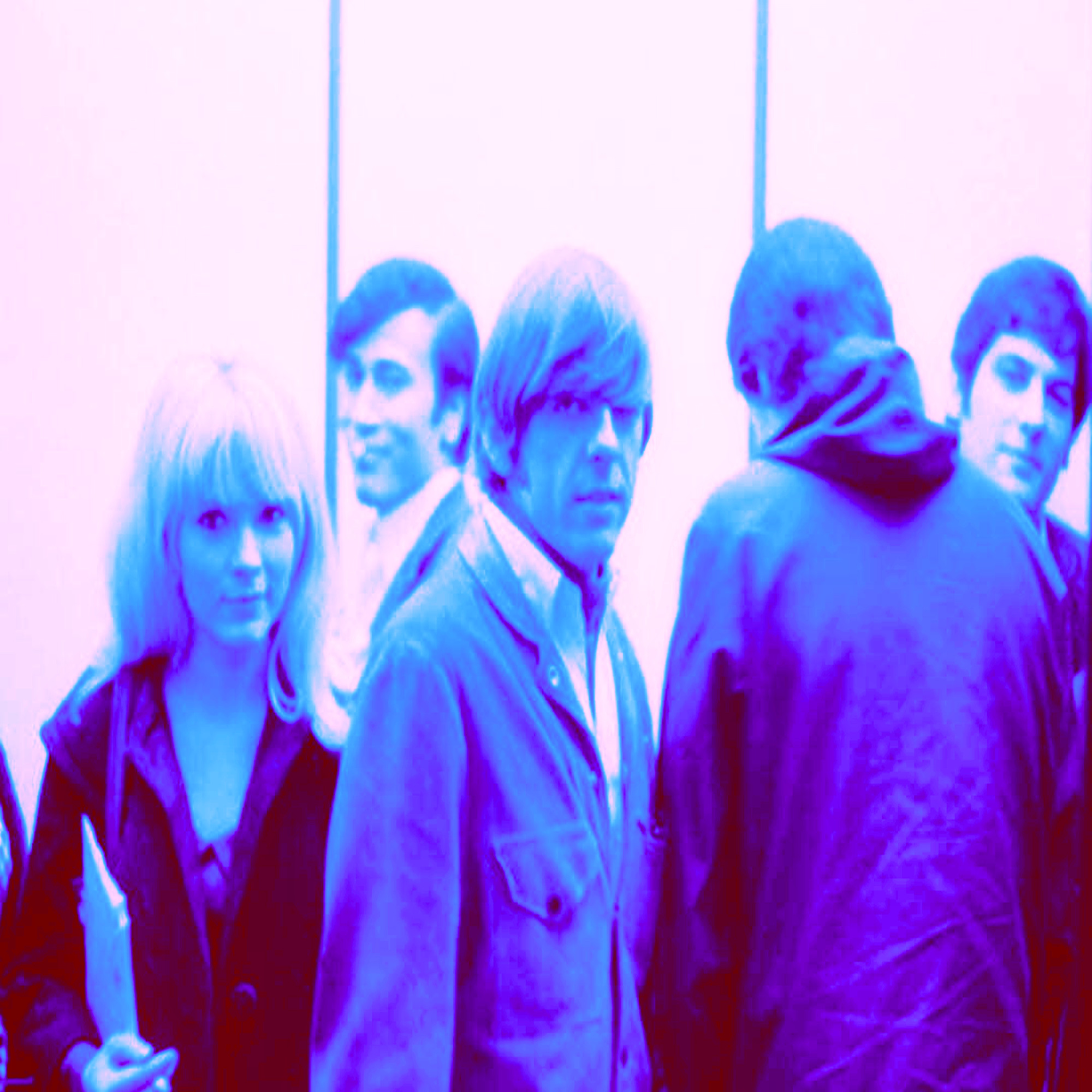
The Chicago Loop are fun too. As they sat quietly in our office one afternoon we found it difficult to believe that these six nice people were the same ones who did all that shouting and laughing and stomping on the record.
But they did except John Savanno, their lead guitarist. He just joined the group. In-person, John shouts, laughs and jumps up and down as well as making groovy guitar sounds. But when the Chicago Loop recorded “She Comes To Me”, they didn’t have a lead guitarist. A friend of theirs, the incredible Mike Bloomfield, the king of the white Chicago blues guitarists, sat in and really wailed.
Introducing The Chicago Loop
Getting the lyrics was a problem. The group remembered the song when it was done by the Coasters in 1958, but when the Loop went to Atlantic Records to get a copy of the original version, Atlantic didn’t have one.
So they wrote the words as best they could remember them. The recording session was wild. Producer Al Kasha wanted a 3 dimensional sound. The party idea was planned, but at times it sounded like a real brawl going on in the background. Everybody screamed and yelled and Bob Crewe, who owns Dyno-Voice Records, broke 10 dozen glasses on the floor before the record was finally completed.
Although it may not be apparent from their first record, two of the Chicago Loop were in folk music a short time ago and the others are well versed in rhythm and blues or rock and roll.
Judy Novy, vocalist and “utility” percussionist, and Bob Slawson, who sings and plays rhythm guitar and harmonica, were once folk singers. Organist/pianist Barry Goldberg, drummer Jack Siomos and bass guitarist Carmen Riale are veterans of Chicago’s thriving R& B scene. Lead guitarist John Savanno has been in dozens of rock bands in New York.
Everyone was out of work when they decided to join forces in Chicago. For, a while they called themselves Time and they came to New York and played at the Night Owl. But nothing happened for them, so they returned to Chicago.
Their next trip to New York was more successful. That was when they met Bob Crewe. Now let’s meet the members of the Chicago Loop one-by-one.
Meet the group:
Judy Novy was born in Chicago on January 18, 1946. When she was very young her father played “old songs nobody’s ever heard of” on the concertina while she and her older brother Len sang along. They continued singing in high school and at local charity shows and places. As Len & Judy, they recorded an album, “Love Is Bittersweet”, and sang folk music.
Last April Len joined the U.S. Army. Judy went to Michigan State College but didn’t like it because “there was no place to sing except for jug bands.” Judy met Bob Slawson, who wasn’t very happy about singing folk music, in a Chicago club.
“What would you like to do?” she asked. “I want to form a rock group,” Bob told her. “I’m thinking about doing the same thing,” Judy replied. So they did. Together. One thing we must add: Judy is very pretty and very charming.
Bob Slawson, born in Cincinnati, Ohio on November 14, 1945, grew up listening to a Nashville, Tennessee rhythm and blues radio station, WLAC. “I bought all the Little Richard records by mail from Randy’s Record Shop” he recalls.
Bob got into folk music and had his own group, the New Almanac Singers. He went to college in Indiana and he appeared as a solo artist at the 1964 Newport Folk Festival. Right after that he went on 3 months and 27 days active duty with the Army Reserve.
When he came out, Bob met Malcomb Hale, formerly with the New Wine Singers, and together they played folk music in Canada, California, the South and at Mother Blues in Chicago. “We were offered a State Department tour of the Far East, including Viet Nam,” Bob told us, “It would have been a groovy personal experience but I couldn’t see it furthering my career very much. And anyway, I wanted to get into rock.” Then he met Judy.
Introducing The Chicago Loop
Carmen Riale was born on July 22, 1945 in Greenwich, Connecticut. He started playing the bass when he was 13. He joined Robby & The Troubadors and played many clubs across the country, including the Thunderbird in Las Vegas.
“We were doing rhythm and blues before most white groups picked it up,” said Carmen. “Maybe that’s why we didn’t get a break. We were too early.”
Robby & The Troubadors, split up. Carmen stayed in Chicago where he met Mike Bloomfield and Barry Goldberg and lots of other people who liked to play rhythm and blues. He met Judy and Bob and things started happening.
Barry Goldberg, born in Chicago 23 years ago, remembers, “when I was ten years old I found a funny station on the radio. It didn’t come in very good, but it played different music. One of the programs was called Jam with Sam. I found out it was blues, rhythm and blues and gospel. That was what I really dug.”
Jerry Lee Lewis and Little Richard were big influences on young Barry when he formed his own band in high school. His first professional job was with Robby & The Troubadors. For 3 years, they toured the United States. When the group broke up, Barry re-turned to Chicago. He played piano and organ with Mike Bloomfield, Otis Rush, Junior Wells, the Miller-Goldbet Blues Band, and the Barry Goldberg Blues Band.
Barry was supposed to our in Bob Dylan’s band shortly before Dylan had his motorcycle accident. Instead, Barry hung around New York, playing on recording sessions. He can be heard on Mitch Ryder’s record “Devil With The Blue Dress On” / “Good Golly Miss Molly”.
Introducing The Chicago Loop
Jack Siomos, a Chicagoan since July 30, 1947, when he was born, always wanted to play the drums. He got a set when he was in the 8th grade and began banging and crashing away He dug the James Brown Band, drummers and “all soulful music.” “I lived in a coloured neighbourhood so I heard their music all day long and got to know how the people lived,” says Jack. “I worked in a band which, except for the saxophone player and myself, was all-coloured.”
Jack likes to listen to Chuck Jackson, Freddy King, The Temptations, Smokey & The Miracles, Dionne Warwick, Little Anthony & The Imperials and Wilson Pickett. He also considers Mitch Ryder and the Righteous Brothers the most soulful white singers. He was the most logical choice for drummer of the Chicago Loop.
John Savanna, a native of the Bronx, New York, born June 6, 1945, began playing the guitar when he was 14 years old. When he was 16, he started playing professionally on weekends. Ever since, he’s been in many different bands, including a few where he was the leader. “I kept getting more and more involved in music” John told us. “When I was 17, I was in a group that made a record, but it never did anything. I’ve always wanted to be in a group that had a successful record.”
Alan Stroh, manager of the Chicago Loop, was looking for a lead guitarist. The manager of John’s group called Stroh and John met the Loop. “I dug their sound very much,” said John, “and I felt ‘Here’s my chance’.” The rest is history.


Discography:
“(When She Needs Good Lovin’) She Comes To Me” / “This Must Be The Place” (DynoVoice 226) 10/66
“Richard Corey” / “Cloudy” (DynoVoice 230) 02/67
“Saved” / “”Can’t Find The Words” (Mercury 72755) 11/67
“Technicolor Thursday” / “Beginning At The End” (Mercury 72802) 08/68
Fragments | The Chicago Loop Jukebox (8 songs)


Leave a Reply