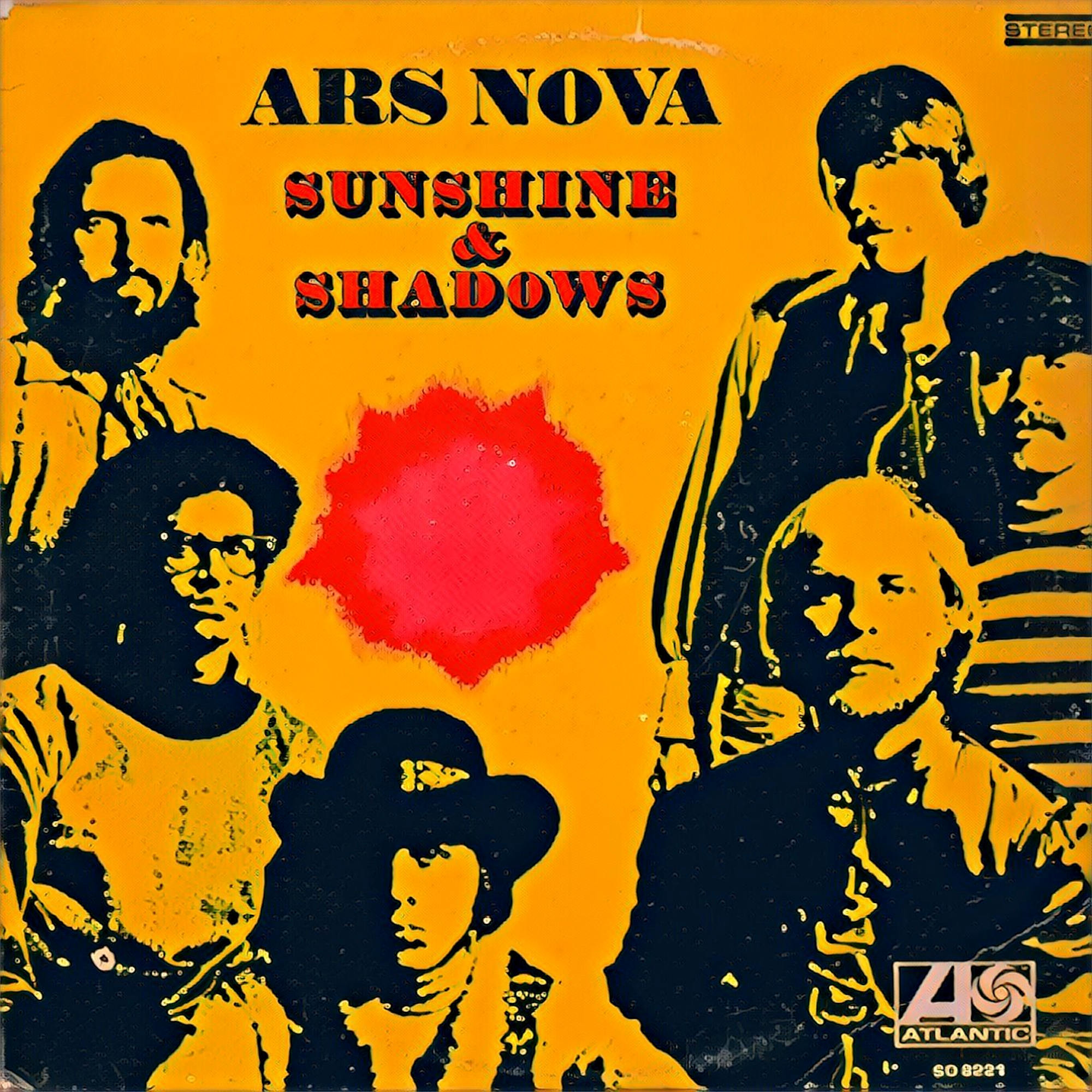
“Well, Well, Well” taken from the LP ‘Sunshine & Shadows’ | (Atlantic Records SD 8221) August 1969
I was doing a story for Life Magazine on the putting together of a new rock group, and more or less happened on Ars Nova. When I first heard them they were engulfing a church in the Chelsea district of Manhattan with a sound so new that I didn’t know whether I was in a cathedral or a cabaret.
Bits of Palestrina, Strauss, and Bach bubbled up between rock, Spanish guitar and baroque brass. I heard them many times afterwards—in a loft in the East Village, in a recording studio, in Los Angeles, at Fillmore East, in my apartment—playing, singing and talking about music.
I saw them happy and I saw them in despair, but it was always impossible to give up a belief in their inventiveness, for their minds are more than moog as the true synthesizers of our times.
Today, America is creating a new music beyond rock. It is not only the African beats heard in the bossa nova, the blues, and even the Charleston; it is also the sounds of the European minuet, a Tennessee mountain ballad or a waltz.
This new American music, properly blended on the verge of being discovered in the minds of many musicians, black or white, and it colours their thinking with new perceptions.
Ars Nova | Well, Well, Well | (Atlantic) 1969
Ars Nova is working on this frontier. Hear “Walk On the Sand” in bossa nova, or “Rubbish” in bop or “Well, Well, Well” in rock blues or “You Had Better Listen” in Eastern jazz and you know that they are out there in new territory.
This new American music exists, not as eclectic imitations, clever combinations or snazzy muddles, but as creative cross-fertilization. It is a sound that you hear in both ears at once.
A sound derived from your landscapes, a sound that spreads wide your sensibilities. It is an Ars Nova. (—JON BORGZINNER Life Magazine)

LP reviews found on the web:
This second and final release from Ars Nova continues the high standards set on their self-titled debut. The only change was in the band members and the adding of a Latin / Spanish type sound to some of the tracks such as “Temporary Serenade” and “Walk On The Sand”, instead of the medieval sounds.
The high points include the title track, the Hendrix-inspired “Well, Well, Well,” the aforementioned “Walk On The Sand” and “Round Once Again.”
There are no duff tracks though, the only slight disappointment is that the production is not as good as the first album and the under-use of Jon Pierson‘s voice.
The rhythm guitarist and main songwriter Wyatt Day seems to be singing on five of the tracks and though he has a good voice, I would have preferred to hear Pierson on more than the four songs he adds lead vocals.
Still, these are minor quibbles on what is a fitting closer to the band’s all too brief career.
“Sunshine & Shadows” is one of the most unique sounding late ’60’s efforts put to wax. An early example of “Jazz-Rock” fusion of sorts.
Ars Nova | Well, Well, Well | (Atlantic) 1969

This release boasts the talents of Wyatt Day who sings and writes pretty satisfying lyrics, Sam Brown, who provides lead guitar, Jimmy Owens, who plays some very tasty trumpet, and Warren Bernhardt, who adds a nice keyboard timbre.
All in all this album has a great deal of variety ranging from old-timey sounding tunes like “Rubbish” to delicate statements like “She Promises Everything” to powerful rock items like the title track and “Please Don’t Go Now.”

NY Psychedelic Art Rock! | Touted as the “new Doors,” Ars Nova’s second release shows the band genre-bending jazz and heavy psychedelia in a style that’s their own.
Shifting from a largely classical centric sound, this was the group’s last album before going their separate ways.
Sunshine & Shadows takes the baroque-meets-psych sound of the debut and turns a bit more to the psych side. The stately brass interludes are gone, but horns still figure prominently in the mix.
There’s some jazzy New Orleans flavour to a couple of the tunes, albeit twisted into a 7/4 vamp on “You Had Better Listen.”

Leave a Reply