
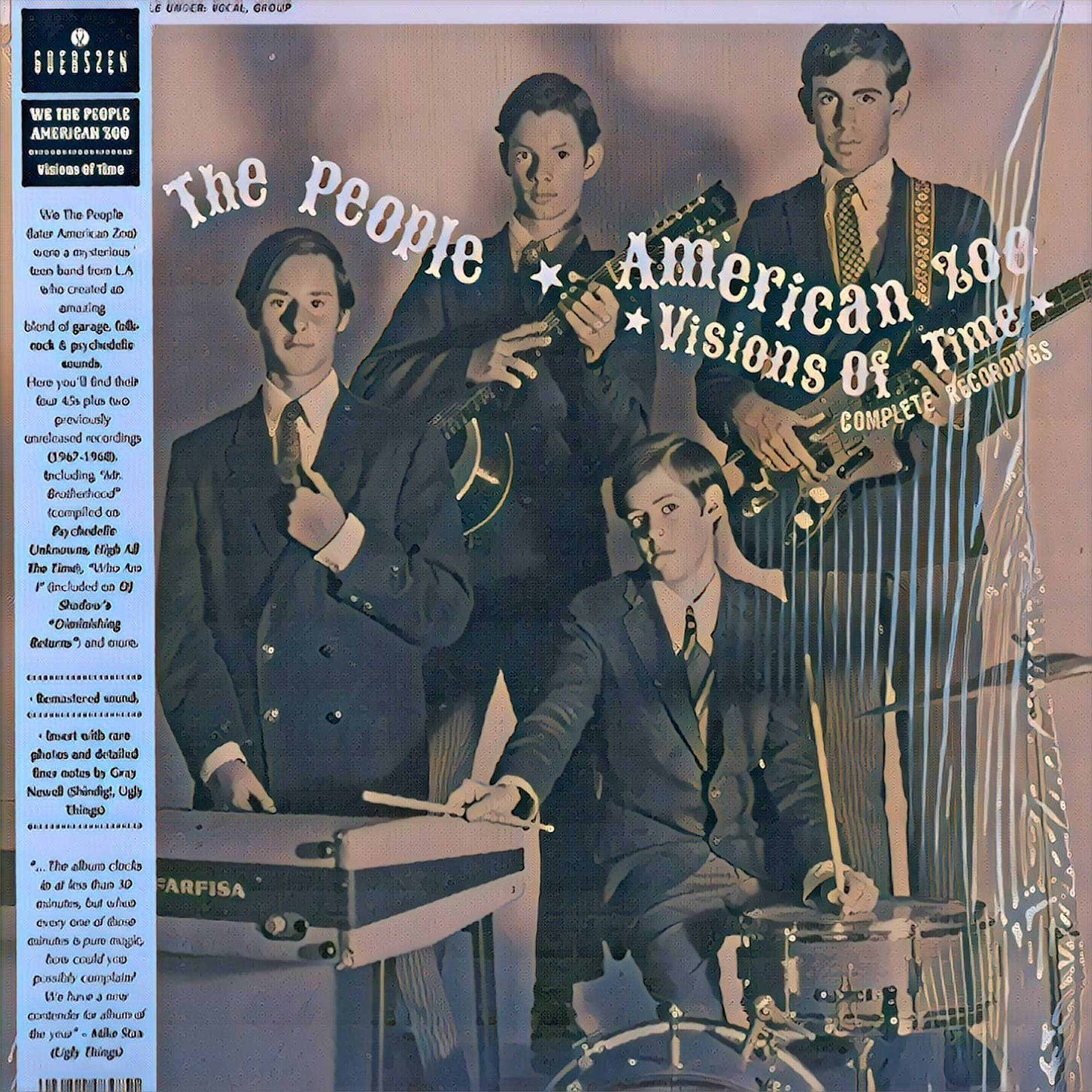
“Visions Of Time” taken from the LP ‘We The People / American Zoo’ | (Guerssen GUESS-143) 2014
We The People | Visions Of Time | (Guerssen) 1967 | How many rock groups featured a member who went on to become an internationally acclaimed avant garde composer, sculptor and artist? Or an Oscar-winning scriptwriter? Or a Grammy-winning producer behind some of the biggest selling hits of the 1980s? How many can boast ALL THREE? The answer is — just one; this unique achievement belongs to the outfit known latterly as American Zoo.
The story begins in late 1965 in the Los Angeles suburb of La Crescenta. Five 7th grade Rosemont Junior High School students formed a band; guitarist Ralph Odenberg, bassist Bill Hawkins, keyboard player Dave Danieli, drummer Steve Zaillian, and acoustic guitar player Bill Bottrell joined together to become The Impalas.
They soon changed their name to the more martial sounding Men of Harlech, inspired by the traditional song that Bottrell, Hawkins, and Danieli had learned to sing in their Men’s Glee Club.
Rehearsing in the basement of the Zaillian family home, they quickly developed a set of cover versions from the pop charts, taking inspiration from British Invasion groups such as The Beatles, The Rolling Stones, and The Animals, as well as home grown hit-makers like The Byrds and The Beau Brummels.
An early live outing in January 1966 was the teen benefit of the annual La Crescenta March of Dimes charity drive, held in the La Canada High School Cafetorium, where they performed in a Parade of Bands alongside other local groups — the Skeletones, The Future Generation (a group from La Canada High featuring Greg Munford, who’d later sing the lead vocal on the Strawberry Alarms Clock‘s number one smash hit ‘Incense & Peppermints’), and Volume 1 (a La Crescenta Valley High combo that also included Odenberg and Bottrell).
We The People | Visions Of Time | (Guerssen) 1967

The Men of Harlech soon became the most popular local group, performing at numerous school dances, church concerts, and YMCA shows. Towards the end of 1966, for reasons no one quite recalls, Steve Zaillian and Ralph Odenberg left the group.
“Steve had the coolest basement / practice space,” Bill Bottrell recollects, “it’s odd I would’ve abandoned that, and Ralph was a good friend, so I can’t remember how it went down.”
Bill Hawkins conjectures “It could have been that they were grounded for a period of time and we just kept on going.”
Deciding they could manage with just one guitarist, the search began for a replacement drummer. Fortunately they didn’t have to look far and Jason Martz was soon recruited.
“I first started playing drums when I was thirteen years old. Well, not really drums: I got a pair of drumsticks and a rubber and wood practice pad that I would hit and hit — it would drive my parents crazy. I tried to learn to read drum music but I had no talent for reading music. My next-door neighbours in La Crescenta was the Bottrell family.
Bill Bottrell’s older brother John had a drum set. When I would visit their house, I loved banging on his drums. I remember thinking, ‘why, oh why did he let those drums sit there and not play them all day and all night’.
full drum-kit
I wanted to own my own drum set more than anything but my parents didn’t want to buy something so expensive that they thought I would probably cast aside when I lost interest. Since I seemed to have a natural talent for drumming, they rented me a snare drum from the local music shop. I would play that snare for hours, until they finally said I could get a full drum kit.
So, with half of my own money, made from delivering newspapers on my bicycle, and half of my parent’s money, I picked out a shiny, brand-new Kent drum set. The full set with Zildjian cymbals cost about $250. I still own and use the same drums some 45 years later- so that turned out to be a good investment.”
“To alleviate my teenage angst, I would listen to psychedelic music full blast on headphones in my bedroom and hit those drums as hard as possible for hours and hours at a time. Even though the entire house shook and my parents could not possibly hear the sound on their TV, they never complained once about my playing!
When Steve left their group, Bill asked me to give it a go and I ended up joining the band. Fortunately, I had a good knack for learning the songs fast. Even though I did not know Bill Hawkins and Dave Danieli before joining the band, we all became great friends.
We The People | Visions Of Time | (Guerssen) 1967

I remember rehearsing in my parents’ living room, preparing to perform at the Crescenta Valley high school dances, and we would have so much fun learning and playing songs. We were literally like The Monkees – laughing and goofing around all the time.”
This enthusiastic new member brought a new energy to the group, as Bill Hawkins points out “He was a little younger and was into slightly different music so it energized us and took us in a new direction.”
The group dropped the Men of Harlech tag and took on a more ‘happening’ name, We The People (the opening words of the United States’ Constitution). They also began composing original material, working together to create what would become their first recordings.
Dave Danieli’s father took the band to a recording studio in North Hollywood to record some demo tracks. That would prove to be a seminal moment for the young Bill Bottrell:
in the studio
“I remember the studio. The smell. The sound of playback from tape. The smell of the tape. It was the first time I would experience those things and those experiences would motivate me through life.”
Jason reveals that they had, more or less, total control over the recording process “Nobody was the official producer of our recording. It was just us teen kids and whoever the engineer was at the time.
Even though I was only 14 years old, I was not nervous one bit. That is until half way through recording the second song. All of a sudden a jolt of adrenalin rushed through my body and I remember thinking ‘Yikes . . . we are recording in a professional studio . . . what the hell am I doing?!!’
I remember my goal was getting the engineer to make the reverb on my drums sound like the guy in The Doors. My drums were kind of crummy, not up to professional standards, and that made the engineer unhappy.
The kick pedal had a squeak and he had to stop recording several times and try to spray oil to stop the sound. He did not have much luck and when I hear those recordings I can hear the squeak. I guess I never got around to oiling it because, in our later recordings, I can still hear the squeak from that lousy pedal.”
The session produced a pair of folk-rock influenced recordings. Dave Danieli’s ‘Back Street Thoughts’ featured a sophisticated arrangement with a plaintive lyric while the introspective ‘Visions of Time’ composed by Bill Hawkins was influenced by: ” . . . the general mood of song writing in those days, related to protest of the Vietnam war and authority” observes Hawkins.
We The People | Visions Of Time | (Guerssen) 1967

Shortly after recording the demos, they won the Crescenta-Canada YMCA battle of the bands by a landslide and then, at the end of March, the group appeared at the annual Hollywood Teen-Age Fair, playing to their largest audience to date.
“That was a very big event in Los Angeles held every year,” explains Jason, “many thousands of kids came. By then, We The People were very accomplished but it was a very big deal for us to drive into Hollywood.
We knew we were good but our gigs were in our small town of La Crescenta. Now we were on a big stage at the Hollywood Palladium with a great sound system and professional lights in front of a big crowd. It would have been easy to choke. But we were on fire.
After our performance, I heard people say something like ‘Wow, that band is great and the drummer is really hot’. I had not gotten feedback like that before and so I was super happy!”
Despite their confidence and flamboyance on stage, all the band members were actually shy and the positive reaction of the audience at the Teen-age Fair, on top of their victory at the battle of the bands, was another affirmation of their talents.
“We felt legitimate,” Bill Bottrell reminisces, “a feeling that our peers could respect us outside our junior-high social system.”
Reena Records
After their set, they were approached by the owner of an independent record label. Jason recounts: “The president of Reena records, Elizabeth Horton, was at the Teenage Fair scouting for bands to sign.
By good luck she saw us perform and since the crowd went wild after our performance, she knew we were something special. She seemed really old to us at the time but was probably in her early forties.”
Elizabeth Horton ran Reena Records from her single-story Hollywood home, at 5642 Beck Avenue, and had released a number of records by country and soul artists. Looking to expand her label’s repertoire, she was alerted to We The People by the owner of the studio where the group had recorded their demo.
“For better or worse, I felt she did not fully understand our type of music.” continues Jason, “That was good because she let us do what we wanted to do and there was very little interference in the songs we recorded and released. But it was bad because it would have been better if she had given us some industry advice and set us up with a seasoned producer, who could have given us guidance and produced some hit songs.
We were just 14 and 15 year old kids doing what we thought was right . . . . and of course, young teenage boys are not always right. I remember thinking she was from the ‘older generation’ and did not understand what was going on with our ‘hippie generation’.”
We The People | Visions Of Time | (Guerssen) 1967

Subsequently We The People went to California Recorders on Sunset Boulevard in Hollywood for sessions engineered by Del Kacher (AKA Del Casher / Del Kacher), a renowned session guitarist and inventor of various electronic innovations, including the Wah-wah pedal and the EccoFonic tape echo system.
Del had played with a veritable A-Z of musicians, from Gene Autry to Frank Zappa, and had appeared with Elvis Presley in the film, ‘Roustabout’.
“I built my studio,” he explains, “for my productions of background music for restaurants and children’s educational music for Activity Records in NY. Frank Zappa brought in Florence Marly, who sang ‘Space Boy’, a song about a Russian astronaut lost in space. Zappa asked me to play all the parts and use my EccoFonic to get weird space echo sounds.
Synths were not yet invented so I made sounds on my guitar that were weird and Frank loved it. I joined his band, The Mothers of Invention, for gigs around LA in 1966 just for fun and to rock out.”
Elizabeth Horton
Elizabeth Horton used Del’s studios for many, if not all, of her projects and even released Del’s own psychedelic instrumental recording ‘The Image’ on Reena, credited to The Relations.
The debut Reena release by We The People was issued in October 1967 and featured two new group compositions. Dave Danieli’s ‘Feelings of My Emptiness’ is a swirling, up-tempo number, despite the downbeat lyric featuring the cautionary hook line: “Girl you’ve lost your faith, God strikes on you”.
‘For No One to See’, credited to Hawkins, Danieli, & Bottrell, is a delightfully mournful minor-key lament. Both songs feature the cryptic lyrics, harmonic vocal interplay, and intricate arrangements that would come to characterise subsequent recordings, although it took time for some of the band members to develop confidence in their writing abilities.
“I remember I waited” explains Bill Bottrell, “I didn’t want to write until I knew what I wanted to write. I didn’t know then what constituted a good song so I confined myself to vocal and band arrangements.”
We The People | Visions Of Time | (Guerssen) 1967

Once these insecurities had been overcome, they began to collaborate on all aspects of composition.
“Typical of the creative process there were ups and downs,” reveals Bill Hawkins, “but I think we all kept our respect for each other and had some truly fluid periods of creativity. I believe we all are thankful to our parents for allowing us the freedom to spend all the time we did with our ‘hobby’.”
The initial pressing was mistakenly credited to The People. It was quickly withdrawn and the second pressing on a gold label put things right. Despite a production credit for someone named Billy Diamond, he had no involvement in the recording sessions at all.
“Horton started working with a guy name Billy Diamond” reveals Jason, “and I believe he told her he was a hotshot in the industry and could make us stars. He was not actually a music producer but a ‘rack jobber’- a promoter who gets records to distributors and radio stations. I think we met him briefly only once.
Diamond told Horton that if she put his name on the records as producer, it would help us get attention but I don’t remember him being in the studio with us. For better or worse, we were generally our own producers.”
second 45
A second 45 was issued in December, coupling a new recording of ‘Back Street Thoughts’ with ‘Who Am l?’, a fine piece of gentle introspective psychedelia. Penned by Hawkins, Danieli, & Bottrell, it was enhanced by some ‘way out’ sounds at the conclusion, courtesy of Del Kacher’s extensive battery of electronic effects.
The group continued to play high school shows and local teen clubs, gaining a large and loyal following among their fellow students, even having their own official fan club, presided over by Gail Horton.
“I am pretty sure Gail was the grand-daughter of Elizabeth Horton”, reveals Jason. “and she was not even a teen yet and was very excited to meet teenage ‘rock stars’. I only remember meeting her once at Mrs. Horton’s house in North Hollywood. Elizabeth, optimistically, printed the fan member cards but as I recall the only fans who got them were Gail and a few of her girlfriends.”
Although there were shortcomings with being signed to a small independent label, such as the lack of promotion and the relative inexperience of those who were concerned with running Reena Records, it also gave the group members time and freedom to concentrate on their schooling, without the pressures and demands they would have faced, had they been under contract to a major label.
We The People / Florida

Actually, it wasn’t long before they did come to the attention of one particular major label, but for all the wrong reasons. At the beginning of 1968, Ms. Horton at Reena received a “cease and desist” letter from RCA Records, informing her of their own recording group We The People, a Florida based garage band that had released several 45s over the previous couple of years; the group had no choice but to change their name once again.
“We were not happy about that and I remember we wanted to fight them” Jason recalls “but RCA was BIG and Reena was small. The band could not agree on a good new name, I think it was me that suggested Blue Plate Special.”
Announcements were made in the press about the proposed name, a colloquial term for a cheap meal served in diners in the US (usually consisting of meat and three veg, dished up on a platter with divisions for each portion of food). Bill Hawkins describes it as “a little too corny, although we thought it hilarious at the time.”
Jason, on the other hand, is more forthright about his suggestion “It was a terrible name and I am so glad we never ended up using it.” Thankfully, when their May 1968 release appeared, it bore a more appropriate moniker. “I do not know who came up with American Zoo,” Jason adds, “but that was a great name.”
Mr Brotherhood
The new release demonstrated just how well the group was working and writing together. ‘Mr Brotherhood’ boasted ethereal keyboards and chiming guitars, combined with rumbling bass and bombastic drum-work to frame characteristically inscrutable lyrics (incorporating blown minds, dolls of inflation, and the house of damnation); it culminated in a wild instrumental sequence ahead of the outro.
On the flip the group departed from their usual folk-psych sound, opting for the straight-ahead, heavy rock vibe of ‘Magdalena’, driven by Jason’s frantic drumming. The actual title of the song was Magdalene, which is how it is sung, as Jason explains.
“If you listen to the song Bill Bottrell and Bill Hawkins sing in harmony ‘Magdalene baby you’re the cream of the crop . . . ‘, and ‘Magdalene honey how I love you so’, not Magdalena.
Magdalena

The very last time they sing it, Bill Hawkins really tries to enunciate “Magdalene aaaa”.
Either Mrs. Horton thought it was called Magdalena or maybe we thought to call it that . . . but really it was Magdalene. I can’t recall who wrote the lyrics or came up that her name. None of us knew a girl or woman named Magdalene. And it was not a religious song. The song came about because we knew we needed to write something more upbeat, more like a hit record.
What we forgot, and what is missing, was a catchy repeating chorus- like virtually all hit records have. Bill Bottrell had a propensity to play an acoustic guitar and rarely an electric — but I vaguely remember him borrowing an electric guitar for the session. Bill Hawkins’ bass is very strong and my drum fills seems pretty remarkable and self-assured for a 15 year old kid.”
second pressing

A second pressing was released a short while later with a truncated version of ‘Mr Brotherhood’, losing a full minute from the original running time but adding some wild psychedelic guitar overdubs, courtesy of Del Kacher.
“I think Del wanted a second crack at the song.” Bill Bottrell explains, “He wanted to play a better guitar solo, never my strong suit, and so he did.”
June 1968 saw the release of another reworked recording. This time Del worked his magic on ‘Who Am I’, enhancing the vocals and overlaying strange hoots and hollers to the end of a beefed-up version, retitled ‘What Am I’; it was coupled with the earlier recording of ‘Back Street Thoughts’.
“The guys were young and had minimum experience. To me, as a producer, I wanted my studio to sound its best and to make American Zoo sound best.
Bill Bottrell was in awe as he watched me run the mixing, play the guitar, and kick the record button in with my foot as I overdubbed the guitar parts. You have to interact with the artist to make them sound their best.”
Live shows
The intention certainly was successful on record, which is as fine a nugget of psychedelic pop as you could wish to hear; unfortunately, lacking promotion it failed to gain any chart action. It also turned out to be the last ever release by the American Zoo, although the group continued to play live shows around Crescenta.
When his father was transferred overseas for his job, Bill Bottrell and the rest of his family relocated to Europe with him, and the remaining members recruited their friend Dave Henry as a replacement.
Dave had been a member of other local bands, competing against American Zoo in various local battle of the bands. The group moved away from performing original material and concentrated on covering other artists.
set-list

A set list from the time reveals titles by Iron Butterfly, Steppenwolf, Cream, Jimi Hendrix, Clear Light, H P Lovecraft, Spirit, Big Brother & The Holding Company, even Led Zeppelin; the only American Zoo original was ‘Magdalene’.
“We backed off the creative part a bit,” Bill Hawkins explains, “as Bill was a strong influence, but kept going with the covers.” “Looking back, we were a great band,” continues Dave Henry, “we did great music but it really wasn’t that people came to see us for us, they came to see us for the covers.
The group did a good job at what we did and could fill up a lot of places. We did play a lot of obscure music that wasn’t really popular, but we loved it.
I was thrilled to be with Bill Hawkins, Jason, and Dave Danielli, they were very talented people. Those guys really had it in them, where I was more an artist. I loved music but really, deep down in my heart, I didn’t think I could make it go all the way and pursue it. So, when Bill Bottrell got back, I stepped out of the band.”
Bottrell’s return actually presaged the end of the American Zoo. As various members graduated from high school and went on to college, the group gradually drifted apart.
“Bill, Bill, and Dave were a year older”, Jason explains, “and so they graduated a year before me. I would no longer see them every day. We stopped playing live.”
Bottrell, Hawkins, and Danielli began a new musical venture, adopting a more progressive sound, taking cues from UK groups such as the Soft Machine, Yes, Gentle Giant, The Move, and King Crimson.
After high school
“They would work on lots of new songs and occasionally I would come into record some drum parts”, Jason continues, “but Bill Hawkins started playing the drums on the tracks since I was not around very much.
Because they spent lots of time together and I was still in high school I drifted out of their circle. They wrote and recorded a full album of songs and shopped it to a few managers and record labels but no one signed the band.
We were courting a manager and we did a gig at our high school so he could see us perform. For some reason, we used a fake stage name. Someone randomly picked a name out of the Glendale, California phone book and we used that as the name of the band; “The Clarence Jarvis band“.
That was the last performance we ever did. They kept doing music together but I graduated and went off to Santa Barbara, California to go to university and I very rarely saw Bill Hawkins or Dave Danieli again.”
With Jason’s encouragement, Bill approached Del Kacher for a position at California Studios, which led to his appointment as assistant recording technician, his first job in a professional recording studio.
Neoteric Orchestra

In 1977 they worked together on Jason’s internationally acclaimed avant-garde symphony with the Neoteric Orchestra, ‘The Pillory’, sections of which were recorded at California Recording Studio.
That year Bill took a position at Soundcastle studios in Los Angeles where he engineered recordings by artists such as Kid Brother, Chris Darrow, Tonio K, The Jackson’s and Jeff Lynn and ELO.
In 1984 Bill donned the mantle of producer for the very first time working with the Christian rock group Northbound on their self titled debut album.
This marked the beginning of a hugely successful career in freelance engineering and production that would see Bottrell open his own state-of-the-art recording studios in Southern and Northern California and go on to work with a plethora of musical icons including Michael Jackson, Madonna, Elton John, Sheryl Crow, George Harrison, and Tom Petty, to name but a few.
Many multi-million selling records would earn him the nickname ‘Big Bucks’ Bottrell and an enviable reputation as one of the very best producers in the industry, receiving numerous Grammy nominations and winning the `Record Of The Year -1994′ for his contributions to Sheryl Crow’s Tuesday Night Music Club.
In the mid 70’s Jason changed his name to Jasun, toured with Frank Zappa during 1976-77 as a keyboard technician / synthesizer programmer for Eddie Jobson, and later contributed overdubbed vocals and percussion for Zappa’s 1978 LP, Live In New York.
In 1982 he released a 45, ‘Won’t Let Me Go’, on his Neoteric label, a powerful slab of driving new wave rock.
the 1970s
Jasun helped Bottrell arrange Starship‘s number one hit single, ‘We Built This City’ in 1985, a record that Bill also engineered. Jasun also contributed a harmonica solo to Michael Jackson‘s ‘Streetwalker’ on Bad reissues and keyboards to Jackson’s 1991 quadruple platinum mega-hit, ‘Black or White’, a song co-written and produced by Jackson and Bottrell.
Jasun’s 1999 CD The Sin Circle was a solo album of alternative rock. In addition to his work as a performer and composer, Jasun is an acclaimed artist, working in various mediums as a painter and sculptor, an author, and an inventor with many patents and copyrights to his credit; a veritable Renaissance man.
In 2005 he was inspired to create a follow up to The Pillory, composing The Pillory / The Battle for The Intercontinental Philharmonic Orchestra and Royal Choir.
Jasun’s predecessor in We The People / American Zoo, Steve Zaillian, went on to a distinguished career in the film industry as a director, producer, and screenwriter. Among his many notable credits are Awakenings, Schindler’s List, Hannibal, The Gangs of New York, and The Girl With The Dragon Tattoo.
Screenplays

His work on Schindler’s List won him an Academy Award, a Bafta, and a Golden Globe, and many of his other screenplays have received Academy Award nominations.
Bill Hawkins made a steady career for himself as a musician before settling down to bring up his family: “I never hit the jackpot but made a living at it until well into my thirties. Fell in love with and married a keyboard player, had two wonderful sons and spent the next twenty years raising them. Now that the nest is empty, my wife and I are enjoying each other and have started playing again.”
Dave Henry went on to build a career as a graphic artist, with Michael Jackson on one particularly notable project, as he proudly recalls: “I was personally hired by Michael to design and fabricate most of the signage, sculptures and graphics at his then new home “Neverland Valley Ranch” in Los Olivos, California.
We got along wonderfully and had the same vision for what the theme and feel of the graphics for the ranch should be. It was the highlight of my career.”
Sadly, Dave Danieli passed away at a relatively early age.
Until now their earliest musical output was a well-kept secret, known only to a few collectors and connoisseurs of obscure records. This collection brings together all their recordings for the very first time and it is fascinating to hear the budding talents of these incredibly creative teens bloom and burst into flower.
Perhaps only a footnote compared to their later achievements, these recordings are nonetheless a remarkable legacy from a teenage group who would never forget their formative experiences, playing as a band during those heady days of the Summer of Love and beyond. (Guerssen LP liners)

Leave a Reply