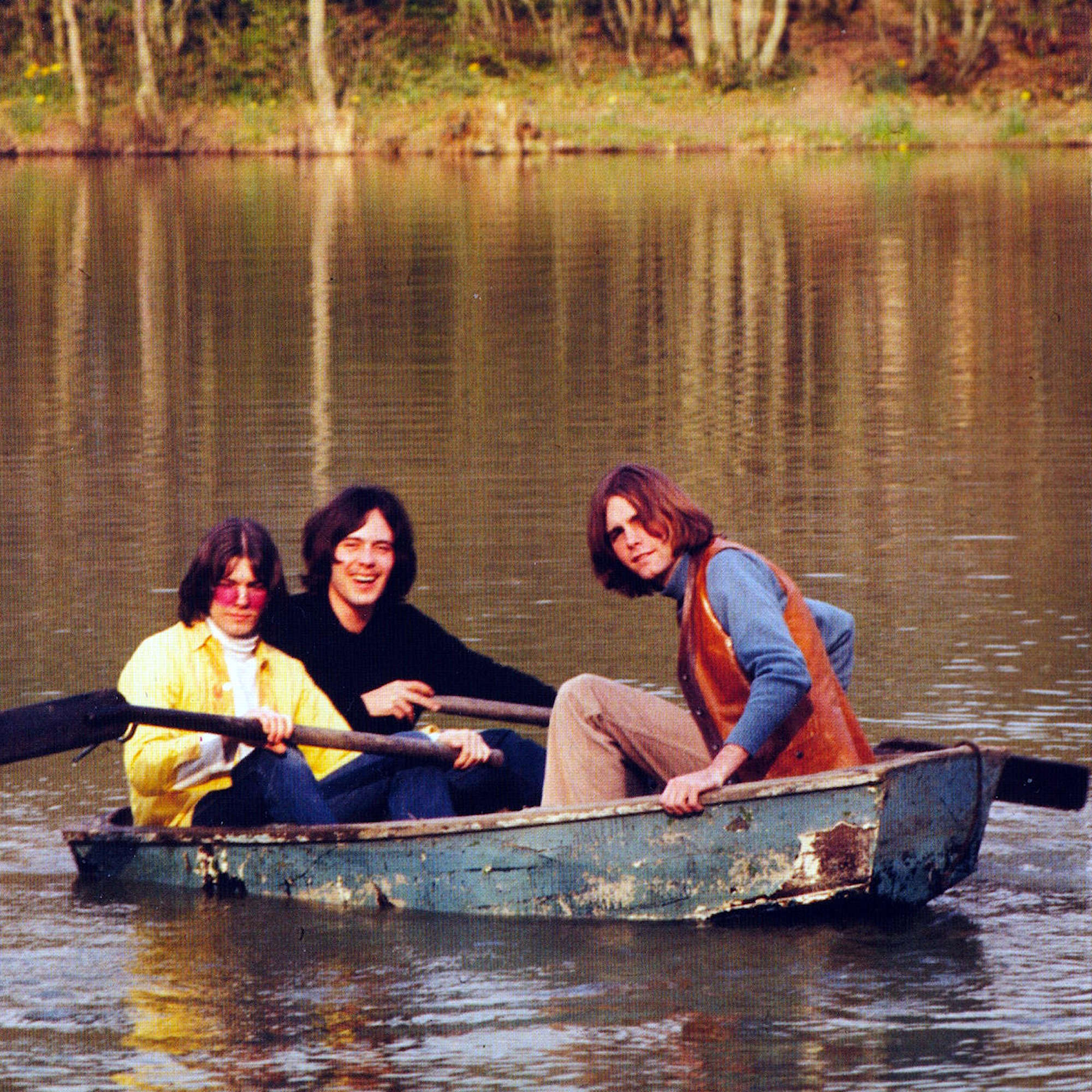
Following changes at Apple Records in 1969 a collection of recordings by New York group Mortimer were never released. Here is their story.
Mortimer: unreleased Apple recordings: It was late Spring 1969. The Beatles’ Apple Records label was preparing to release the debut albums of the first two groups signed to Apple, The Iveys and Mortimer. The Iveys had released an Apple single in November 1968. But for Mortimer, a trio of American teenagers from New York City, On Our Way Home, and the accompanying single of the same name, would be their first work to be issued by Apple.
Both albums were complete and mastered. The Iveys were scheduled for a July release, to be followed soon thereafter by Mortimer.
Apple Records President Ron Kass — himself an American — was certain that On Our Way Home was going to be a big record for the label. Their album had been produced by Apple’s A&R man Peter Asher and would feature “On Our Way Home,” an as-then unreleased Beatles song (later retitled “Two Of Us”) that Paul McCartney had personally given Mortimer to record as their inaugural Apple single.
Allen Klein
All that remained to be done was to finalise the album cover artwork. But suddenly, Ron Kass was gone, ousted from Apple in May by Allen Klein, a New York City-based accountant who had recently been appointed business manager of The Beatles and Apple. Peter Asher would resign from Apple the following month.
The Iveys and Mortimer had been enthusiastically championed by Kass and Asher, and now that both men were no longer with Apple, their albums were put on indefinite hold. The Iveys album would sneak out in Japan, Italy and Germany due to interest from the local EMI distributors, but the Mortimer album and “On Our Way Home” single would never see the light of day.
Members of Mortimer would haunt the Apple office for a few more months, hoping that Apple would change course and release their album, but their moment had gone and no one at Apple was willing to challenge Klein’s decision to shelve their record. Their options exhausted, Mortimer reluctantly called it a day.
In the ensuing years, Mortimer’s brief association with Apple — particularly the unissued “On Our Way Home” single — became part of Beatles legend, though little was known about the group or the material they cut for Apple.
Mortimer: unreleased Apple recordings

The superb music they made in London in 1969 would languish in a tape vault for close to five decades, before finally being exhumed and dusted off for this long-overdue release.
Mortimer’s career was the unfortunate collateral damage of the power struggle that had ensued at Apple when Allen Klein assumed control of the company. Ironically, it was not Mortimer’s first run in with Klein.
In 1966, the group — then known as The Teddy Boys — was a quartet comprised of Tom Smith and Bob Ronga on vocals and guitar, Tony Van Benschoten on bass and vocals and Guy Masson on drums. The Teddy Boys released four singles, including two garage-rock stompers for Cameo-Parkway in 1966.
Due to their regional success, Cameo-Parkway put the group into a Philadelphia studio to record an album. It was completed and ready to go when a certain Allen Klein purchased controlling shares of Cameo-Parkway Records. Klein and his company, Abkco, assumed control of the company and proceeded to drop most of the artists signed to the label, including The Teddy Boys.
Teddy Boys
The Teddy Boys were devastated by this sudden change in fortune, but they took it somewhat in stride as they were having the time of their lives as the house band at Sybil Burton’s famed Arthur club in New York City.
Many nights, The Teddy Boys would finish their set around 2am, and would retire to their groovy pad on the top floor of Arthur to unwind by jamming on acoustic guitars and to enjoy popular substances of the day.
It was during these nocturnal jam sessions that they developed a sound that captured the attention of manager Danny Secunda. It was acoustic, but it was not folk music. Rather, it was rock music played on acoustic guitars and conga drums.
Secunda secured the group a contract with Philips Records and they recorded an album in late 1967 that was issued in May 1968. By the time that the album reached the shops, Mortimer had been reduced to a trio, with Bob Ronga leaving the band over a dispute about the group’s management.
Mortimer’s self-titled album received positive reviews, they appeared on American Bandstand and had considerable airplay on New York radio and in other markets, but their record did not become a national hit.
Mortimer: unreleased Apple recordings
Mortimer were playing shows around New York when Danny Secunda decided to take the group to England in September 1968. It was a short-lived venture as the group were stopped at Heathrow and deported back to New York due to lack of funds and the fact that Secunda, already in London, hadn’t arrived at the airport with the proper paperwork.
Undeterred by this setback, Mortimer would save up some money and return in November 1968.
Outside of playing the Marquee Club several times, not much happened for Mortimer in England. On their final morning in London the group were packing up and enjoying their last taste of British pop music on the BBC.
Mary Hopkin
“We heard over the radio that Apple was looking for songs for Mary Hopkin and for you to bring your tape to Apple Records,” recalled Guy Masson. “So the three of us went down to Apple Records and we walk in and we go, ‘Hi, we’re Mortimer and we heard on the radio that you were looking for songs,’ and we walk in with our acoustic guitars and the receptionist said, ‘You have to leave a tape.’

So Tony was pretty sharp and said, ‘We can’t make a tape, we don’t have time, we’re going back to the States tomorrow.’ So she says ‘Alright, let me call up to the publishing office,’ and she tells Mike O’Connor, ‘Mortimer is here,’ and he goes, ‘Mortimer? John gave me their album, send them up!”
Mortimer were stunned to hear that Mike O’Connor knew who they were and was familiar with their debut album. Earlier that summer, Masson and a friend had in fact delivered a copy of Mortimer’s record to John Lennon and Paul McCartney when the two Beatles were staying in New York City at the apartment of Nat Weiss (The Beatles’ American attorney).
John Lennon
“We had heard on the radio that The Beatles were in town,” recalled Masson, “and a friend of mine kept pushing me to take a copy of our record to Weiss’s office/apartment which was only around ten blocks from where we lived.”
Masson and his friend were able to gain access to Weiss’s building and took the elevator to his apartment where a party was in progress. “We knocked on the door and Nat Weiss answered it,” said Masson. “We told him we were Mortimer and I said, ‘I want to give this album to John and Paul.’
He took the album and went back inside and came back a little later and said, ‘I gave it to John and he said he would seriously give it a listen.”
It will never be known if John Lennon actually listened to the record, but Mortimer’s album made it back to London with Lennon and was passed on to Mike O’Connor in Apple Publishing.
Masson continues: “So we went up to (O’Connor’s) office and sat around with our guitars and sang our songs. While we’re going along singing a song called “Life’s Sweet Music,” there are two doors in this office, one opens up and George Harrison walks in dressed in this Indian-styled green long jacket.
He comes bopping in and he’s clapping and he’s dancing all around, and the three of us are going, ‘Holy Toledo, that’s George Harrison,’ and he says, ‘Sign them up’ and he went out the other door.
So we told our manager and he followed up, and the next thing you know, they bought us off of Mercury, and we’re signing contracts with Apple Publishing and Recording.”
Mortimer: unreleased Apple recordings
Mortimer signed a three-year contract (with a further one-year option) with Apple on 30th November 1968.
Peter Asher was assigned the task of producing Mortimer. The timing couldn’t have been better as Asher’s principle artist at Apple, James Taylor, had just returned to the United States the previous week to try to kick his heroin addiction.
Asher knew nothing about the group so he booked them into Trident Studios for an afternoon to run through all of their original songs. Thirty-nine tracks were recorded. Conspicuously absent was the song that had inspired George Harrison to sign them to Apple, “Life’s Sweet Music,” which had appeared the previous year on their Philips album. Sorry George.
Stark acoustic sound
Sessions for Mortimer’s album began in February 1969, when Peter Asher returned to London after several months working out of Apple’s Los Angeles office in the Capitol Records tower. In Asher’s absence, Mortimer had been busy, writing new songs and rehearsing.
They had been so prolific that only one song from their December 1968 demo session, “People Who Are Different,” would be recorded for the album. The remaining songs would all be new material that the group had written between December 1968 and February 1969.
Asher and arranger Richard Hewson envisioned a different approach than the stark acoustic sound that had distinguished Mortimer’s Philips album. Most of the tracks would still be heavily acoustic, but several, particularly the songs most likely to be the singles, were much more produced.
One song in particular, the brassy, upbeat “You Don’t Say You Love Me,” totally dispensed with the acoustic guitars and (for the most part) conga drums. Asher – freed from the production limitations that had been imposed by the downbeat, introspective songs of James Taylor – was clearly going for an all-out pop hit.
Propelled by a dynamic horn and string arrangement, a bubbly electric bass line from Tony Van Benschoten and Guy Masson showing off his prowess behind a drum kit, “You Don’t Say You Love Me” was tailor made for American AM radio. “Peter told us,” remembers Tony Van Benschoten, “that he had always wanted to produce his own “wall of sound” production.”
African instruments
On other tracks, Asher experimented with more unusual sonic textures, adding a vocal chorus to “Dolly” and African instruments to “Last of the H.” “Peter brought in some outside musicians to help us,” explained Tom Smith. “We had an upright bass player named Spike Heatley playing on our song “People Who Are Different.”
On our song “Dolly,” Richard Hewson brought in a choir of twelve people to sing the parts he had written. Richard Hewson also played piano on a song we hoped to make a single, “Pick up Your Heart.” Peter Asher sang on “You Don’t Say You Love Me” and he also played bass on a track.”
Tony Van Benschoten remembers that “we used the same African drummers that had played on the Stones’ “Sympathy For The Devil,” and when the final take ended, the lead drummer came up to me in tears. He said that part of the repeated vocal chorus was the word for mother in his language and it made him think of home all the time he was playing.”
Completed master tape
Mortimer’s album took shape over multiple sessions, and after several months of recording, the album was complete and a master tape was compiled on 17 April. With tape in hand, Asher made the rounds at Apple, playing it to anyone who could spare a few moments to listen.

It received an enthusiastic response from the Apple staff and several songs – “You Don’t Say You Love Me” and “I Didn’t Know” were earmarked as the potential singles. Paul McCartney heard the tapes and was impressed by what he heard, but he then made Asher and Mortimer an unexpected offer that they felt they (literally) couldn’t refuse.
“McCartney popped in on us – he used to drop in and see how things were going with all the artists that were signed to Apple – and we had just recorded a song, “You Don’t Say You Love Me,” and Peter thought that it might be the single, so he played it to Paul,” recalled Tom Smith.
Mortimer: unreleased Apple recordings
“Paul said that he liked it but said, ‘I don’t know if it’s a single.’ Paul noticed that we played a lot of acoustics and he said ‘I’ve got a song I think you guys would be perfect for,’ and he played us “Two of Us,” which was then still called “On Our Way Home.”
He played us an acetate of him and John playing it on acoustic guitars. They were joking together like The Everly Brothers saying, “Take it, Phil’ and things like that. It was nice, but honestly I don’t think any of us thought that it was a single. But the fact that Paul gave it to us and that Peter said ‘Let’s go and try it,’ we went and recorded it.”
Asher recording sessions
Asher and Mortimer dutifully returned to Trident to record “On Our Way Home” and the song was completed and mastered on 1st May. Given the acoustic foundation of Mortimer’s sound, it was obvious why McCartney thought that the song would be ideal for the group, but the idea sounded better in concept than on tape.
Mortimer’s arrangement – which included a synthesizer part played by Mike Vickers – smoothed out the song’s rough edges but their performance failed to match the charm of The Beatles’ demo. Tony Van Benschoten recalls that “the three of us always felt unhappy about it, we felt that we had let Paul down.”
It didn’t sound like a sure-fire hit, but several songs (“Christine Tildsley” and “Last Of The H”) were dropped from the original track list and “On Our Way Home” was added as the first song on Mortimer’s album.
The group were unsure about how the song had turned out, but felt that they were in no position to turn down a Beatles song and even a tentative performance of an unreleased Beatles song may have had a genuine chance to become a hit.
A loss for Apple
But it was not to be. Kass and Asher exited the company and the members of Mortimer – not being familiar with the inner machinations of a record company – could not comprehend why Apple were not releasing their album, regardless of the personnel changes.
For a few months, it looked like “On Our Way Home” might be put out as a European single (Apple 16 was pencilled in as a possible catalogue number) but summer came and went with no Mortimer record appearing on Apple’s release schedule.
One last attempt
The cancellation of the Mortimer album ended the career of a promising group with a very distinctive sound. The Mortimer debacle was a loss for Apple as well. Outside of the money spent on the sessions (those orchestrations didn’t come cheap), Apple desperately needed another group to fill out their roster and Mortimer would have fit the bill perfectly.
Unlike the other Apple artists, they came to the company reasonably well established in the critical American market where they were already a known entity to record buyers, music journalists and radio programmers.
Guy Masson made one final attempt to find out what was happening with their record. Fortifying his courage in a nearby pub, he remembered marching into Apple and asking the receptionist, “Where is Allen Klein?’
Mortimer: unreleased Apple recordings
They said he’s on such and such floor in such and such office and I just charged in there and saw this man behind a desk with a light, with these two huge business guys, all in suits.
I don’t remember what I was doing, but I was ranting and raving about our album and what was going on, can we get this finished and Allen Klein just kinda looked at me and said to these guys, ‘Could you escort this man out please,’ so they took me out, they escorted me right out of his office, down the stairs and to the lobby and said, ‘Please leave Mr. Klein alone.”
And that was the end of Mortimer. Tom Smith and Tony Van Benschoten – not keen to face the draft back in the United States – would remain in England, Tom finally returning to the States in the early seventies. Guy Masson returned to New York in late 1969, where he would appear on Van Morrison’s Moondance album.
Van Morrison
But outside of the Van Morrison session, none of the members of Mortimer would make any further recordings, which makes the release of On Our Way Home all the more welcome and somewhat poignant.
It’s an album positively brimming with top-notch songs, first rate musicianship and a sense of raw enthusiasm that is particular to young artists. Listening to the album they made in London a lifetime ago in 1969, it’s not far- fetched to think that Mortimer could have found real commercial success with Apple.
But we’ll never know for sure and can now just be glad that Mortimer’s long lost Apple album has finally found its way home. (Stefan Granados, November 2016)
An earlier Mortimer record review on The Monocled Alchemist


Leave a Reply