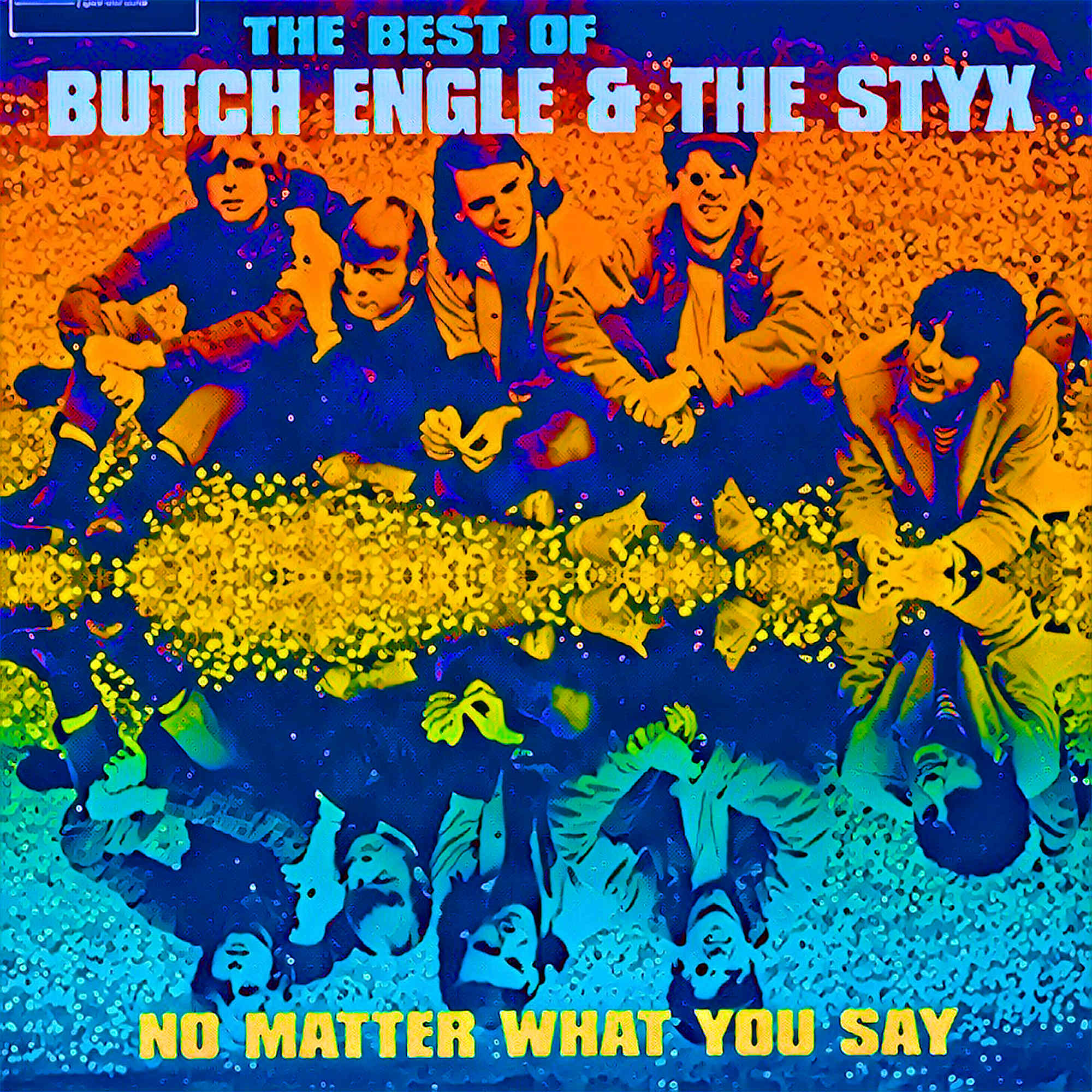
Angst, Fuzz & Farfisa from Mill Valley
Butch Engle & the Styx: The angst-ridden vocals of Butch Engle were a perfect fit for the pungent yet mysterious Farfisa ‘n’ fuzz brew cooked up by the Styx in the bubbling cauldron behind him.
The combo had the eerie moan of 1966-67 so perfectly dialed-in, the band expired a few months after the calendar flipped to 1968.
In their heyday, however, the Mill Valley, California, quintet were the equal of anyone in San Francisco, just across the Golden Gate Bridge.
Band Bash ’66
Friends since their days at Tamalpais high school in the early ‘60s, Engle, bassist Hap Smith, drummer Rick Morrison and guitarists Bob Zamora and Mark McDermott—McDermott was replaced by keyboardists Mike Pardee in ‘65 and then Larry Gerughty in ‘66—released three killer singles, copped first prize in a huge San Francisco band battle, got a sniff from Warner Brothers Records and still seemed to be swimming upstream most of their career.
“We’d just won first place in the H. Liebes Band Bash ‘66 at the Cow Palace,” says Engle, “so we were booked into California Hall to open for the Hedds. We got booed for the first 30 seconds, but by the fourth song they had to close our show because the kids were going crazy out there.
Larry Gerughty, who looked like Brian Jones, got jumped out front later by fans looking for souvenirs.” Who knows what would have happened to Engle, himself, if the mesmerizing frontman had been so foolhardy?
Butch Engle & the Styx
Since he also played football at Tamalpais high, Engle felt secure enough to sign up for choir class in 1961. He soon fell in with future Sons Of Champlin leader Bill Champlin who asked him to join the Royal Keys.
“Bill told me, ‘I’ve been trying to come up with a reason to fire our lead singer. Would you like to do it?’”
Engle inherited the group in 1963 and changed the name to the Showmen when Champlin split to form the Opposite Six, forerunner to the Sons Of Champlin.
By 1964 the Showmen—absorbing Smith, Zamora and McDermott from the Leftovers along with Morrison on drums—had retooled their sound. Ventures and Kingsmen influences were replaced with the fab new strains of the Beatles and the Stones.
The Showmen
The Showmen soon found themselves in the primitive studio setup of MEA Records of Sausalito, ready to record their first single, the raucously careening “You Know All I Want”/ ”Tell Me Please.”
“It was time for Bob to write some original songs,” says Engle who describes MEA as “a one-microphone setup.” Adds Smith, “MEA had been putting out Zen poetry/lecture albums by Alan Watts. We paid them to record us, and it was a one-take deal. All they asked when we went in to mix the session was, ‘How much reverb do you want on this?’”

By 1965 McDermott was having serious psychological problems that caused him to leave the band. “His psychiatrist told him, ‘What you need to do is quit music and take up bowling,” says Smith. “Part of the reason Mark lost it was that we had evolved away from the Ventures instrumentals he loved,”
No reason Zamora couldn’t slide over and play lead, the Showmen reckoned, ignoring his protests: “I play rhythm. I don’t play lead.” “He was right,” agrees Smith. “Bob had soul, not technique. But he could fake his way through it. And he knew how to make people come by and say, ‘Wow, that was really cool!’”
Adding Pardee on keyboards, Smith notes, “really smoothed out our sound.”
With the new sound, a change in the band’s name also seemed in the cards. “Rick got the name Styx by using a Ouija board. He asked it, ‘What’s the new name for our band?’ And then we all said, ‘That’s not a word!’ But we looked it up in the dictionary and, sure enough, it was there: Styx.”
Butch Engle & the Styx
Butch Engle And The Styx were so hypnotic in person they were seeded through to the final round of the H. Liebes Band Bash in April of 1966 without having to formally audition. “Lloyd Liebes—the son of the owners of this large clothing chain—had done well with one-hour shows in the downtown store,” recalls Engle. “He spent months going all over the Bay Area looking for bands for this gigantic three-day ‘battle’ at the Cow Palace.
“Lloyd came to one of our dances and really liked what we did. During the finals everybody had go-go girls on stage with them. You were judged on how well the girls could dance to you. I told Lloyd, ‘You’ve seen my act.
No matter how they wiggle they’ll look better than me. I won’t do it!’ So we didn’t use them and we still won.”
The Golliwogs
Engle considers the Liebes shindig a turning point in his musical career. “Lloyd wanted to manage just me, but I told him, ‘These guys are the reason I’m here. I can’t do that.’ And I turned him down. That band attitude may have kept us from going further, but it also gave us, I think, audience credibility.”
Smith recalls a similar temptation one Saturday afternoon while the Styx were cutting demos at Fantasy’s Treat Avenue San Francisco studio. “Max Weiss took me aside and said, ‘I’ve got a band here that might need a bass player. They’re called the Golliwogs.’ But I told him, ‘No, no, I’m sticking with my friends.’”
One excellent career move the Styx did make was to hook up with Beau Brummels song-writing whiz Ron Elliott.

“My father was retired from the military,” says Engle, “and he became the night superintendent at the Industrial Indemnity building in San Francisco at California and Battery. And Ron Elliott’s mother ran the elevator there. One day she mentioned she had a son who was doing a record. Then, in the fall of ‘64, there it was, bang bang, on the radio: ‘Laugh Laugh.’”
Butch Engle & the Styx
Engle had a standing invitation to meet up with Elliott. “Finally I drove my car over to his parents’ house, near San Francisco State, but he wasn’t there so I slept in the car until he came home.
I think he was kinda knocked-out that I’d waited all day to meet him, and we got along right away. We chatted about his music and what I did. Basically, he took the band on. He did the arrangements. He did everything.”
Smith still marvels at Elliott’s songwriting prowess. “Every time we’d go over to Ron’s he’d have 20 new tunes. He was writing three songs a day, all consistently amazing.” Engle enjoyed cherry-picking from the Brummels’ leftovers. “Ron, Sly Stewart, Tom Donahue and Bobby Mitchell would choose which songs would go on an album, and then we could take what we wanted from whatever was left.”
Leo Kulka
When Donahue peddled his Autumn roster to Warner Brothers in 1966, the Styx agreed to give two sides to WB subsidiary Loma and began recording at Leo Kulka’s Golden State Recorders.
It was material Engle particularly fancied. “We were in the studio,” says Engle, “opening with the vocal chorus on ‘No Matter What You Say’ and everybody just headed for the booth to listen to the tune.”
Unfortunately, says Engle, Loma tapped Elliott’s “I Like Her’—described by Engle as “experimental”—as the Styx’ debut single. “‘No Matter What’ was the hit. Everybody knew it. But we made the decision to ‘go with the one that brung ya.’”

Following their brief fling with WB/Loma, the Styx made arrangements for two masters to go to Lou Dorren’s fledgling SF Peninsula imprint, Onyx. “Lou came up with the name for his label because it looked good with Styx,” reveals Smith. “We were his first attempt to find a band.” By late 1967 “Hey, I’m Lost”/ ”Puppetmaster” was in the can for Onyx.
Promotion Stunt
Engle still regrets the grief his band gave Dorren, probably fall-out from their short dance with a major label. “We gave Lou a hard time. We were really unreasonable, making him perform impossible promotional stunts like dropping balloons with our name on them from an airplane.
I don’t know why we wanted to kick Lou in the balls, since he was the one guy who would have hocked his home for us.”
Engle and Smith are equally baffled why Butch Engle And The Styx went their separate ways. “We were scheduled to do an album, but everybody was feeling frustrated,” admits Smith. “I have no idea why we broke up.”
Engle—a tough captain who always insisted on zero tolerance for on-the-job drugs and alcohol—recalls putting his foot down at one of Smith’s “goodbye tour” bookings. “We’d played Healdbsburg with Moby Grape and Hap had a gig lined up that | didn’t want to do.
So I told him I wasn’t doing it, and they had to refund the money. I could always hear the crowd scream for me. We’d changed the name to Butch Engle And The Styx because that’s what the fans called us.
I didn’t know music. I was just the front guy. But I did that part so well the audience recognized it, and by 1968 there wasn’t anything else to try.
We’d been to the mountain top,” concludes Engle, no mean feat for a band that grew up in the shadow of towering, enigmatic Mount Tamalpais. (Jud Cost)
the Podcast
Any feedback? please send to me via the contact form link provided.
I present you their recorded material interspersed with vintage sixties radio promo adverts. This is Episode #70 of “The Monocled Alchemist” podcast.
Featured songs in order of appearance:
- Creedence Clearwater Revival / The Grass Roots – Long Beach Arena concert promo spot
- No Matter What You Say
- I Like Her
- Donovan live in concert at The Bushnell, Hartford, CT radio promo spot
- Hey, I’m Lost – version 1
- Going Home
- Flying Nun TV Show promo
- Puppetmaster
- Left Hand Girl
- Jim Madison WRCQ Washington DC ‘Request-o-Matic’
- I Call Her Name
- Hey, I’m Lost – version 2
- Three Dog Night ‘It Ain’t Easy’ LP radio promo
- She Is Love
- I’m A Fool
- The Troggs – Miller Beer radio spot #1
- Smile, Smile, Smile
- You Know All I Want

Leave a Reply