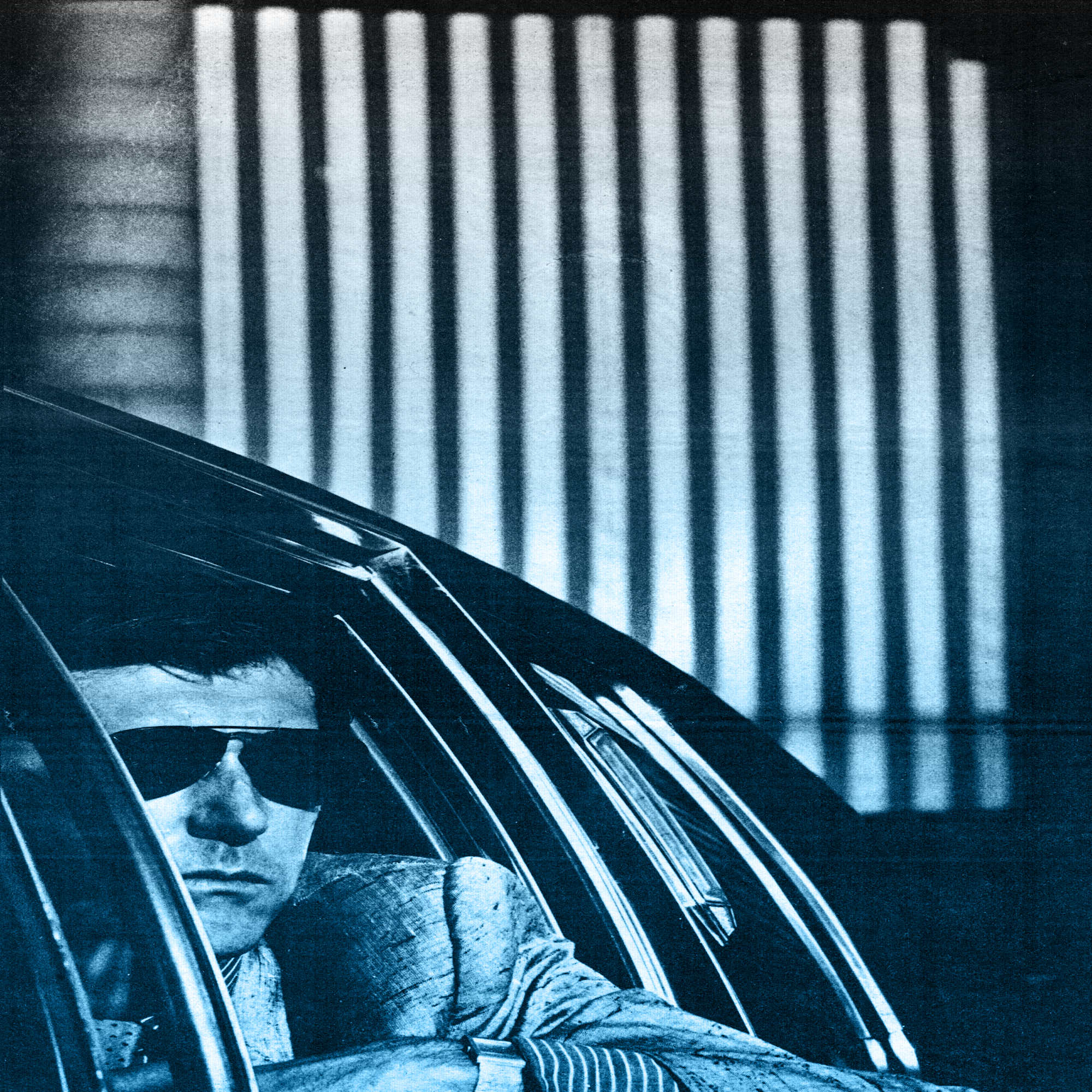
During a truce with the music press, Bryan Ferry allows a rare insight into the creating of the Roxy Music hit LP ‘Avalon’.
Article published in NME, 19th June 1982
Bryan Ferry | In A Lonely Place | I’M TALKING WITH BRYAN FERRY AT THE E.G. OFFICE ON LONDON’S KING’S ROAD AND HE LOOKS . . . WELL, LIKE BRYAN FERRY. Impeccably groomed, stainless steel smile, long, lank hair prone to falling across limpid blue eyes. He is a disgracefully handsome man.
The surprising thing, however, is how boyish he appears in the muted-blue suit. Ferry is endearingly unsure of himself and — can it be? Yes! — Rather shy! Don’t get me wrong, Ferry’s got style to burn. He handles a cigarette with incredible elan and, the mark of a true gentleman, he makes those around him feel at ease. But there’s a wistfulness and vulnerability about him that’s distinctly at odds with his image as an oily lounge lizard who slinks through a rarified Helmut Newton world of cruelly beautiful women, Persian rugs and champagne.
Ferry has been accused of being a decadent escapist, a fin de siecle dandy who’s made a tainted fortune chronicling the twitches and tinglings of the idle rich.
In truth, Ferry depicts his central theme, romance as an arena fraught with opportunities for heroism. His preoccupation with form and style — also attacked as shallow hedonism — can, in fact, be seen as an attempt to impose a semblance of (artificial) order on a chaotic world.
Really, what can one do when the world’s gone mad but pluck a rose for one’s beloved!
Ferry retreats further into the mist of eros on Roxy’s new album ‘Avalon’. Avalon is actually a part of the Camelot legend, a place described by Ferry as “the ultimate romantic fantasy land”, and this record, lyrical and smooth, conjures that terrain with impressive grace. There are no rough edges whatsoever on this music. It rolls in like a glittering fog, and Ferry’s shivering croon sounds downright mystical.
It goes without saying that many of the bands currently dominating the charts have learned a lot from Ferry but he’s not the sort of man to claim he was the first.
Beyond the fact that he is his own harshest critic and is rather humble, he is far too preoccupied with his own private world to fret about pop trends.
Ferry keeps his world private by meeting with the press as infrequently as possible and although he reveals bits of himself in this interview, I felt he got away with many secrets intact.
Style, secrets, soul — such is the stuff pop heroes are made of.
Bryan Ferry | In A Lonely Place
YOUR MUSIC is often attacked as being escapist. Does an artist have any obligation to address the political issues of his time?
It’s useful for the artist to interpret the times he lives in and reflect things that happen, and obviously political events are part of all that, but I don’t think there’s any obligation to do it. I have nothing against political themes being used by artists and those things can provide some interesting material.
When I was at University I was taught by this artist named Richard Hamilton who lives up in Oxfordshire. I hadn’t seen him in years and was up there the other day so I went to see him. He was working on this enormous painting that looked sort of religious to me. It was based on a photograph that was taken in the Maze Prison over in Ireland where they have political prisoners. But Hamilton said that for him it wasn’t a political painting even though it will be interpreted as that by an audience.
He simply thought it was a striking image. I once covered a Dylan song, ‘A Hard Rain’s A-Gonna Fall’, which had a political theme, but that wasn’t my interest in it at all. The lyrics are very strong in that song as they are in a lot of his things — and I was simply interested in the richness of the imagery. And that’s a good instance of how you can do something that has layers of meaning.
Are you often surprised at the things that are read into your music?
No, because when you write something and then look at it, typewritten, you tend to become quite analytical about it and you see all the possibilities. In Shakespeare there are always double meanings — and that’s one of the great things about the English language.
You don’t write with a specific point you’re trying to make?
Sometimes. It depends on the song, or even the line, but often you’re simply playing with words.
How did you feel when punk was dominating the charts and established pop stars were being dismissed as obsolete?
I felt great faith in myself and felt that I wouldn’t be discarded by an intelligent audience.
How powerful is pop music? Can it effect real social change?
It probably can in that it’s the art form — if you want to call it an art form — that’s closest to the people. It’s much closer to people than movies now, at least to young people, and it has been for quite a few years, certainly since The Beatles.
So yes, I think it does effect the culture. For instance, the way that musical artists look has become quite important in the last ten years and that has effected the way that people dress and wear their hair. You can see its impact in ways like that.
Do you feel any responsibility as a role model then?
Up to a point, but I don’t feel any grave seriousness about that. I don’t feel inhibited by it or think, God, I mustn’t do this . . .
Bryan Ferry | In A Lonely Place
I heard you interviewed on the radio the other night and you were quite complimentary about many of the new groups who’ve been heavily influenced by you. Do you really like Soft Cell and ABC, or were you just being diplomatic?
I’m a Libra so it’s hard for me to be openly nasty. I also don’t feel that it’s my place to criticise other people’s work. And, there’s always something cute about something, even if it’s lightweight. Soft Cell, for instance, look really weird. In all the gay bars you’ve ever been in you see guys like that with really bad make-up, and I think that’s kind of interesting. It’s sort of like a very English; a very provincial version of Berlin decadence.
Do you keep up on trends in music?
No, that’s one thing I don’t find too interesting. I listen to the radio when I drive, especially if I’ve got a record out, I’ll listen to see what it sounds like on the radio and how it compares to the other records that are being played. Radio in England is so good that I tend to listen to the other channels rather than the pop channels. I listen to Radio 3, which plays non-stop classical music because it just seems to suit me more. And driving from the country into London I listen to Radio 4, which has things like plays, quiz shows, nature programs, and weird, very English things.
HOW IMPORTANT is an exaggerated, easily understood image in selling records?
Incredibly important. Whenever you do an album cover, that’s the main issue you’re dealing with. (Laughing) My image isn’t very clearly defined and that’s why I’m not that successful.
You don’t see yourself as successful?
In a way . . . I have no real complaints. It’s interesting that in America the simpler the image a star has — be it movie star, television personality, whatever—the more successful they seem to be. That’s not as true in England because the British are more prepared to accept weirdness and complexity, and I think that’s because the hard sell principle doesn’t happen quite as intensely in England. Things are just made available and the audience then makes a decision.
In America there’s this sense that things are much more important. There’s more money at stake so success is more important. If an American record company decides to break an artist, they put a lot of money into it and push him very hard. That never really happened with me
So, you feel that you don’t have a clear image in America?
I might have one, but it might not be accurate. Maybe I’m just seen as a guy who wears suits or something.
I think a lot of people see you as a romantic fatalist along the lines of F. Scott Fitzgerald.
Oh, that’s very flattering. I don’t mind that at all.

Bryan Ferry | In A Lonely Place
Your image is also that of an affluent gentleman of leisure, or country squire. How accurate is that?
Not very. I have stayed in houses where the life-style is that of an 18th Century country squire and it’s not a life-style I could totally live. It’s great to play at, but it’s too negative and too much like living in a museum. There are aspects of it that seem truly civilised though.
Yesterday I went to visit an old friend of mine who’s the sort of mad eccentric who could only live in England. He’s a dean at Oxford and I walked around there with him and found it really an amazing place.
I thought to myself, Christ, this is the way I ought to live! Leather volumes everywhere; very old buildings with knowledge just sort of dripping off the walls. But ultimately I couldn’t do it because I like electric guitars too much, plus, I thrive on change.
Are you playing a character onstage?
With every song you do that a bit. You take an aspect of yourself and either simplify it or ham it up. To some extent it’s like method acting. In an hour and a half show you go through a lot of different moods, one right after the other, and people aren’t really like that. You say to yourself, How does this song go? Oh yeah, then you get into a role for it and leave that role when the song ends.
Is that the extent of your interest in acting?
It is so far. You have to be a bit more of a show-off than I am to be an actor. You really have to love yourself, and there are people who really do. I’ve got nothing against that because I love movies and stars. There are certain faces that you just like to see — Charlton Heston, Marlon Brando, whoever. I once played a small role in a Swiss television show and I hated watching myself. I kept thinking Oh God, what a terrible camera angle. I’d rather not be seen than look bad. My reaction was a sort of vanity really.
Is vanity a vice?
No, not at all. It can destroy people but it all depends on how you use it. I’m only vain in the sense that I’m unsure of myself. I’d love to be the sort of person who never looks in the mirror because they’re always confident that they look great. I generally feel that I look terrible which is why I don’t like cameras or being photographed. Cameras make me stiffen up.
Even after all the success you’ve had, that hasn’t changed?
Not really. I don’t mind being photographed by friends, holiday snaps and that sort of thing, but when you get into a studio with the lights and all, I usually find I’m just not in the mood for it.
WHY DO YOU do so few interviews?
I always feel vaguely embarrassed talking about myself. There’s something not quite right about it. Plus, I like TO think that the work speaks for itself and doesn’t need footnotes.
How has success changed you?
Not that much, maybe because it’s taken a long time and come to me fairly late in life. I didn’t start making music until I was 25, and by that time you’re usually fairly well formed as a person and less likely to change if anything extreme happens to you. I’ve enjoyed most aspects of success, although it does impose certain limitations. You can’t really live like a normal person because you aren’t a normal person.
Has success forced you to live an insulated life?
Yeah, somewhat. I live in the country most of the time. The only city I really enjoy being in is New York because it’s very easy to become anonymous there.
New Yorkers do have a different code governing the treatment of celebrities.
Yes. New Yorkers are too cool to bother a celebrity, and that’s why it’s very pleasant there. Say you’re walking down Madison Avenue, you might pass one or two people who look and recognise you, but they’d never stop you, or if they did, they’d do it in a very charming way.

Bryan Ferry | In A Lonely Place
Are you surprised at what you’ve achieved in life or did you always feel driven to leave your mark on the world?
I did always feel different, maybe because where I came from, Newcastle, is a rough part of the world with no possibility for anything but escape. I was the third in a family of four children and had three sisters. My family always felt I was bright and they encouraged me with school and going to university. They saw education as a ladder to something and would’ve liked me to be a doctor. But I never considered anything like that for a second and always felt drawn to creative things.
What’s the earliest memory fixed in your mind?
My first piano lesson, which I had when I was five years old. I can remember coming home with my little music case and sitting down and playing this scale. My sister, who was a great pianist, then came in and started teasing me and saying, No, you don’t do it like that, you do it like this! She then sat down and started playing Beethoven’s Moonlight Sonata very well. I got so angry I started punching her and I never took another piano lesson. I play now but I’m totally self taught.
What was the first record you bought?
Jazz 78s. Jazz is what I was really interested in and the first EP I got was by Charlie Parker. I played it so much that I can remember every solo on it to this day.
Do you feel that there are jazz and blues elements in your music?
Definitely. I see my music as sophisticated modern blues, and perhaps that’s why I always relate to sad music. My main influences were black American artists, and yet I’m very white and very English. Those are the two polarities and there are a lot of things in between.
So, you see yourself as more in the tradition of Parker, Cole Porter and Frank Sinatra than the pop/rock tradition?
Cross those three with Jimi Hendrix and Otis Redding and that would be the sort of party I like.
HAVE THERE been pivotal episodes in your life that in retrospect you can see clearly changed you?
I think living in LA, as I did for six months in the mid-’70s made me a bit more resilient. I love going to Los Angeles for a week or two, but when I lived there I stayed in Bel Air and it was quite an experience to live in that weird land of the lost. There’s no real focus in LA and I found it difficult that there were no streets leading to a centre. I was a night person at that point but there weren’t any nightclubs.
I’d gone there to write so I spent most of my time locked up in this house and the only person I ever saw was the maid. I’m not a very social person, although if someone rang me up and said do you want to go to a party, I always went. But I never really organise things myself, and LA is the sort of place where you have to have lots of friends you really like and you have to make an effort and have them around you.
And you can go a bit weird if you start running around with strange movie-type people. I got into one of those slip-streams when I was there, where I saw the same people every night but in different locations. I wrote The Bride Stripped Bare while I was there and that’s a very gloomy album.
Do you see yourself as a melancholy person?
Basically. Up and down, sometimes to quite an extreme. Occasionally I can be really funny to be with. The people you laugh with are generally the ones you know best and humour is usually the main basis for any close friendships I have.

Bryan Ferry | In A Lonely Place
Is there humour in your music?
Sometimes. Perhaps it doesn’t come through as often as it ought to. Making records gets to be a very serious business for me because I’m very passionate about it. So perhaps my brooding, melancholy side comes through more on record. I can imagine someone who didn’t know me listening to my work and thinking, God, what a gloomy person. But I suppose that’s the side I find most creative. When I’m in a light-hearted frame of mind is the last time I’d ever want to go sit at the piano and work.
It’s a popular theory that an artist has to be in some kind of conflict or turmoil to do good work. Do you think there’s any truth to that?
Yes, I think there is. But then, if you have a good memory you can always remember what it was like when you were last in turmoil. Making Avalon was interesting in that, for a change, I wasn’t going through much. But I’ve found that although you might think your day to day life is fine and there’s no great trauma going on, as soon as you start making music, all kinds of angst seems to appear out of thin air. I don’t know if it’s from memory or what. Perhaps it’s just the introspection — asking what’s the meaning of life: why am I doing this? Why does this chord sound good next to that one?
Do you have structed writing habits or do you have to be in the mood?
I do have to be in the mood, unless I have a deadline. I’d love to be one of those writers one reads about who get up at six in the mornings and write until nine, then answer correspondence. My head is very sloppy. I like everything around me to be neat and well ordered but inside it’s frequently rather muddled, especially when I’m working.
I once read a book that posited the theory that physical beauty and romantic love were the most destructive ideas in the history of human thought. Do you think there’s any truth to that?
I think romantic love has been constructive because it often goes hand in hand with unrequited love, and the best art seems to come out of those emotions. That sense of longing produces great art because it’s almost as though you’re creating something to replace what isn’t there. In a sense you’re making a surrogate love object. And you’re also trying to make something beautiful so that people will applaud you and want you. (Laughing) I think it always helps if you’re a bit fucked up in the head.
How do you define glamour?
Questions like that are inhibiting because one sees such marvellous definitions of things like style and glamour in ‘W’ magazine. You know — “style is a white carnation on your dinner table.” I suppose I’d define glamour as the best of its kind.
Is there an element of unattainability in glamour?
When a thing is well presented it sometime, seems unattainable. There is something glamorous about something you want and can’t have.
YOUR LAST album, ‘Flesh and Blood’, was one of the most commercially successful albums you’ve made. To what do you attribute that?
The music was more clearly defined and controlled as opposed to the earlier stuff which was slightly more complex and not so easy on the ear. And I don’t think it’s necessarily a bad thing to make a record people can hear and like instantly.
Is your music evolving more in that direction?
I think so. Avalon, is even more that way and if those are the reasons that the last one did well then this one should do even better.

Bryan Ferry | In A Lonely Place
What does Avalon mean?
Avalon is part of the King Arthur legend and is a very romantic thing. When King Arthur dies the Queens ferry him off to Avalon which is sort of an enchanted island. It’s the ultimate romantic fantasy place.
You’ve said that this isn’t a concept album yet the title implies that it is.
Yes it does, but there you are. I’ve often thought I should do an album where the songs are all bound together in the style of West Side Story but it’s always seemed like too much bother to work that way. So instead I have these ten poems or short stories that could, with a bit more work, be fashioned into a novel.
Do you ever do any writing that’s not related to music?
No, I’m not a natural writer in that I don’t keep a diary or have to write every day. I wish I did but I’m not disciplined enough. On the other hand, I think things happen when they have to happen. You can only force or encourage yourself so far and then there must be a natural desire to do it.
Are you satisfied with what you’ve accomplished or do you feel that you’ve yet to paint your masterpiece?
I hope it’s still ahead of me. I’m very self-critical and don’t feel at all satisfied with what I’ve done so far.
Which of your work functions as a central reference point for you?
A particular song or album that you measure others against? I think perhaps my LA album, I didn’t actually make ‘The Bride Stripped Bare’ in Los Angeles, but it certainly came out of my experiences there. It had a very intense, manic quality which I liked. There are so many people making pretty songs and although I like a good tune, I’m more interested in all the other things that can lie beneath the surface of a song.
Do you feel that you take risks as an artist?
Not enough. I’m sometimes discouraged to do that by managers and whatnot, and generally they’re right. Perhaps I’ve been going through a period of consolidation but as far as I can see it, the new album is not taking risks, although I think it’s quality work nonetheless.
Was ‘The Bride Stripped Bare’ your riskiest record?
In a sense it was. It was done in 1976-77, which was when the punk explosion happened and I was aware that if I made a record like my first records from six years before, which were sort of rough edged, it would’ve been just right for the time. But instead I endeavoured to make an album that was smooth on the surface, but jagged underneath — jagged on its emotional side. So yes, that was a risky thing to do.
HOW IMPORTANT is commercial success to you?
Fairly important. It goes in phases where I don’t care too much and then if I want something and find I can’t afford it I think (laughing), Gee, I should be selling more records!
But that’s not my chief motivation in life and I think life would become really miserable if it did become too important. I just see myself as a well paid artist and that’s quite a good thing to be.
What’s the difference between an artist and an entertainer?
An entertainer cares more about the audience than the work he’s doing and the reverse is true of an artist. An artist is interested in the audience’s reaction and he wants a good reaction, but he won’t compromise to get it. An entertainer will stand on his head or do anything to get the applause.
What do you see as your chief strength as an artist?
I have a very vivid imagination and I work quite well with other people. I’m good at directing other musicians and bring the best out of them by talking to them in a slightly different way — saying things like, Think green or whatever. I hear music in a very visual way.
Bryan Ferry | In A Lonely Place
What painters to you particularly like?
I like Bonnard very much. I sort of collect English painters of the 1900s — Wyndham Lewis, Virginia Woolf’s sister Vanessa Bell; Duncan Grant who was part of the Bloomsbury Group. They aren’t too expensive yet because most American museums are just starting to collect them so most of them are still fairly obscure. Wyndham Lewis is my favourite of the people I collect.
Are you looking forward to touring again?
I love performing. I get a bit of stage fright but that’s quite good because it’s a form of adrenalin. But the novelty of touring has worn off and I’d prefer to just go back into the studio. The argument is that you double your record sales by touring, but I’ve never seen any proof of that and generally contest that argument.
Touring is such hard work and it’s a kind of work that I find somewhat destructive. The thing about it is, there are 23 hours of the day to fill outside of that hour on stage. And then there are the nights when you just can’t face going on. Maybe you’ve got a sore throat or just don’t feel up to it, but you’ve got to do it because the audience is sitting there waiting. I’ve never called a show, and sometimes the shows you dread the most turn out to be exceptionally good. But you quickly reach the point of complete mental and physical exhaustion. The last time we toured I wound up going to hospital, and we had to cancel two weeks of shows in Spain. It’s not the healthiest way to live.
You know, Atlantic is a great record company and I was kind of sad to leave them. (Roxy have moved to Warner Brothers in America), but they always had us figured as a low budget act, you know, art music from England. Even though we had number one albums they still saw it as, well, their sales have been such and such, therefore they get this size promotion budget. After a few years of that we stopped touring because we lost money every time we did tour. Even though we filled medium size halls everywhere we went, we couldn’t fill really big places and that’s the only way you make any money.
It gets a bit depressing going out and working really hard then coming home and being told, well, you only lost $50,000 on this tour. I’ve always thought that video could accomplish what touring accomplishes and now that they’ve got that television channel in American that shows nothing but music video, maybe it will. For years I’ve been asking why can’t we just make a video of the album and send it out? Anyhow, our tour plans are still up in the air at this point.
Bryan Ferry | In A Lonely Place
WHAT WOULD you like to change about your life at this point?
Nothing major. I sometimes wish I were more inclined towards self-preservation or more interested in myself, which probably sounds weird. When I’m working I’m only interested in myself and I am a fairly competitive person. I like to win in any situation, although I’m quite a good loser if I’m playing sports or something.
With music I want every record to be a huge hit as well as an artistic triumph, but if I have to choose, I’d rather have the artistic triumph than the commercial blockbuster. You know, it takes a few years, but you finally learn to accept that there are only so many people who are going to like what you do.
What’s the biggest obstacle you’ve had to overcome in your life?
Shyness. I’ve learned to deal with it fairly well but I’ll always be a rather reserved person and not particularly loud. It’s just my natural role to be the detached observer.


Leave a Reply