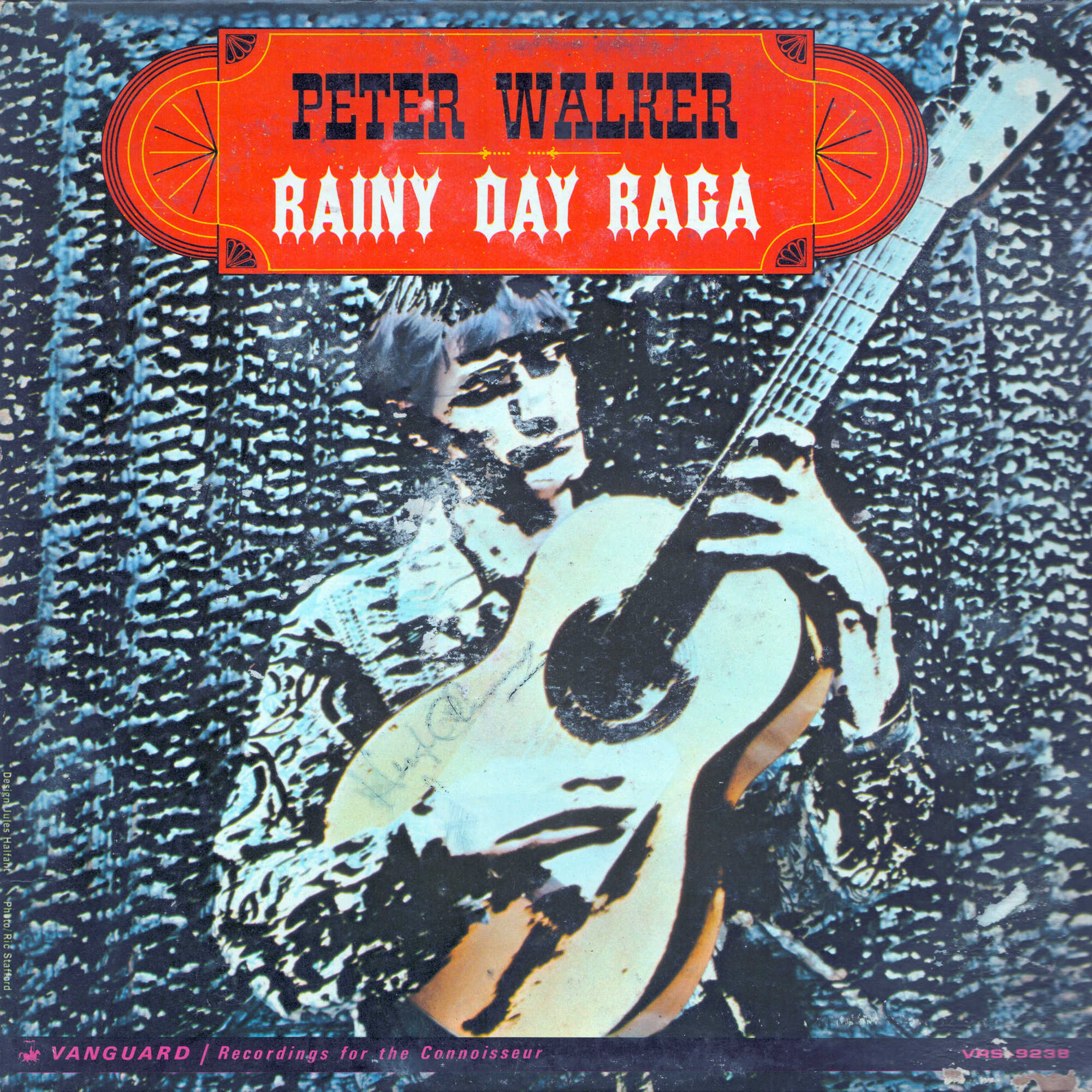
“Spring” is my pick from the LP | Peter Walker – ‘Rainy Day Raga’ (Vanguard VRS-9238) March 1967
Article published in Crawdaddy!, August 1967
“Spanish sunlight on green-blue water rippling at noon, a happy moving-out wind/wave dance . . . ”
“Swirling devil wind gusting over white sand, dunes shifting in midday blind heat, relentless and inevitable . . . “
“Rush hour on a Spanish road . . . “
These are a few of the images that came to me on hearing this LP for the first time. I tried an experiment with a friend; we just dug without knowing titles, and wrote down the images we got from the sound. On comparing there were a hell of a lot of similarities (this may be due to our mutual groove level but I prefer to think that it’s a result of the sounds communicating on a subconscious level) – and one standout point: all the images were very organic – wind, water, country, the universe – natural object orientation, as opposed to situation orientation.
Peter Walker, of Cambridge, Spain, North Africa and Mexico (and lately musical director for Dr. Timothy Leary) is into something good. American folk music has been in a declining period ever since Dylan blew the boundaries all to hell; traditional performers still get work (but not as widely) and most “city” interpreters have become all but obsolete . . . or electrified.
Peter Walker | Rainy Day Raga | (Vanguard) 1967
Sandy Bull was one of the first to delve into the possibilities of the mixing of American and Eastern musical forms (see his two LP’s on Vanguard), Richard Farina and his goddam beautiful wife Mimi carried the idea a step further on a few cuts of their Vanguard albums (see “Dopico” and “V.”) and the latest step is taken by Peter Walker (also on Vanguard).
Perhaps David Noebel of right-wing fanatic fame is preparing to explain how this is part of an insidious plan to orientalize and destroy American music?
While Bull’s and Fariica’s work tended to have more of the feel of Indian and Persian styles, Walker sounds more Spanish/Mexican. For this reason the title of the LP is a bit mis-leading – musically and soundwise there is only a little here that bears much resemblance to Indian raga form, except in result; a multiplied awareness and pleasure in the surrounding scene.
“Peter Walker plays on the ancient protein strings of the genetic code,” says Timothy Leary, and forgetting all prejudices (either for or against Leary) you have to agree. Walker’s guitar has the knack for weaving moods with the fast flashing tones; accompanied sometimes by tamboura, sometimes by a 12 string drone, sometimes by flute and tambourine, sometimes by 2nd guitar, the result is a perfect functional fusion. Walker consistently taps the buried pre-conscious level of awareness and evokes memories of scenes we saw somehow before without our knowledge.
“Morning Joy” opens the album – it’s full of sunshine/water happiness, aided by the floating flute of Jeremy Steig. “Norwegian Mood” is a paraphrase of the Lennon-McCartney (a British comedy team) number. The theme is never precisely stated, rather he begins in the centre and works out with the melody sunbeaming beneath like a clockwise revolving spiral opening.
Peter Walker | Rainy Day Raga | (Vanguard) 1967

“White Wind” swarms with colour impressions (the swirling devil dance quoted above). “Bianca” is a vignette with the feel of an evening cafe in Spain.
“Spring” is an unfolding scene – like sunlight spreading out over the snow-covered mountain country. “Sunshine” uses a tamboura drone and has the sultry feel of noontime market with flies circling.
“Rainy Day Raga” is not really a raga (if you want to be precise about it) but it has the cosmological feel of a raga (my friend got images of hills like red waves, space, a salamander explosion, stars unfolding).
“Road to Marscota” is full of surging vitality (the life-force of Black Orpheus), and though very busy and active is somehow one of the least successful cuts on the LP.
“April in Cambridge” features Walker’s involved, convoluted guitar massing mazes over the shadow-shifting drone of tamboura and guitar. The LP closes with “River,” a beautiful piece, deep and running with all the passion and gentleness of a river busy with the overhanging vines in its turbulence.
Peter Walker | Rainy Day Raga | (Vanguard) 1967
Now I’m hip that every listener will get different images when listening – and that’s as it ought to be – the only reason I’ve gone into mine is that mere physical description of the mechanics involved would accomplish nothing – it’s like trying to describe a sunset. You either dig or you don’t.
A beautiful LP to sit quiet and dream with, or to put on low and talk love over – it works on several levels – a good thing, not a put down . . . people also need music to talk to – and Musak ain’t where that’s at at all.
If you need a classification, call this the new American folk music – since America has no real musical tradition of its own, but rather is a melting pot of styles and influences, this is as American as any other form, even though the basis here is the music and style of Spain and Mexico, mixed with the philosophy and cosmological conceptions of the East.
Some have called it American Folk Raga – so if you need a label, there it is. But instead of labelling, why not listen and enjoy?
This LP is pictures of pieces of the universe, tales told by a sensitive hand, direct to your inner ear, exploding like little water bubbles on a lake. Unless you’re a stone city freak, you’ll dig moving in its spaces. (Tony Glover)
Peter Walker | Rainy Day Raga | (Vanguard) 1967

Peter Walker—tall, thin, dark haired, and intense—is an exciting young guitarist and creative musician who through this own playing, and as musical director for Dr. Timothy Leary‘s “Celebrations” is giving a new direction and a new sound to American “folk” music today.
His sound—his word —blends the sensuous raga from India with American folk music and adds his long experience with flamenco and near eastern rhythms.
He began to get the sound in his fingers in Cambridge; travelled through Spain and North Africa, then found the rest of what he was looking for while he was living in Mexico, and listening to Indian classical music on a car-battery operated phonograph. It’s a sound that goes back to the ancient concepts of the Indian raga, and then goes off into its own journey into sounds and ideas for today.
NOTES BY PETER WALKER

American raga, or as Bob Shelton of the New York Times calls it, American folk raga—the word raga is used because of the association with Indian classical and folk music, employs the Indian concept of starting with a drone, adding a scale based on the drone, then a melodic line based on the scale, then weaving, reweaving, and interweaving the melodic line so that a freely improvised piece is constructed.
When playing ragas on the guitar my approach is to set up a drone pattern usually based on the first, fifth and fourth intervals of a western scale, and when I feel that a steady pulse of the drone has been established to work in a melody line based on a popular American folk song, or just any melody line that I find appealing.
Then, when the melody line has been inserted I feel free to improvise, based on the emotions that the drone and the melody line have created within me. While still staying within the same modal structure.
I feel free to play any combination of notes which I think will add to or carry further the particular feeling or improvisational colouring that I am trying to convey. The idea is to constantly build up towards a logical conclusion or concise musical statement, and finally to reach it.
An analogy would be that of a person trying to run backwards up a slide, resting between attempts, each time getting closer to the top, and finally running straight up and over. The music reaches a fusion point, and a sound is produced like running brook water with the improvisations like bubbles flickering over the surface. Then the piece must be quietly closed out.
Line-up:
Peter Walker (guitar / compositions)
Monte Dunn (2nd guitar)
Jeremy Steig (flute)
Alex Lukeman (12-string drone)
Bruce Langhorne (tambourine, bells)
Jean-Pierre Merle (tamboura)



Leave a Reply