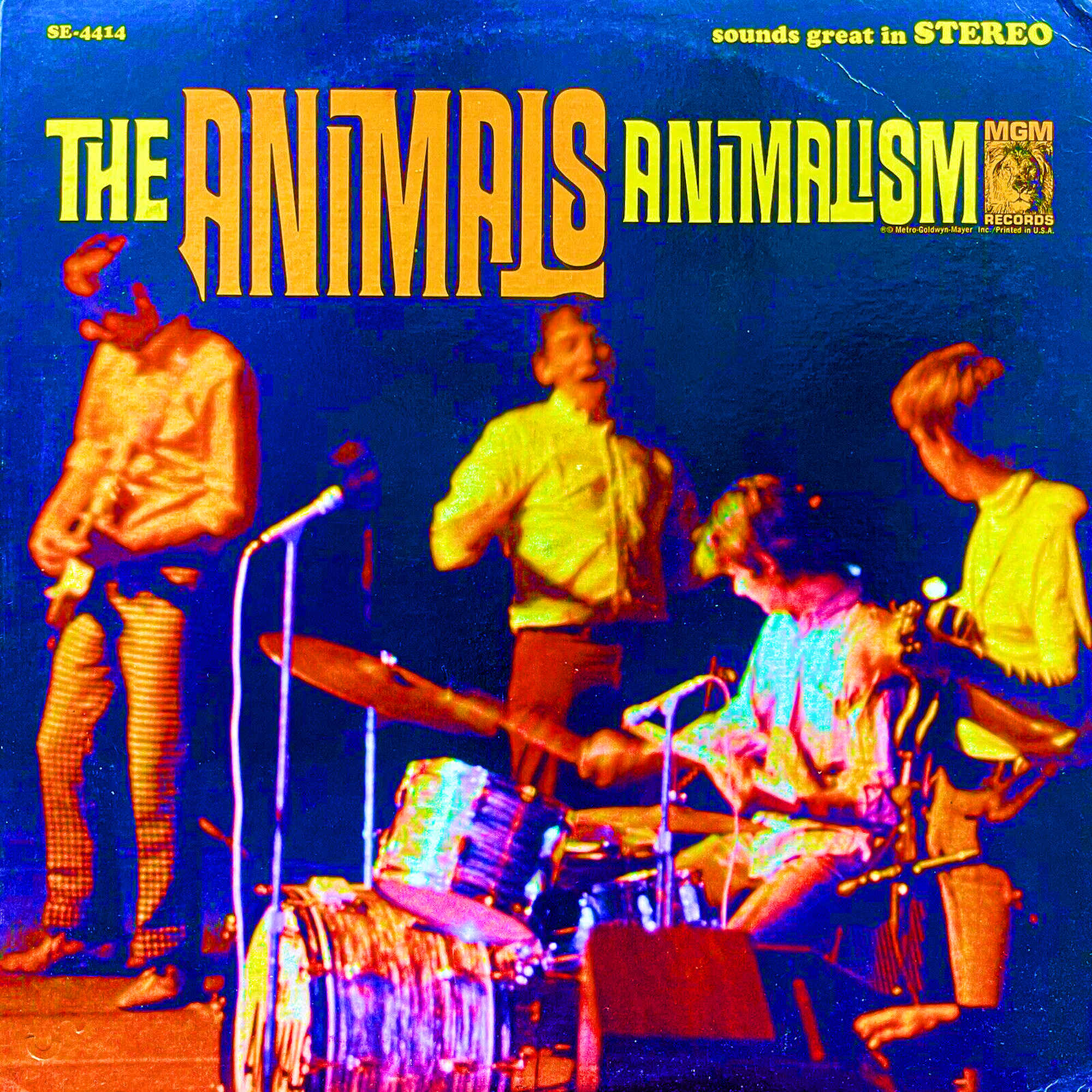
“The Big Bright Green Pleasure Machine” is my pick from the LP | The Animals – ‘Animalism’ (MGM E-4414) November 1966
Article published in Crawdaddy!, January 1967
The Animals | Animalism | (MGM) 1966 | Since ‘Animalism’ represents the final disc effort by five British bluesmen we all know and (to varying degrees) admire, I suppose this review is an obituary of sorts. The break-up of England’s gutsiest musical export is not news, of course – Eric Burdon announced it on their American tour this summer – but the album helps point up the reasons why they had to split.
The problem is basic: two of them are musicians who can grow, the other three are not. Burdon, the lead singer, has developed considerably over the past two years. His vocals have always been spotty – ranging, in the early days, from overwrought anguish on “House of the Rising Sun” to the sweet and subtle understatement of “For Miss Caulker” – and he still sings a few numbers as if his tonsils were on fire, but ‘Animalism’ proves that soul (has finally dominated shout. On two of the cuts (“Hey Gyp” and “Going Down Slow”) his voicings are nothing short of brilliant, and on several others he is good to excellent. “Louisiana Blues,” however, makes me weep for Muddy Waters.
The Animals | Animalism | (MGM) 1966
The man Eric is keeping with him, drummer Barry Jenkins, shows enough on this and the previous album to indicate that he can dynamite anybody’s rhythm section. His percussion on “Hey Gyp” is masterful, especially when he drives under Burdon’s “Can’t you hear my heart beat?” with a tom-tom heart-throb of his own.
The three men Eric left behind are Hilton Valentine (lead guitar), David Rowberry (organ and piano), and Chas Chandler (bass). All plan to stay in or around the recording scene but I doubt it will do them much good. When they lost Burdon and Jenkins, they also lost their soul.
Valentine is easily the best of the lot, which means he’s dull but does have his moments. His finest moment ever is the six minutes, twelve seconds-worth of “Going Down Slow,” where he trots out a bagful of blues technique in a fine elastic tone reminiscent of that old instrumental hit, “Apache.”
It’s become a cliche to say that a blues or jazzman deals in cliches, but, unfortunately, that’s exactly what Valentine does. The virtue is that you’ve heard it all before, but you’ve never heard so much of it at once.
A quiet sort of fellow
And despite his triteness and distressing ability to stretch a single note or phrase ad nauseam (witness solos on “C. C. Rider” and, here, “Rock Me Baby”), his guitar work helps make “GDS” a sort of blues epic. It’s the last cut on the second side, as though he knew he’d better say it all now or forever hold his peace.
Rowberry, on the other hand, is described in the liner notes as -“a quiet sort of fellow,” and I suppose this means he has no moments at all. He certainly hasn’t shown any on record. At his best (which is usually on piano) he can nail down a pretty mean rhythm (“The Other Side of This Life”), but when Burdon tells him to rock out on “That’s All I Am To You,” the results are almost embarrassing.
The Animals | Animalism | (MGM) 1966

Chas Chandler’s bass lines are consistently uninspired, but at least they are consistent. He’s not a master of tone, as is Bill Wyman, nor a master of taste, as is Paul McCartney, but you can’t really fault him for being merely a steady performer.
On one occasion (a brief bit in the middle of “The Other Side of This Life”), he even thrums up Burdon’s half-spoken lyrics to give the number some unexpected teeth – so Chandler, too, has his moments. Burdon obviously hopes to do better, but I suspect he could do a bit worse. Let’s talk about the album.
First of all, ‘Animalism’, is good, probably because Burdon chose most of the material, and as Burdon goes, so go the etc. Those who feel that the early Animals short-changed them on the guitar/rhythm side of their sound might call it one of the group’s best.
Aside from the magnum-opus try of “Going Down Slow,” they do some fine, furious cooking on “Hey Gyp” (a Donovan song, via Bo Diddley and blues tradition), where Burdon demonstrates that he, Jagger, and that Troggs are about the only real phrase-makers in the business. And Jenkins’ back-beat drum work is beautiful.
Other cuts on the plus side are “Rock Me Baby,” which is as hard as they make them in Chicago, and Fred Neil‘s “The Other Side of This Life.”
“Smokestack Lightning,” although superior to the Yardbirds‘ version, does little more than explain where that fine loopy guitar figure in “C. C. Rider” came from – Burdon’s singing is too strained and he loses badly to Howling Wolf on those falsetto moans.
The Animals | Animalism | (MGM) 1966

“Hit the Road, Jack” opens with a bass and a whisper, then drowns in a Rowberry explosion. As an arrangement, it’s interesting, but the contrast between good soft Burdon and bad loud Animals just about destroys it.
“That’s All I Am to You” produces some pleasant rock, trite but cheerful back-up singing, and ferocious rim work on the part of Mr. Jenkins, while “All Night Long” is an example of how not to mix Indian sounds with hardrock blues.
“Shake” provides another negative lesson: how to ruin a fuzz-tone.
All that remain are “Outcast,” a fair shout song with a fine scream; “Lucille,” disappointing even to fans of Little Richard; and “Louisiana Blues,” which bears more resemblance to the Blues Project than to Muddy Waters and is poor any way you look at it.
The outstanding motif of the album is the frequent use of “thin” sound: Burdon’s voice over the guitar figure and/or drums. They used it on “C. C. Rider,” they use it here on “Other Side,” “Rock Me” and “Hey Gyp” – and if it hadn’t been for a similar break on “Have You Seen Your Mother, Baby?”, I would have thought that nobody would ever use it better.
The Stones can’t do everything better, though, and it’s doubtful that they or any other pop group could ever quite duplicate that peculiar bag which lies somewhere between “We Gotta Get Out of This Place” and “Going Down Slow” – a blues bag with a difference. I suppose an album by the same name would be the best definition around. Burdon calls it simply “soul,” and if the break-up doesn’t rupture his career, he might be able to tell us more about it later.
DAVID JOHNSON
Leave a Reply